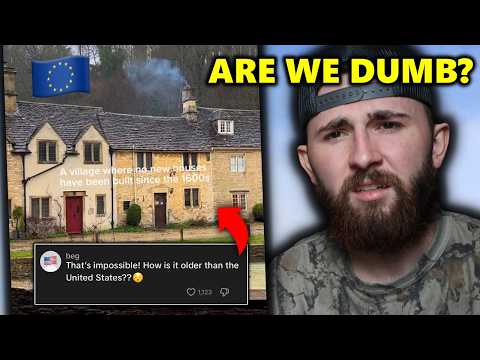
Eight-hundred-year-old wooden doors, alleged portals to hell and castles that have survived everything from medieval sieges to modern warfare give the reaction plenty to work with. The host approaches European castle history with genuine astonishment, and that enthusiasm becomes the organizing force of the piece. Rather than pretending to be an expert, he repeatedly stops to question dates, construction methods, preservation and even what qualifies as a castle, creating an accessible entry point for viewers who may know little about the subject.
The opening material on Houska Castle immediately establishes the mixture of history and folklore that runs through the compilation. Stories about prisoners being lowered into a mysterious pit, winged creatures and a supposed portal to hell are treated primarily as spooky entertainment, with the host responding through exaggerated disbelief and jokes about refusing to enter the site. Importantly, these supernatural ideas remain presented as legends and local claims rather than demonstrated historical facts, although the reaction naturally spends much more time enjoying the horror possibilities than examining where the stories originated.
The historical sections become more substantial when attention turns to surviving medieval structures. Castle Rushen is presented as an unusually intact example from the medieval period, while Chepstow Castle provides some of the most memorable details, particularly the claim that tree-ring analysis dates its surviving oak doors to the 1190s. The host's amazement at original wooden material enduring for centuries is repetitive but understandable, and his instinctive comparison with the relative youth of the United States gives the history a clear perspective for his largely American framing.
Chepstow also allows the material to move beyond architecture into military and social history, covering defensive geography, iron-plated doors, medieval ownership changes and the later transformation of ruins into tourist attractions. The claim that tourism along the River Wye helped establish an early form of British sightseeing is intriguing, and the host responds appropriately by recognizing that castles can tell stories not just about warfare but about how later generations viewed and repurposed the past. His humor occasionally interrupts potentially interesting details before they can develop, but his curiosity keeps the segment lively.
The discussion of "fake ruins" is another useful surprise. Scotney Castle is described as containing authentic medieval elements that were later deliberately modified to enhance a Romantic landscape, introducing the idea of architectural follies and reconstructed ruins. The host initially misunderstands the term, then works through the distinction between genuinely ancient remains and structures designed or altered to appear picturesquely old. That process of confusion followed by discovery suits the reaction format particularly well because the viewer gets both the factual explanation and an unscripted response to it.
The weakest historical section is the ranking of European countries by castle numbers. Figures ranging from roughly 4,000 in the United Kingdom to tens of thousands in Germany, Ireland, France and Italy are repeated with little explanation of definitions, methodology or sourcing, and the host himself correctly notices the problem. His questions about whether châteaux, fortified residences, ruins and other castle-like buildings are being counted expose how difficult such rankings are to interpret. That skepticism is valuable, but the presentation never resolves the issue, so the numbers function more as spectacle than dependable comparison.
Dover Castle closes things on stronger ground by showing how one strategic site accumulated layers of history from Roman activity through Norman construction, medieval sieges, Napoleonic defenses and the Second World War. The host's surprise at Dover's proximity to France and at the continued usefulness of the location reinforces one of the broader lessons of the compilation: these structures were shaped by geography as much as by architecture. His constant jokes, verbal detours and exaggerated reactions will be either part of the charm or a distraction depending on the viewer, but beneath them is sustained curiosity about why castles were built, how they survived and what remains authentic.
Pros
- Genuine curiosity turns unfamiliar architectural and historical details into approachable discoveries rather than a dry lesson.
- Chepstow Castle's medieval doors, defensive features and later tourism history provide especially memorable material.
- The discussion of Scotney Castle usefully introduces the distinction between authentic ruins and deliberately constructed or modified follies.
- The host questions questionable castle-count statistics instead of accepting the enormous figures uncritically.
- Dover Castle effectively demonstrates how one strategic location can accumulate Roman, medieval and modern military history.
Cons
- Frequent jokes, repeated expressions of disbelief and long reaction tangents sometimes overwhelm the historical information being presented.
- Supernatural stories surrounding Houska Castle receive substantial attention without much investigation of their historical origins or evidentiary basis.
- Rankings of countries by number of castles rely on huge figures without explaining definitions, counting methods or sources, making the comparison difficult to assess.
- Several promising historical topics are interrupted before they can be explored in much depth.
Enthusiastic reactions and a steady stream of striking examples make European castle history feel immediate even when the presentation is more entertaining than rigorous. The strongest moments combine visible curiosity with specific architectural or historical details, while the weaker sections rely on folklore, uncertain statistics or extended comedic detours. As an accessible reaction to medieval history it succeeds well, even if viewers seeking careful historical analysis will want considerably more context.