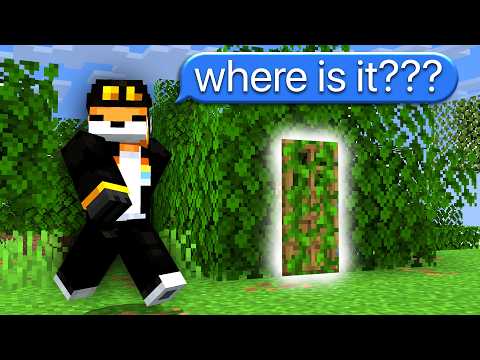
A mysterious prison in Minecraft's End dimension forces thousands of captured players through a series of deadly challenges, with only the survivors earning a chance at freedom. Parrot finds himself among the prisoners after entering the dimension, initially unaware of who constructed the enormous facility or why its guards are detaining players. His first challenge pits him against another prisoner in a fight where only one can advance, establishing the prison's brutal rules. What begins as a straightforward survival competition gradually develops into a much larger story involving fallen kingdoms, political rivalries, secret alliances, and the possibility of a devastating war across all three Minecraft dimensions.
The adventure becomes considerably more interesting when Parrot encounters Minitech, the former Guardian of the End Dimension, who claims that Spoke seized control of his kingdom and transformed the region into a prison. Their shared circumstances establish an uneasy partnership, with both characters determined to escape and reclaim their respective territories. The second floor introduces dangerous parkour challenges, including a difficult double Neo jump that requires precision and confidence. These sequences effectively demonstrate the prison's escalating difficulty while allowing Minitech to establish himself as an experienced guide. His knowledge of the facility is initially reassuring, although his familiarity with its obstacles eventually becomes an important source of suspicion.
The third floor provides one of the adventure's strongest stretches by transforming the escape attempt into a competitive PvP tournament. Participants must accumulate three victories before suffering a second defeat, creating meaningful consequences for every encounter. After losing to a better-equipped opponent, Parrot reluctantly accepts Minitech's offer to teach him three essential combat skills: spacing, tempo, and aim. The resulting training sequence gives the story an unexpectedly educational dimension, explaining strafing, W-tapping, critical hits, and cursor control through practical demonstrations. Parrot's frustration with his apparent lack of improvement adds personality and emotional weight, particularly when Minitech reveals that he has deliberately increased his own difficulty to test his student's persistence. Although the extended practice occasionally slows the adventure, the subsequent victories provide satisfying evidence of Parrot's progress.
The fourth floor replaces physical combat with an elaborate puzzle involving twelve doors arranged around a circular chamber. Players apparently understand when individual doors will open, but the consequences of choosing incorrectly remain uncertain. Parrot and Minitech investigate the guards, examine the room's layout, record opening times, and eventually discover a numerical pattern connecting each door to the next. Their use of maps to investigate disappearing players introduces a clever experimental element, while the eventual discovery of an additional letter-based code rewards careful attention to seemingly insignificant details. This section offers a welcome change of pace from continuous fighting, although the prolonged waiting periods and complicated timestamp explanations can become cumbersome. The final solution also arrives rather abruptly after an extended struggle, reducing some of the satisfaction that a more gradually developed revelation might have provided.
The fifth floor delivers a dramatic cooperative battle against a powerful commander associated with Spoke's forces. Unlike the earlier sword-focused encounters, this confrontation requires coordinated TNT minecart explosions, careful positioning around pillars, and efficient management of limited supplies. The commander possesses superior equipment and a dangerous mace, forcing Parrot and Minitech to rely on teamwork rather than conventional combat superiority. Their communication becomes increasingly frantic as their resources disappear, and the last successful attack creates an effective moment of relief. The encounter works particularly well because the mechanical challenge reinforces the growing trust between the two characters. However, the repeated shouting, overlapping instructions, and rapid exchanges sometimes make it difficult to follow exactly how the combat unfolds.
The greatest narrative reversal occurs after the commander is defeated, when Minitech admits that this is his third attempt to escape the prison. His mentorship was not entirely selfless: he deliberately selected Parrot as a partner capable of surviving the challenges but potentially weak enough to defeat in the final arena. The revelation transforms their relationship and leads to a confrontation between two displaced kings, each desperate to save his own people. Rather than reducing Minitech to a conventional villain, the story allows his conflicting motivations to remain understandable. The final duel becomes more compelling through its emotional stakes than through the combat mechanics alone, culminating in Minitech's decision to surrender and sacrifice his own freedom. His request that Parrot eventually return to help liberate the End gives the conclusion a meaningful sense of obligation and unfinished business.
The final exchange with Spoke expands the conflict beyond the prison while complicating the audience's understanding of its purpose. Spoke insists that the facility was designed to contain dangerous criminals rather than innocent travelers, directly contradicting Minitech's account. His accusations against Parrot introduce their troubled history, while his proposed alliance raises questions about whether his ambitions are motivated by security, conquest, or personal resentment. This ambiguity provides an effective foundation for future developments, although the presentation largely depends on character testimony rather than independently demonstrating which account is accurate within the story. More broadly, the enormous population described in the premise receives relatively little individual attention, with most prisoners functioning as background figures or disposable competitors. The adventure ultimately succeeds more as a scripted-feeling, character-driven Minecraft drama than as a detailed exploration of how a thousand players collectively behave inside a prison simulation.
Pros
- The five-floor prison structure creates a clear progression of increasingly difficult challenges, sustaining tension throughout the escape attempt.
- Varied gameplay involving survival combat, precision parkour, PvP tournaments, cryptographic puzzles, and TNT minecart tactics prevents the adventure from becoming mechanically repetitive.
- Minitech's lessons on spacing, tempo, aim, and W-tapping provide genuinely useful Minecraft PvP instruction while contributing directly to Parrot's character development.
- The twelve-door puzzle introduces an inventive mystery that rewards observation, experimentation, and logical reasoning.
- Parrot and Minitech develop a convincing partnership through shared setbacks, training, strategic cooperation, and conversations about their lost kingdoms.
- The revelation of Minitech's previous escape attempts adds a memorable betrayal that complicates his motivations without completely undermining his sympathetic qualities.
- The final arena confrontation delivers an emotionally satisfying resolution built around sacrifice, responsibility, and the competing obligations of leadership.
- Spoke's appearance introduces conflicting perspectives and broader political consequences, creating an intriguing continuation of the Unstable SMP storyline.
Cons
- The thousand-player premise receives limited exploration beyond the initial prison population, with most participants remaining anonymous and largely irrelevant to the central narrative.
- Extended training exercises and long periods of waiting during the fourth-floor puzzle occasionally disrupt the otherwise energetic pacing.
- The complicated door-opening sequences can be difficult to follow, particularly when numerical patterns and later discoveries are explained rapidly.
- Frequent shouting and overlapping dialogue during combat sometimes obscure the positioning, strategies, and immediate consequences of important encounters.
- Several major developments depend on information revealed through character dialogue, leaving important accusations about Spoke and the prison's true purpose unresolved.
- The substantial reliance on existing Unstable SMP rivalries, kingdoms, and character histories may make the broader stakes harder for newcomers to appreciate.
Parrot delivers an ambitious Minecraft prison adventure that successfully combines varied survival challenges with an increasingly personal story about trust, betrayal, and the responsibilities of leadership. The creative floor designs, practical PvP training, and emotionally charged partnership with Minitech make the experience consistently engaging, even when lengthy preparation and complicated puzzles weaken its pacing. Although the massive prison population remains underdeveloped, the satisfying final sacrifice and confrontation with Spoke establish this as a particularly memorable chapter in the Unstable SMP storyline.