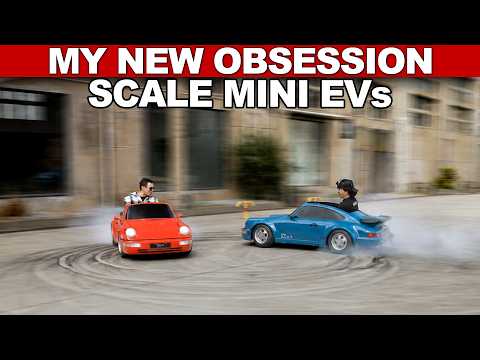
Four scaled-down classics with identical nine-horsepower engines create an unusually unpredictable starting point, because outright power cannot separate the Porsche Speedster, Ferrari 250 GT California, Jaguar E-Type and Mercedes-Benz 300 SL. Their steel chassis, fiberglass bodies, leather interiors, three-speed sequential gearboxes and rear-wheel-drive layouts give the competition enough mechanical substance to feel like more than a novelty. Better still, the remarkably faithful shapes of the cars make the sight of full-grown adults squeezing inside them inherently amusing before anyone reaches the start line.
The racing quickly reveals that identical specifications do not produce identical performance. Driver weight becomes important enough for the competitors to swap cars, and the Porsche initially appears particularly quick while the Jaguar ultimately records the best quarter-mile time at 30.5 seconds. The Ferrari's 32.2-second run wins the final configuration, ahead of the Mercedes at 32.9 seconds and Porsche at 35.5, but the closing explanation usefully clarifies that the Porsche had previously managed 31.7 seconds without additional passenger weight. Providing those times prevents all the chaotic swapping and joking from obscuring what actually happened.
Much of the entertainment comes from how seriously the group treats an inherently ridiculous competition. Launches are analyzed, slipstreaming is invoked, driver weight becomes a performance variable and mechanical failures are discussed with the exaggerated urgency of a conventional drag race. The quarter mile itself takes so long that the drivers begin joking about waiting for the finish marker, an effective reversal of the channel's usual emphasis on extreme acceleration. The miniature scale provides the joke, but the familiar drag-racing structure gives it momentum.
Mechanical trouble adds another layer of unpredictability. The Jaguar loses an exhaust component and later suffers another failure, while the participants repeatedly accuse one another of breaking the cars. A quick repair gets the Jaguar moving again, and its eventual fastest time makes its retirement more consequential than a random interruption. However, the failures also make the comparison increasingly messy, since different drivers, repairs and changing passenger loads mean this is ultimately entertainment rather than a controlled performance test.
The two-person race pushes that disorder deliberately further. Trying to fit two adults into a tiny Porsche while dividing responsibility for steering, throttle, braking and gear changes is an effective visual and logistical gag, and the resulting loss of performance reinforces the importance of power-to-weight ratio in an immediately understandable way. Yet the extended discussion about seating positions, limbs and controls goes on considerably longer than the actual competitive insight requires, while repeated crude jokes sometimes substitute for more inventive banter.
That looseness becomes the main weakness of the presentation. Stalls, breakdowns, a bird-dropping interruption, tap roulette and prolonged joking all fit the playful atmosphere, but they repeatedly delay the next meaningful piece of racing. The late brake test provides a sensible additional challenge, especially after the earlier claim that the cars have ABS is contradicted by the apparent wheel locking during the test. The presenter appropriately reacts to that discrepancy rather than pretending the observed behavior supports the original description, although the matter is not investigated further.
Overall, the format succeeds because it understands that miniature classics traveling a quarter mile in roughly half a minute are more entertaining as a comedy competition than as a serious performance comparison. The timed results, car swapping, mechanical failures and brake test provide enough structure to stop the concept becoming pure messing around, while the participants' chemistry carries the slower stretches. Tighter editing and fewer repetitive or crude exchanges would make the central contest more consistently effective without sacrificing its deliberately silly personality.
Pros
- The four faithfully styled miniature classics make for an immediately distinctive and visually amusing competition.
- Identical stated engine outputs shift attention toward weight, driver differences and individual vehicle performance.
- Actual quarter-mile times provide a clear result despite numerous swaps, failures and experimental race configurations.
- The Jaguar's 30.5-second best run and Porsche's 31.7-second solo result add useful context to the Ferrari's eventual 32.2-second victory.
- Mechanical failures and the two-person Porsche experiment create genuine unpredictability rather than relying entirely on scripted-feeling jokes.
- The brake test adds variety and openly acknowledges the apparent discrepancy surrounding the claimed ABS.
Cons
- Frequent driver and passenger changes make the races too inconsistent to function as a rigorous comparison between the four cars.
- Extended joking around stalls, seating positions, breakdowns and other interruptions slows the progression between races.
- Repeated crude humor becomes less effective through repetition and occasionally overwhelms the automotive material.
- The apparent absence of functioning ABS during the brake test is noticed but never meaningfully resolved.
Miniature proportions turn an otherwise conventional drag-racing format into an enjoyably absurd contest, while recorded times and genuine mechanical unpredictability give the comedy a competitive backbone. It is considerably stronger as automotive entertainment than as a controlled comparison, but the unusual machinery and enthusiastic group chemistry make that an easy compromise to accept.