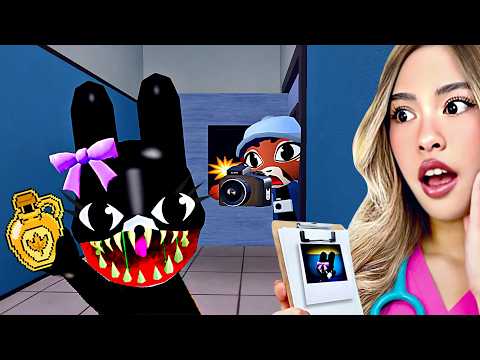
The update gives the hospital noticeably more personality before its larger mysteries even emerge. The secretary has changed, Dr. Harlow has a striking redesign, the Secret Agent receives a scanner, and additions such as the taser, deployable security camera, upgraded computer, and extra check-in window create new things to test between the familiar patient-processing routines. The video does a good job of discovering these changes through play rather than simply listing patch notes, so even small additions feel like part of an unfolding investigation.
Dr. Harlow provides the strongest new material. His altered appearance immediately becomes a source of suspicion, but the more interesting development comes from his late-night conversation about something terrible having happened at the hospital, the corporation saving what was left of him, and research that he believes will eventually make things better. The video appropriately treats this as a mystery rather than a settled explanation. Later, the scanner apparently produces a different result for Harlow than it did earlier, adding another intriguing clue without establishing exactly what the change means.
The returning characters also develop the hospital’s broader story. Ron from accounting mentions experiments, hidden discharge logs, missing files, and the exhausting paperwork he processes for the corporation. Rathie discusses his missing sister, who worked for the Animal Corporation, before leaving a key and disappearing because the corporation is supposedly pursuing him. These conversations suggest overlapping secrets involving the corporation, its research, and the hospital’s past, although the video sometimes moves through dialogue so quickly that potentially important details receive less attention than they deserve.
Barney’s storyline is stranger but more entertaining. The player repeatedly gives him coffee, stores his suitcase, supplies him with a scalpel, hides him from Officer Duckman, and eventually receives the suitcase and an extra coffee machine. The running joke of knowingly helping a suspected serial killer works because the host commits to treating friendship as more important than the obvious warning signs. It also demonstrates how character interactions can reward choices across multiple encounters rather than functioning as isolated bits of dialogue.
The gameplay sections provide enough chaos to keep the lore hunt from becoming a sequence of conversations. Anomaly attacks, fires, critical patients, surgery, monsters, camera checks, and decisions about whether suspicious visitors are normal create a frantic rhythm. Some spontaneous mistakes are genuinely funny, particularly attempts to identify anomalies and the realization that disposing of someone incorrectly still counts as a hospital death. At the same time, routine treatment sequences are shown at considerable length, and the repeated commentary about characters being suspicious becomes less effective once nearly everyone is treated as potentially abnormal.
Daisy and the UV camera offer the clearest example of both the video's appeal and its limitations. Her appearance introduces a genuinely new mechanic involving photographing something invisible at the check-in window, but confusion over the instructions leads to the photograph being wasted on Rathie. Daisy then takes the camera back, preventing the video from demonstrating what the mechanic was actually supposed to reveal. The failed experiment is amusing and authentic to the playthrough, but it leaves one of the update's most interesting additions unresolved.
Presentation is energetic throughout, with constant reactions, jokes, speculation, and direct engagement with new discoveries. That enthusiasm suits a game built around suspicious NPCs and unpredictable events, but it occasionally works against the investigation itself. Important dialogue is sometimes interrupted or only partially absorbed, and theories such as Barney possibly having worked at the hospital are improvised from suggestive details rather than demonstrated by the game. The video is strongest when it shows an interaction and lets the resulting clue speak for itself; it is weaker when rapid speculation blurs the difference between discovered lore and playful guessing.
Pros
- Dr. Harlow’s new dialogue provides substantial mystery surrounding his past, the corporation, and the hospital’s research.
- Ron, Rathie, Barney, and Daisy receive interactions that make the update feel more character-driven.
- New tools and upgrades, including the scanner, UV camera, security camera, and taser, give the host useful mechanics to investigate.
- The anomaly attack and other emergencies keep the lore-focused exploration from becoming too static.
- Spontaneous mistakes and reactions make the discovery process entertaining rather than overly scripted.
Cons
- Important dialogue is sometimes rushed through or openly not followed closely, weakening the analysis of the lore being uncovered.
- Speculative theories are frequently introduced without enough distinction between clues actually provided by the game and playful interpretation.
- Repeated treatment sequences and constant declarations that characters are “sus” become repetitive.
- The UV-camera storyline ends with an accidental photograph, leaving a major new mechanic and its intended secret unexplored.
- Several promising mysteries are introduced without enough follow-through to connect the clues into a clearer picture.
This is an energetic exploration of an update that appears to push Animal Hospital further toward an ongoing mystery involving Dr. Harlow, the Animal Corporation, missing people, experiments, and increasingly important NPC relationships. The best discoveries raise worthwhile questions and show that the update contains more than cosmetic changes, while the chaotic gameplay keeps the investigation entertaining. The tradeoff is that rapid reactions, missed dialogue, unfinished experiments, and loose speculation prevent some of the most intriguing clues from receiving the careful examination they deserve.