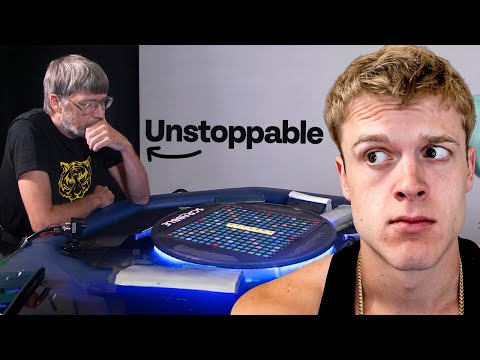
Nigel Richards has achieved a level of competitive success in Scrabble that seems almost impossible to comprehend, particularly when compared with the accomplishments of legendary athletes. By placing Richards alongside Michael Jordan, Lionel Messi, Tiger Woods, and Magnus Carlsen, the narrator immediately establishes an ambitious argument: that the New Zealand Scrabble champion may be more dominant within his discipline than almost anyone in competitive history. It is an attention-grabbing premise that transforms a familiar word game into a fascinating examination of memory, strategy, and exceptional human performance. Although the comparisons are inherently subjective, they provide an entertaining framework for understanding why Richards deserves recognition beyond the relatively specialized world of competitive Scrabble.
The opening tournament story involving Richards and an opponent named Rajeev provides an excellent illustration of his abilities. After Rajeev scores 50 points with the word "looters," Richards responds with "influxes," connecting existing words and exploiting two triple-word squares to produce an extraordinary 221-point play. The narrator makes the moment accessible through animated storytelling, imagining Rajeev's disbelief and the excitement of spectators watching the match unfold. Richards subsequently constructs "pernoctated" using letters already positioned on the board, demonstrating the remarkable spatial awareness and vocabulary knowledge required at the highest level. These specific examples give the audience something tangible to appreciate rather than relying exclusively on championship statistics.
The explanation of Scrabble as a combination of chess and poker is particularly effective. Competitive players must recognize possible word combinations, calculate scoring opportunities, anticipate their opponents' available letters, and make strategic decisions using incomplete information. This comparison helps dismantle the misconception that Scrabble is simply a contest of spelling ability or vocabulary size. The narrator's basketball analogies, including comparing Richards' enormous scoring advantage to an athlete casually sinking half-court shots while already leading comfortably, further translate unfamiliar competitive achievements into recognizable sporting situations. However, the dramatized exchanges between players, officials, and spectators sometimes blur the distinction between documented events and humorous embellishment.
Richards' reported success across multiple languages provides the story with its most astonishing development. Having already accumulated five English-language world titles, he reportedly spends two months memorizing French Scrabble vocabulary before winning major French competitions, despite needing a translator during his acceptance speech. The narrator then describes Richards extending this approach to Spanish Scrabble and winning another championship. These achievements are presented as evidence that his talent extends beyond ordinary linguistic fluency into an unusual capacity for recognizing and retaining valid word combinations. The distinction is important because memorizing words for competitive play does not necessarily mean understanding or speaking the corresponding language. While the account is compelling, the narrator provides little supporting documentation for the exact preparation periods, championship records, or circumstances surrounding these victories.
The discussion of endgame accuracy introduces a more analytical dimension to the presentation. According to the narrator, an engineering student's examination of Richards' performances found an error rate of just 1.2%, compared with approximately 50% for other leading players and 4.5% for the computer program used in the analysis. These figures, if accurately represented and drawn from comparable evaluations, would suggest extraordinary decision-making consistency. The narrator also makes a useful distinction between an outright mistake and a move that is merely less than mathematically optimal. Unfortunately, the analysis is not identified in sufficient detail to evaluate its methodology, sample size, or definition of error. The suggestion that Richards effectively outperforms computers is exciting, but the evidence presented supports a narrower conclusion about the particular endgame analysis described.
The exploration of Richards' cognitive abilities adds another interesting layer, beginning with the account of his mother introducing him to Scrabble at age 28 after struggling against his card-playing skills. His apparent ability to track cards and calculate probabilities creates a plausible connection between different forms of strategic reasoning. The narrator then considers speculation that Richards possesses eidetic memory, distinguishing that concept from popular claims about photographic memory and acknowledging that no formal assessment is presented. Importantly, Richards himself reportedly attributes his success to studying and repeatedly reviewing words rather than claiming any extraordinary neurological gift. This willingness to leave the question unresolved is a welcome moment of restraint, although the repeated descriptions of Richards as practically superhuman occasionally undermine that caution.
The presentation ultimately succeeds because of its infectious enthusiasm and ability to make a specialized competitive activity feel dramatic and accessible. Its conversational delivery, humorous imagined dialogue, and comparisons with familiar sports provide momentum throughout the story. At the same time, the narrator's insistence that Richards essentially never makes mistakes or experiences bad performances goes beyond what the cited statistics can establish. The argument that he is the most dominant competitor in the history of organized games would also benefit from a clearer method for comparing achievements across fundamentally different disciplines. Nevertheless, the combination of remarkable tournament examples, multilingual accomplishments, and questions about human cognition makes this an engaging introduction to an unusually accomplished competitor.
Pros
- The comparison with legendary athletes immediately establishes the significance of Nigel Richards' competitive achievements and makes an unfamiliar subject accessible to a broad audience.
- Detailed explanations of the 221-point "influxes" play and the subsequent "pernoctated" move provide memorable demonstrations of advanced Scrabble strategy.
- Comparing Scrabble with chess and poker effectively communicates the importance of probability, calculation, vocabulary recognition, and strategic anticipation.
- Richards' reported victories in English, French, and Spanish competitions introduce a fascinating dimension to his abilities that extends beyond conventional language proficiency.
- The discussion of endgame accuracy offers a potentially meaningful quantitative perspective on his consistency and distinguishes suboptimal decisions from outright errors.
- The examination of eidetic memory, card counting, and intensive memorization introduces interesting questions about the relationship between natural aptitude and deliberate practice.
- Energetic narration, humor, and relatable sporting analogies transform competitive Scrabble into an entertaining story with genuine dramatic momentum.
Cons
- The central claim that Richards is more dominant than any competitor in organized gaming or sporting history lacks a consistent comparative framework.
- The extraordinary endgame accuracy statistics are presented without enough methodological information to assess their reliability or broader significance.
- Imagined conversations and exaggerated spectator reactions occasionally make it difficult to separate factual tournament details from comedic storytelling.
- Statements suggesting Richards never makes mistakes or has bad performances overstate what the available examples and reported statistics demonstrate.
- The championship accounts and multilingual memorization achievements would be more persuasive with clearer dates, tournament identification, and supporting evidence.
- Speculation about exceptional memory remains unresolved, and the presentation offers limited insight into Richards' actual study methods beyond repeated word memorization.
Nigel Richards' remarkable Scrabble career provides the foundation for an entertaining exploration of competitive mastery, strategic intelligence, and the limits of human memory. The narrator excels at making complicated gameplay understandable and transforming unusual achievements into memorable sporting drama, even when the enthusiasm occasionally exceeds the supporting evidence. Although stronger sourcing and more measured comparisons would improve its credibility, the presentation remains a fascinating and enjoyable introduction to one of competitive word gaming's most extraordinary figures.