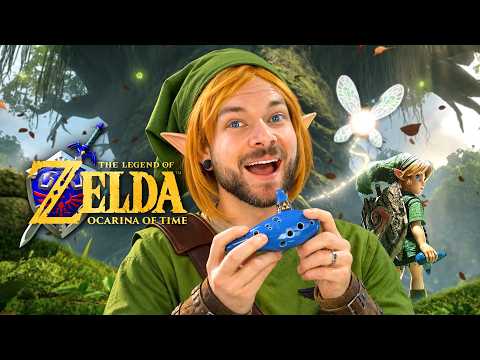
Taking off the Iron Boots used to mean opening a menu. Now it takes a press of the D-pad, and that small change tells you more about Nintendo’s approach to this remake than the much-advertised jump button. The reviewer makes a persuasive case for the cumulative effect of quicker item swaps, gyro aiming, and a free camera, while acknowledging that the loss of fixed angles takes some character out of places like the castle gardens. Sprinting and jumping get a cooler reception because the old puzzles and spaces rarely give either move much to do.
Navi’s glow gives the discussion of the visual overhaul something specific to look at. Her light falls on Link, enemies, and nearby surfaces as she moves, while the stolen flames in the Forest Temple give its wings distinct colors. These examples explain how the remake changes the feeling of stepping into a dungeon more vividly than the repeated praise for its reported 60 frames per second. The reviewer also makes room for Digital Foundry’s observations about shimmering in Hyrule Field and distortion around hair and fur, though calling the rest of the presentation technically flawless gives those caveats little weight.
The treatment of Ocarina as a children’s fairy tale gives the review a way to talk about what the remake preserves. The reviewer finds more personality in the brief encounters with Link’s allies because voice acting, facial animation, and staging give those scenes greater expressive range. The lightly reworked soundtrack gets an affectionate assessment, too. The comparison with the more subdued music of recent Zelda games is sharpest when it explains how thoroughly melody shapes Ocarina’s identity, and broadest when the reviewer declares that Zelda has lost its music.
The Water Temple makes a good test of what fidelity means in practice. The reviewer describes a more streamlined dungeon that still leaves you trying to remember which switch will get you to the next water level. That distinction between simpler navigation and lingering disorientation is more revealing than a catalogue of altered rooms would have been. Together with the examples from the Fire and Shadow Temples, it shows how much of the original’s appeal rests on giving each dungeon its own rules, even when the individual puzzles are straightforward.
Eiji Aonuma’s account of younger developers approaching a game some had never played gives the essay a natural route into its question about who the remake serves. The reviewer argues that the original’s technological novelty helped its simple combat and story appeal across age groups, while younger players today may respond more directly to the fairy tale itself. There’s warmth in the idea of a returning player sharing the game with a child or teenager. The argument is less persuasive when the reviewer treats that shared playthrough as the only way to recover something of the first encounter, especially after describing how much pleasure there was in revisiting Hyrule alone.
The shift from review to personal essay is clearly signposted, but the detours into World of Warcraft and Star Wars arcade racing delay the return to Zelda after the basic point about recapturing a feeling is already clear. The sponsor pitch at the opening is brief, while the closing segment runs through grips, a travel cover, and a dock adapter just after the essay reaches its most personal moment. That placement makes for an abrupt exit from a piece whose best observations come from sustained attention to the game.
Pros
- The control comparisons show how small interface changes improve actions players repeat throughout the game.
- The examples involving Navi and the Forest Temple explain how lighting changes the mood of familiar spaces.
- The discussion of voice acting and music connects the remake’s presentation to its fairy-tale character.
- The Water Temple comparison identifies what the redesign streamlines and what remains satisfyingly disorienting.
- Aonuma’s comments about younger developers give the generational argument a concrete starting point.
Cons
- The language of perfection sometimes undercuts the reviewer’s specific technical and design criticisms.
- The extended comparisons with other games slow the final stretch of the essay.
- The claim that sharing the game with a younger player is the only way to recapture its original feeling asks too much of a personal insight.
- The lengthy closing advertisement breaks the mood of the essay’s final passage.
The recommendation carries weight because the reviewer can explain why an old frustration was worth removing and why an old confusion was worth keeping. The essay earns its personal turn when it wonders what a newcomer might see in Hyrule today, and it has enough detail to make that question interesting even to viewers who have never been there.