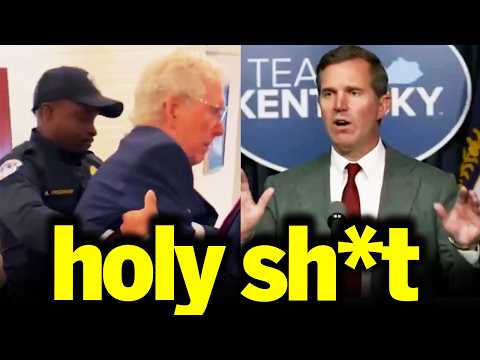
Mitch McConnell’s prolonged absence supplies the provocative question promised by the title, but it arrives surprisingly late in a wide-ranging conversation dominated by elections, corporate behavior, economic anxiety and institutional power. Kara Swisher and guest co-host Jacob Soboroff instead spend most of their time examining what they see as signs of political and civic deterioration, from companies accommodating Donald Trump’s preferred geographic renamings to federal efforts involving voter rolls and mail-in ballots. The discussion is energetic and unusually candid, though viewers expecting a sustained investigation into McConnell’s whereabouts will find that subject reduced to a brief closing exchange.
The strongest political section concerns voting and election administration. Soboroff argues that federal efforts targeting alleged noncitizen voting are addressing a problem whose scale has not been demonstrated here, while Swisher raises concerns about changes affecting mail ballots and polling locations. Their larger argument is that administrative disruption and intimidation could undermine participation even without widespread fraud. Soboroff’s experience covering elections gives the discussion useful perspective on election workers and state-level administration, but the hosts frequently move from describing reported developments to predicting motives and future abuses without supplying enough evidence within the program to establish those conclusions.
That tendency toward certainty becomes more noticeable when Trump and his allies are discussed. Swisher’s commentary is deliberately combative, with insults directed at figures including Ted Cruz, Pete Hegseth and administration officials, while Soboroff largely shares her political assessment. Their frustration is unmistakable and sometimes entertaining, but there is little meaningful challenge between the hosts. Claims that particular actions amount to attempts to steal elections, intimidate voters or establish pretexts for later intervention deserve especially careful evidentiary treatment; here, those interpretations are often delivered as the obvious explanation rather than separated consistently from what has actually been established.
The corporate and technology discussion is more naturally suited to Swisher’s strengths. Apple and Google’s mapping decisions become a jumping-off point for examining corporate accommodation of political power, while alternatives such as MapQuest and other browsers and search services provide a practical consumer angle. Swisher makes an effective distinction between Trump pursuing symbolic renamings and technology companies voluntarily choosing how to respond. Still, assertions about why executives make those choices are largely interpretations, and the conversation would be stronger with more direct evidence about the companies’ stated reasoning.
Economic concerns broaden the program further. Rising government bond yields lead into affordability, borrowing costs, inequality and the possibility of financial instability, with William Cohan providing the clearest explanation of why bond-market signals matter. Soboroff wisely states that he is not offering financial advice and shifts toward the lived consequences of unaffordability, including rebuilding after Los Angeles fires and the difficulties facing people with multiple jobs. That human-centered perspective fits his stated journalistic approach, although the conversation sometimes jumps too quickly from concerning market indicators to the possibility of a major stock-market crash without developing the economic case in sufficient detail.
The Kalshi segment similarly identifies an interesting problem without fully resolving it. George Santos’s punishment for betting on circumstances connected to his own behavior offers a concrete example of the conflicts prediction markets can create, and the hosts raise worthwhile questions about political candidates and insiders wagering on outcomes they can influence. Soboroff’s broader fear that betting markets could affect election results is presented more speculatively, however. His preference for repeatedly talking with people in communities rather than treating polls or betting prices as substitutes for public opinion is a thoughtful journalistic principle, but anecdotal encounters have their own limitations as measures of an electorate.
As a piece of conversational political commentary, the program benefits from strong chemistry, specific anecdotes and a willingness to connect national stories with local consequences. Soboroff’s discussion of Los Angeles journalism, wildfire coverage and reporting on immigration enforcement is particularly effective because it explains why local reporting matters rather than merely praising it abstractly. The sprawling format is also the main weakness: lengthy advertisements interrupt the momentum, subjects change rapidly, and the promised McConnell question ultimately receives little more than Swisher asking why a senator absent from public view for an extended period is not attracting greater scrutiny. That is a legitimate question based on the circumstances described, but viewers are given neither an answer nor much additional reporting with which to evaluate it.
Pros
- Soboroff brings valuable field-reporting perspective to discussions of elections, Los Angeles, immigration enforcement and local journalism.
- The election segment explains why administrative changes and pressure on election workers can matter even apart from proven ballot fraud.
- Swisher effectively connects corporate decisions by major technology companies to broader questions about political influence and consumer choice.
- The bond-market discussion translates an abstract financial development into understandable concerns about borrowing costs and affordability.
- The hosts have lively chemistry and move comfortably between national politics, technology, economics and media.
Cons
- The McConnell question highlighted by the title receives only a brief discussion near the end and produces no substantive answer.
- Political motives and predictions are frequently stated with greater certainty than the evidence presented in the conversation can establish.
- The hosts overwhelmingly share the same political perspective, leaving consequential claims with little internal scrutiny or counterargument.
- The rapid movement among elections, technology, bonds, gambling, journalism, basketball and media consolidation makes the program feel scattered.
- Multiple lengthy advertisements substantially interrupt an already expansive conversation.
Swisher and Soboroff deliver an animated, often insightful discussion of institutional trust, political pressure and economic unease, with the best material emerging when concrete reporting supports their broader concerns. Its forceful commentary sometimes outruns the evidence presented, however, and the tantalizing McConnell question functions more as a closing provocation than a genuinely investigated story.