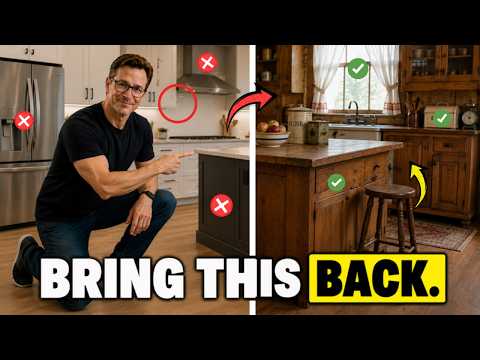
Layered lighting gets an unusually sensible defense here, with Nick rejecting the social-media rule that the central ceiling light should never be used while still acknowledging why harsh overhead illumination can be unflattering. His preference for warm bulbs, dimmers and multiple light sources gives the discussion a practical foundation rather than reducing it to taste. That balance—recognizing why a trend exists before arguing against its absolutism—is one of the better qualities of the presentation.
The kitchen flooring discussion follows the same pattern. Engineered hardwood is presented as more resilient to ordinary spills than some homeowners fear, but Nick repeatedly qualifies that point by telling viewers to check the specific manufacturer and product specifications. He also makes a useful distinction between water resistance and waterproofing, then shifts from material performance to visual planning by considering whether an open floor plan or a natural doorway creates a sensible transition between hardwood and tile. The advice is strongest when it accounts for both function and architecture rather than declaring one material universally superior.
Rugs receive a similarly situational treatment. A kitchen rug is defended as a source of color, pattern and comfort, provided it is not exceptionally valuable or difficult to clean, while bathroom rugs are treated with greater caution because of repeated exposure to moisture. The comparison is grounded in everyday use, although some of the cleanliness discussion relies more on common-sense assumptions than any detailed material guidance. Nick is persuasive when he distinguishes between spaces instead of treating every supposedly controversial design choice as an all-or-nothing rule.
The book-styling and carpeting sections are much more openly opinionated. Reversing books so only the page edges show is dismissed as both decorative affectation and a practical failure because titles become invisible, while color-organizing books is criticized for separating related volumes. Wall-to-wall carpet receives a more nuanced verdict: Nick dislikes it in most shared living spaces but accepts the bedroom as its most logical application because softness and comfort matter more there and a doorway provides a clean material transition. His humor makes these arguments entertaining, although repeated jokes about bodily fluids become an unnecessary running distraction.
Kitchen functionality produces some of the clearest recommendations. Nick strongly prefers a single-basin sink because larger cookware and mixing bowls are easier to maneuver, while conceding that double basins can still suit people who wash dishes by hand or want separate rinsing space. His support for upper cabinets is equally practical, centered on storage rather than current fashion. The argument against replacing useful cabinetry with open shelves is particularly effective because it acknowledges the photographic appeal of styled shelves while questioning how well that presentation reflects ordinary household clutter.
The discussion of white kitchens is arguably the most thoughtful segment because it separates “dated” from “bad.” Nick argues that white cabinetry can simultaneously signal a particular design era and remain visually serviceable for years, contrasting its relative longevity with currently fashionable white oak and emerging darker wood tones. That distinction undermines the simplistic online tendency to label anything no longer fashionable as obsolete. It also supports one of the broader themes running through the episode: chasing what is currently fashionable is a poor basis for expensive, long-lived renovation decisions.
The presentation benefits from a conversational, self-aware style and a willingness to admit personal preference, but it sometimes stretches straightforward points with repetition, asides and exaggerated jokes. The opening promise to deliver the “correct” opinion is clearly playful, yet the format still depends heavily on Nick’s personal experience rather than systematic comparisons of cost, maintenance, installation or durability. That is appropriate for an opinion-led design discussion, but viewers making major renovation decisions would still need product-specific and professional guidance beyond these general principles.
Pros
- Frequently distinguishes personal preference from practical considerations, especially with lighting, flooring, carpeting and cabinetry.
- The hardwood discussion responsibly advises checking manufacturer specifications rather than treating all engineered products as identical.
- Strong spatial reasoning around flooring transitions, open plans and room boundaries makes several recommendations genuinely useful.
- The distinction between something being dated and actually being unattractive or unusable is a thoughtful corrective to trend-driven design commentary.
- Single-basin sinks and upper cabinetry are evaluated through everyday functionality rather than appearance alone.
Cons
- Several sections rely primarily on personal experience and broad assumptions rather than detailed material, maintenance or cost comparisons.
- Repetition and extended jokes sometimes make simple arguments considerably longer than necessary.
- The recurring bodily-fluid humor becomes distracting and adds little to the design analysis.
- Some categorical dismissals, particularly around book styling, are more entertaining than analytically nuanced.
- The promotional interruption near the beginning briefly disrupts the momentum before the main discussion has properly developed.
Nick is at his best when he treats fashionable design rules as context-dependent choices rather than universal truths. The combination of practical reasoning, humor and willingness to defend unfashionable options makes the discussion useful, even if the loose pacing and anecdotal basis occasionally limit its depth. It succeeds more as thoughtful homeowner guidance than as a definitive design authority.