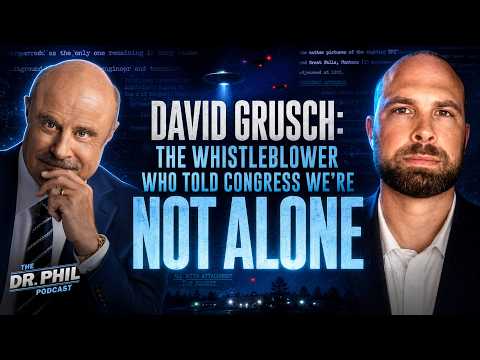
Few interviews in the UFO disclosure movement attempt to cover as much ground—or make as many astonishing claims—as this extended conversation with former military contractor Jacob Barber. Over the course of the interview, Barber describes his alleged involvement in covert U.S. government operations, the recovery of unidentified craft, classified intelligence programs, psychic research, and what he believes is evidence of a non-human intelligence interacting with humanity. Whether viewers ultimately accept his claims or remain deeply skeptical, one thing is undeniable: this is one of the most fascinating and provocative UFO interviews in recent memory.
The interview succeeds largely because of its pacing. Rather than immediately diving into extraordinary claims, Barber spends considerable time establishing his military background, explaining how compartmentalized intelligence programs operate, and describing the culture of covert operations. This slower approach gives viewers an opportunity to understand how someone in his position believes they could have participated in highly classified missions without necessarily knowing the full scope of the programs involved.
Once the discussion turns toward unidentified aerial phenomena, the interview becomes genuinely captivating. Barber recounts two alleged recovery operations involving unusual craft—one described as a smooth, white egg-shaped object and another as an octagonal disc-like vehicle. Rather than relying on dramatic embellishment, he presents the stories with surprising restraint, often acknowledging the limits of what he personally knows while distinguishing between direct experience and later conclusions.
Perhaps the interview's most controversial section involves Barber's descriptions of so-called "psionic" programs, where individuals allegedly communicate with or even summon unidentified craft through consciousness rather than conventional technology. These claims venture far beyond the now-familiar discussions of military UFO sightings and into territory that many viewers will find difficult to accept. Yet the interviewer wisely allows Barber to explain these ideas at length rather than constantly interrupting or dismissing them, giving audiences the opportunity to evaluate the testimony for themselves.
One of the strongest aspects of the conversation is its tone. Unlike many UFO interviews that lean heavily into sensationalism or conspiracy rhetoric, this discussion remains relatively measured. Barber frequently admits when something falls outside his personal knowledge and avoids making absolute claims where he lacks firsthand evidence. That restraint actually enhances his credibility, even for viewers who remain unconvinced.
The interviewer also deserves credit for asking challenging questions. Rather than accepting every statement at face value, he repeatedly raises obvious objections: Why should anyone believe these extraordinary claims? Could this all be misinformation? How could such a massive secret remain hidden for decades? These skeptical questions help create a balanced conversation instead of a one-sided presentation.
Another compelling theme is the discussion of government secrecy. Barber argues that compartmentalization allows highly sensitive information to remain hidden even from senior military and government officials. Whether or not viewers agree with his conclusions, the interview offers an interesting look at how classified programs are believed to function within national security circles.
Visually, the interview relies almost entirely on conversation rather than flashy graphics or dramatic editing. While some viewers may find this less exciting than heavily produced documentaries, it places the focus squarely on Barber's testimony and allows the audience to judge his demeanor and consistency for themselves.
That said, the interview is not without weaknesses.
Its greatest limitation is that many of the extraordinary claims rely almost entirely on personal testimony. While Barber references documents, classified briefings, and alleged corroborating witnesses, the interview itself provides relatively little independently verifiable evidence. For viewers who require hard proof rather than eyewitness testimony, this will likely be a significant hurdle.
The conversation is also extremely long and occasionally repetitive. Certain themes—government secrecy, compartmentalization, consciousness, and patriotism—are revisited multiple times. Some tighter editing could have improved the overall pacing without sacrificing important context.
Finally, some of the more speculative discussions surrounding consciousness, telepathy, and non-human intelligence may be difficult for mainstream audiences to embrace without additional supporting evidence. These sections are thought-provoking but remain the most controversial parts of the interview.
Pros
- Fascinating firsthand account presented in a calm, measured manner
- Excellent questioning that balances curiosity with skepticism
- Provides detailed insight into alleged covert military operations
- Encourages viewers to think critically rather than simply believe or dismiss
- Covers a wide range of topics within modern UFO disclosure
Cons
- Extraordinary claims are supported primarily by personal testimony
- Some sections become repetitive due to the interview's length
- Discussions of consciousness and psionics may feel highly speculative
- Viewers looking for definitive evidence may leave unsatisfied
Whether Jacob Barber is recounting genuine classified experiences or sincerely interpreting events through his own perspective, this interview represents one of the more compelling long-form conversations in the ongoing UFO disclosure debate. It avoids many of the sensational tropes common in the genre, instead allowing a detailed narrative to unfold naturally while encouraging viewers to weigh the evidence—and the lack of it—for themselves. The interview does not provide definitive proof that non-human intelligence exists or that covert retrieval programs operate as described. What it does provide is a thoughtful, remarkably detailed testimony that raises intriguing questions about government secrecy, military compartmentalization, and the possibility that there are aspects of our world still waiting to be understood. For anyone interested in UFO disclosure, military whistleblowers, or the broader conversation surrounding unidentified aerial phenomena, this interview is well worth watching—even if only to challenge your own assumptions.