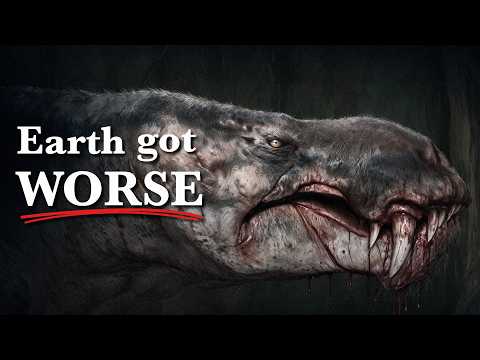
This video explores how a series of paleontological discoveries made between 2022 and 2026 have reshaped scientific understanding of Tyrannosaurus rex. Rather than presenting the familiar Hollywood predator popularized by Jurassic Park, it traces how more than a century of research has gradually replaced early reconstructions with a far more evidence-driven picture. The presentation combines the history of the dinosaur's discovery with recent advances in biomechanics, fossil analysis, microscopy, chemistry, and statistical modeling to explain why researchers now view T. rex differently than previous generations did.
One of the video's greatest strengths is its chronological structure. Beginning with Barnum Brown's famous fossil discoveries and the early twentieth-century reconstruction of T. rex, it demonstrates how scientific understanding evolves as new evidence becomes available. Rather than portraying earlier scientists as simply mistaken, it explains how limited fossil material forced researchers to rely on educated inference, leading to familiar but inaccurate features such as the upright posture, dragging tail, and incorrect forelimbs. This historical framing gives later discoveries much greater impact because viewers understand exactly what assumptions are being overturned.
The discussion of modern research is impressively broad without becoming overwhelming. Studies examining tooth structure, lip anatomy, metabolism, body proportions, locomotion, growth rates, and sensory capabilities are introduced in a logical sequence, with each section building upon the previous one. Scientific methods—including microscopic examination of teeth, spectroscopy, CT-based anatomical modeling, growth ring analysis, and biomechanical reconstruction—are explained in accessible language that remains understandable to viewers without a scientific background. Instead of simply announcing new conclusions, the video spends considerable time explaining how researchers reached them, making the evidence nearly as interesting as the findings themselves.
Importantly, the presentation usually distinguishes well between established findings and more tentative interpretations. Well-supported conclusions, such as revised posture, evidence supporting a warm-blooded metabolism, or the likelihood of lips covering the teeth, are presented alongside explanations of the underlying research. More speculative ideas—such as the possibility of exceptionally large fifteen-ton individuals or hypotheses regarding juvenile feathering—are clearly described as statistical projections or interpretations rather than confirmed discoveries. This distinction helps maintain scientific credibility while still conveying why these possibilities are exciting for paleontology.
The section examining body reconstruction is particularly effective because it challenges popular artistic depictions without exaggerating the evidence. Rather than arguing that previous estimates of weight were dramatically incorrect, the video explains that newer modeling techniques suggest T. rex was considerably more muscular than older reconstructions implied. Likewise, the discussion of locomotion avoids sensationalism by replacing cinematic imagery with biomechanical evidence suggesting a quieter, more balanced, bird-like gait. These examples reinforce the video's broader theme that scientific refinement often changes interpretation more than raw measurements.
Another highlight is the treatment of T. rex growth and ecology. By explaining revised growth rates, longer juvenile development, and the proposal that some fossils previously assigned to juvenile Tyrannosaurus may instead belong to the separate genus Nanotyrannus, the video illustrates how new interpretations can reshape understanding of an entire ecosystem rather than just a single species. Even where ongoing scientific debate exists, the narrative remains focused on explaining why these questions matter instead of presenting controversy for its own sake.
The presentation is also engaging from a storytelling perspective. James Stewart balances scientific detail with an enthusiastic narrative style, frequently returning to the central idea that each technological advance has gradually revealed a predator more specialized than earlier reconstructions suggested. The production maintains momentum across a lengthy runtime without relying excessively on dramatic language, although moments of rhetorical flourish occasionally push beyond what the underlying evidence alone establishes.
The primary limitation is that the video covers an enormous number of recent studies in a relatively short period. Individual papers often receive only enough attention to summarize their methodology and conclusions before the discussion moves to the next topic. Specialists seeking deeper discussion of competing interpretations, unresolved debates, or limitations within each study may find some sections necessarily compressed. In addition, while speculative projections are usually identified appropriately, viewers should remember that several conclusions discussed remain active areas of paleontological research rather than universally settled consensus.
Pros
- Presents more than a century of Tyrannosaurus research within a clear historical narrative.
- Explains modern paleontological techniques in language accessible to non-specialists.
- Carefully connects scientific methods with the conclusions they support.
- Generally distinguishes established evidence from statistical projections and ongoing scientific interpretation.
- Covers anatomy, biomechanics, growth, metabolism, sensory biology, and ecology in a well-organized progression.
- Maintains an engaging presentation while remaining largely grounded in published research.
Cons
- The ambitious scope limits the depth devoted to several individual studies and competing interpretations.
- Some projections, particularly regarding maximum possible size and aspects of behavior, remain inferential rather than directly demonstrated by fossil evidence.
- A few dramatic narrative flourishes slightly overstate how definitive some emerging interpretations currently are.
This is an excellent synthesis of how modern paleontology continues to reshape one of history's most famous dinosaurs. Rather than relying on sensational claims, it demonstrates how advances in imaging, chemistry, biomechanics, and fossil analysis have steadily refined scientific understanding of Tyrannosaurus rex. By placing recent discoveries within the broader history of the dinosaur's reconstruction, the video shows that scientific knowledge is constantly evolving as new evidence emerges. Even where some conclusions remain provisional, the presentation consistently encourages viewers to appreciate both the discoveries themselves and the process through which they are made.