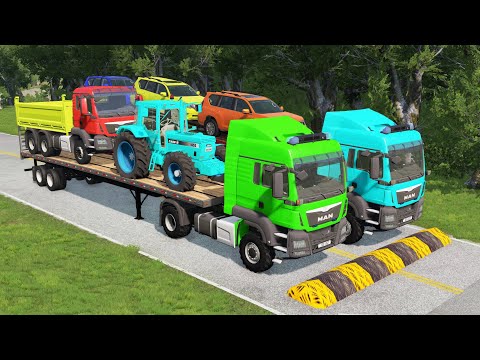
A stream of crashes, rescue requests and short reactions drives the presentation, with phrases such as “Please help!” and “Okay, let’s go!” returning again and again. That creates an immediately frantic tone appropriate for a BeamNG Drive scenario built around vehicles, obstacles and transportation, but the dialogue provides very little context for what is actually happening from moment to moment.
The flatbed-truck premise suggests a sequence centered on recovering or transporting vehicles through hazardous situations. The repeated calls for assistance reinforce that rescue structure, while occasional reactions such as “Oh wow!” and “Good job!” mark moments of apparent success. Unfortunately, those reactions are so generic that they do little to distinguish one encounter from the next.
There is at least a recognizable rhythm to the action. A problem occurs, someone calls for help, the response moves toward another attempt, and abrupt exclamations such as “Bang!” signal collisions or impacts. For viewers primarily interested in watching simulated vehicle mishaps rather than following a developed story, that simplicity may be enough to keep the sequence moving.
The presentation becomes noticeably repetitive, however, because a small collection of lines accounts for nearly all of the spoken material. “Please help!” dominates particularly heavily, while repeated variations of “Okay, let’s go!” offer little additional information. Even brief changes such as “What are you doing?” and “Stop right there criminal scum!” stand out mostly because the surrounding dialogue changes so rarely.
That lack of descriptive commentary also limits the usefulness of the BeamNG Drive setting. There is no meaningful discussion of the vehicles, damage, driving decisions, pothole challenge, flatbed operation or simulation behavior. The action therefore has to carry virtually the entire experience, with the spoken component functioning more like repetitive sound cues than narration.
As a lightweight vehicle-action piece, the concept is easy to understand and the constant urgency prevents long stretches of inactivity. Yet the dialogue does not develop the premise enough to give individual crashes or rescues much personality, making the overall experience feel more repetitive than escalating. More varied reactions and clearer connections between the dialogue and specific driving challenges would substantially improve the presentation.
Pros
- Maintains a consistently energetic pace through frequent rescue calls, reactions and impact cues.
- The repeated requests for assistance provide a simple recurring structure for the vehicle-recovery action.
- Occasional changes in dialogue briefly add variety to the otherwise straightforward scenario.
Cons
- Heavy repetition of “Please help!” and “Okay, let’s go!” quickly becomes monotonous.
- Spoken material provides almost no useful detail about the flatbed transportation, pothole encounters, vehicles or driving challenges.
- Minimal narrative development makes the individual incidents difficult to distinguish from one another.
- Generic reactions contribute little personality or explanation to the simulated action.
The rescue-and-crash setup provides enough urgency for simple BeamNG Drive entertainment, but the extremely limited dialogue leaves most of the premise dependent on the visuals alone. Greater variety and more situation-specific commentary would make the sequence considerably more engaging and memorable.