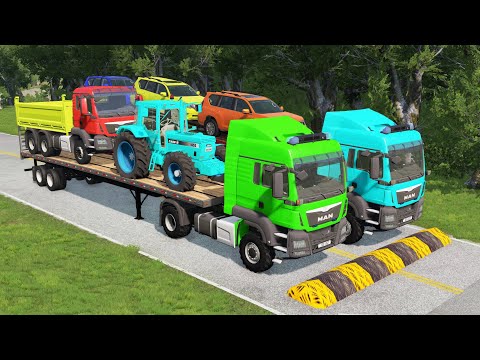
A stream of crashes, pleas for help, and quick recoveries drives the action, with the dialogue repeatedly shifting from distress to an enthusiastic “let’s go” once assistance arrives. That simple rhythm fits a vehicle-rescue scenario, but there is very little dialogue establishing what is happening to the cars, why the flatbed is needed, or how each situation differs from the last.
The McQueen transportation premise appears designed primarily around visual action rather than storytelling. Short exclamations such as “Bump!” and “Oh wow!” reinforce collisions and unexpected moments, while repeated calls for help provide an obvious reason for the rescue vehicle to intervene. It is straightforward enough to follow without extensive explanation, which can work well for a fast, spectacle-oriented BeamNG Drive presentation.
Repetition, however, quickly becomes the dominant characteristic. “Please help,” “OK,” and “let’s go” recur so frequently that the dialogue stops adding much personality or progression. Even when the action presumably changes on screen, the spoken material provides little indication that the stakes, challenge, or circumstances have evolved.
There are occasional bits of character that break the pattern. The opening “Stop right there criminal scum!” introduces a more playful confrontation, while “Good job!” and the repeated excited affirmations give successful moments an upbeat payoff. These fragments suggest a deliberately exaggerated, cartoon-like tone rather than any attempt at realistic vehicle recovery.
The pothole concept could have provided a stronger organizing hook by emphasizing different crashes, vehicle damage, or increasingly difficult recoveries. Instead, the sparse commentary offers almost no detail about the obstacles themselves or the transportation process. Viewers looking for explanations of BeamNG Drive mechanics, vehicle behavior, or recovery techniques therefore get little substantive information from the presentation.
As lightweight crash-and-rescue entertainment, the simplicity has some value: there is almost no exposition to slow down the action, and the repeated distress-and-rescue cycle makes the basic objective immediately understandable. Yet that same simplicity severely limits variety and leaves the concept dependent on its visuals to supply nearly all of the entertainment. More varied reactions, clearer scenarios, or a stronger progression between incidents would give the chaotic driving a more satisfying structure.
Pros
- Keeps the rescue premise easy to understand through direct calls for help and immediate responses.
- Brief celebratory reactions give successful recoveries an upbeat, playful tone.
- Minimal exposition allows the vehicle action to remain the focus.
Cons
- Recycles the same pleas for help and short responses so often that the dialogue becomes highly repetitive.
- Provides almost no context about the potholes, crashes, vehicles, or individual rescue situations.
- Does little to develop the flatbed transportation premise beyond a recurring distress-and-recovery loop.
- Offers virtually no insight into BeamNG Drive mechanics or vehicle behavior.
The simple rescue cycle can support quick, chaotic vehicle entertainment, but the dialogue does too little to distinguish one incident from another. Its energetic fragments suit the action, while heavy repetition and minimal development leave the overall concept feeling thin.