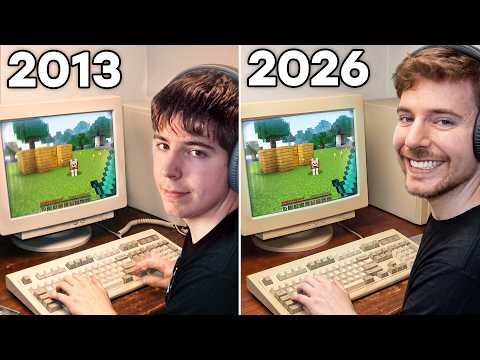
Long before Minecraft introduced many of its modern gameplay mechanics, community developers were already transforming the sandbox into something considerably more ambitious. From functional portal guns and miniature armies to challenging mutant bosses and elaborate dungeon towers, these early modifications offered possibilities that extended well beyond the original game. The creator revisits four particularly memorable mods, comparing their earliest incarnations with modern interpretations to determine whether their enduring popularity is deserved or simply a product of nostalgia.
The Portal Gun segment provides an especially fascinating look at the evolution of Minecraft modding. Beginning with a version designed for Minecraft Beta 1.4, the creator demonstrates functioning portals, momentum-based movement, energy pellets, companion cubes, and protective boots before progressing to the more sophisticated 1.7.10 release. His personal recollection of struggling to install the original modification adds authenticity to the retrospective, while the discovery of an old comment thanking a tutorial creator establishes a genuine connection to Minecraft's earlier community.
Exploring adventure maps across three generations of Portal modifications demonstrates how dramatically their creative potential has expanded. The modern interpretation introduces seamless views through portals, more refined physics, specialized surfaces, and the addition of repulsion and propulsion gels. The creator also thoughtfully considers the gameplay implications of restricting portal placement, recognizing that greater accuracy to the original Portal games can introduce limitations while improving survival balance. However, his extended struggle with one of the older test chambers becomes unnecessarily repetitive, interrupting an otherwise informative comparison.
Clay Soldiers offers a particularly interesting reversal of expectations, with the original modification proving more impressive than its modern counterpart in several respects. The extensive customization options allow miniature soldiers to equip weapons, improve their armor, ride horses, revive fallen allies, and develop specialized combat abilities. The organized battles entertainingly demonstrate the consequences of different equipment combinations, particularly when explosive soldiers devastate an opposing army. The modern version retains the entertaining premise but exhibits inconsistent item collection, less convincing combat behavior, and substantially fewer customization options during the demonstration.
The Mutant Creatures comparison benefits from the creator's decision to fight the monsters rather than simply demonstrate their appearances and abilities from a safe distance. Encounters with mutant zombies, creepers, Endermen, and skeletons provide an entertaining showcase of their distinctive attacks and rewards. The modern Mutant Monsters adaptation largely preserves the original concept while introducing refinements such as specialized skeleton armor abilities. Nevertheless, inconsistent equipment, protective effects, and technical problems complicate direct comparisons of combat difficulty, while the creator's uncertainty about several mechanics occasionally leaves features inadequately explained.
Battle Towers rounds out the retrospective with an effective demonstration of how a relatively straightforward concept can develop into a considerably more elaborate adventure. The original modification's escalating floors, treasure chests, and powerful guardian establish a satisfying foundation, while Brass Amber's Battle Towers introduces interconnected progression, themed environments, specialized enemies, environmental hazards, and spectacular structural collapses following boss defeats. Although only three of the six discussed tower concepts are currently available in the version explored, the existing content demonstrates considerable potential. The creator openly acknowledges this limitation rather than allowing his enthusiasm to obscure the modification's unfinished state.
Throughout the presentation, the creator's spontaneous reactions, personal memories, and willingness to acknowledge mistakes make the retrospective feel genuine rather than excessively rehearsed. His enthusiasm occasionally becomes overwhelming through repeated exclamations and profanity, and greater familiarity with certain mechanics would have improved the efficiency of several demonstrations. However, his concluding observation that nostalgia naturally favors the most memorable successes of an earlier era adds welcome perspective. Rather than declaring modern modding inferior, he recognizes that enduring concepts can remain entertaining through faithful preservation or thoughtful reinvention.
Pros
- The comparisons between original modifications and modern interpretations provide an engaging perspective on Minecraft's modding history.
- The creator's personal memories establish an authentic connection to the early Minecraft community.
- The adventure maps, miniature battles, boss encounters, and dungeon exploration demonstrate the modifications through practical gameplay.
- The examination of Clay Soldiers provides a refreshing example of an older modification outperforming its modern counterpart.
- The discussion of gameplay balance, visual design, customization, and progression extends beyond superficial nostalgia.
- The creator openly acknowledges technical problems, missing features, and his own mistakes.
- The concluding discussion thoughtfully recognizes the selective nature of nostalgia.
Cons
- The prolonged attempts to solve an older Portal adventure map puzzle unnecessarily disrupt the pacing.
- Inconsistent equipment and protective effects make some combat difficulty comparisons less reliable.
- Insufficient familiarity with certain mechanics leaves several interesting features incompletely explained.
- The frequent profanity and repetitive expressions of excitement occasionally become distracting.
- Incorrect modification versions and technical complications interrupt the continuity of several demonstrations.
Combining nostalgic entertainment with meaningful comparisons of game design, this retrospective offers an enjoyable exploration of Minecraft's remarkably creative modding history. Although more preparation and consistent testing would have strengthened its conclusions, the creator's enthusiasm and willingness to recognize both improvements and shortcomings give the presentation considerable credibility. It ultimately demonstrates that imaginative gameplay concepts can remain compelling long after their original technical foundations become outdated.