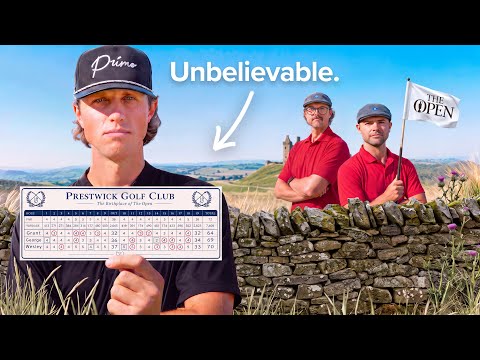
The Major Cut arrives at Royal Birkdale with unusually convincing stakes. Grant, George, and Wesley use five over—the cut line they cite from the 2017 Open—as their target while playing the course shortly before another Open Championship, with grandstands in place and wind immediately affecting strategy. Wesley also brings firsthand history with the venue and fresh disappointment from narrowly missing Open qualification, giving the usual make-the-cut format an extra layer of relevance. What follows is less a showcase of pristine scoring than an extended attempt to survive bunkers, unpredictable wind, awkward lies, and their own mistakes.
The opening hole establishes that struggle almost too effectively. Drives find trouble, bunker shots become recovery exercises, and the group combines for what they call the worst hole in Major Cut history. Starting with doubles and a triple puts the cut line under immediate pressure, but it also gives the round somewhere meaningful to go. Instead of watching three golfers protect comfortable scores, the audience spends most of the day tracking who can recover, who is drifting outside five over, and whether the disastrous beginning can eventually become something respectable.
Royal Birkdale itself provides the video's strongest material. The players repeatedly have to adjust conventional yardages for the wind, including moments when a 190-yard shot demands a club that would normally seem absurdly short. Pot bunkers force sideways or conservative recoveries, exposed holes change dramatically depending on direction, and the golfers experiment with lower flights, bump-and-runs, and other links-style shots. The local caddies strengthen these sequences considerably by providing targets, reads, landing numbers, and course knowledge rather than leaving every decision to the players' improvisation.
Wesley's driver struggles provide the clearest individual storyline. He openly describes having the “whoopsies,” explains how badly the driver had behaved before Open qualifying, and initially relies heavily on safer clubs. That makes every later decision to pull driver feel consequential, particularly when the misses reinforce why he was reluctant to use it in the first place. George and Grant have their own swings between excellent and poor execution, including a near hole-in-one for Grant, strong par-three play, missed short putts, questionable strategic decisions, and stretches where George creates valuable separation from the others. By the closing holes, George sits at three over while Grant and Wesley reach the 18th tied at six over, giving the final hole a natural competitive setup.
The group's chemistry keeps a difficult round from becoming grim. Plastic tees, “flow state,” toe flicks, the driver whoopsies, arguing with caddie reads, and repeated declarations that they have finally stabilized the round become running jokes. Their willingness to criticize their own shots also works well: poor wedges, bad drives, tentative putts, and misguided decisions are usually acknowledged immediately rather than explained away. Coming directly after George and Wesley's Open qualifying attempt, the contrast between nearly reaching the championship and struggling through this round becomes another source of self-deprecating humor.
There is useful golf insight underneath that comedy. The players discuss why links bunkers must be avoided, how wind alters effective yardage, why certain trajectories work from particular lies, and how the same hole can become substantially different depending on wind direction. The caddies add local perspective, while Wesley occasionally relates the conditions to his previous competitive experience at the course. None of this is presented as a formal instructional lesson, but the constant club-selection conversations and course-management decisions make the round more informative than a simple stroke-by-stroke competition.
The main drawback is length and repetition. Nearly every shot receives discussion before and after execution, and the group repeatedly revisits the cut line, the upcoming road trip, Wesley's driver problems, the recent qualifier, and whether the round has finally turned around. A merchandise interruption and an extended giveaway explanation also break the competitive rhythm. Those segments are understandable within the production, but the round is compelling enough that tighter editing around the golf would have preserved the personality while giving the changing leaderboard more momentum.
Pros
- Royal Birkdale's wind, bunkers, lies, and links conditions create a genuinely demanding setting for the Major Cut format.
- The disastrous first hole immediately establishes meaningful pressure against the five-over target and makes the subsequent recovery more compelling.
- Local caddies contribute useful course knowledge, yardage adjustments, green reads, and links strategy throughout the round.
- Wesley's driver struggles, George's stronger scoring position, and Grant's near ace give the three golfers distinct storylines within the same competition.
- Strong group chemistry turns bad shots and strategic mistakes into recurring comedy without removing the competitive stakes.
- Discussions of trajectory, wind, bunker avoidance, club selection, and course management add worthwhile golf detail.
Cons
- Repeated conversations about the cut line, driver problems, upcoming road trip, and recent Open qualifier make portions of the round feel longer than necessary.
- Merchandise and giveaway segments interrupt the momentum of an otherwise naturally developing golf competition.
- The conversational presentation occasionally becomes so busy around individual shots that the larger scoring picture temporarily recedes into the background.
Royal Birkdale is exactly the kind of course that makes the Major Cut concept work: difficult enough that five over remains relevant, visually and strategically distinctive enough to make individual holes memorable, and unpredictable enough that one poor swing can completely change a player's position. The catastrophic opening gives the round immediate adversity, while the recovery that follows turns the leaderboard into an ongoing survival story rather than a procession of routine pars. Wesley's battle with his driver, Grant's near hole-in-one, George's steadier position, and the caddies' local knowledge give the long round enough personality and golf substance to sustain it. The presentation could be tighter, particularly when promotional material and repeated conversations interrupt the scoring drama, but as a links-golf Major Cut staged around Royal Birkdale's championship setup, it captures both the punishment and appeal of trying to survive a course built to expose mistakes.