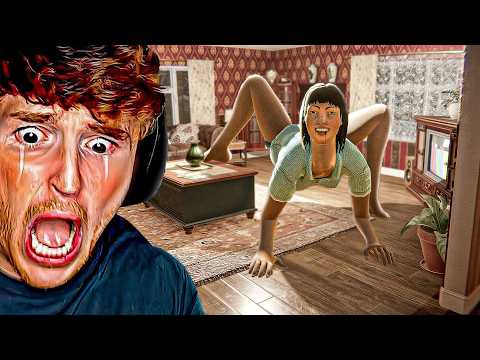
A seemingly ordinary evening of frog-leg soup quickly gives way to a house where puddles, appliances, animals, traps, possessed relatives, and poorly timed decisions can turn fatal. Markiplier immediately recognizes the sequel’s central idea: survival depends less on conventional combat than on learning an elaborate chain of hazards through repeated deaths. His familiarity with the first game gives him useful context, but House 2 quickly proves complicated enough to leave him scrambling anyway.
The strangest early detour is an entire playable game within the game. What initially looks like a simple console diversion becomes a substantial horror sequence involving batteries, an axe, enemies, a combination, a gun, and grotesque versions of family members. Markiplier’s increasing disbelief at spending so much time inside this nested adventure is funny, and the sequence effectively establishes House 2’s willingness to experiment, although its length temporarily makes the main game feel almost forgotten.
Once the household death cycle properly begins, the playthrough finds its identity. Markiplier has to discover that a puddle must be cleaned before his sister slips, a toilet needs flushing, the dog can be distracted with food, the television can be broken, a knife can expose additional secrets, and a supernatural threat can be driven away with a bell. Each discovery adds another requirement to an increasingly demanding routine, while failures are reflected in the family portrait and journal. The game turns ordinary domestic chores into a macabre time-management puzzle, and watching the necessary sequence gradually emerge is the most satisfying part of the playthrough.
That design also produces some wonderfully absurd experimentation. A baseball, pie, banana, anvil, pizza delivery, talking horse, mysterious phone numbers, bullets, mice, and an unexpectedly helpful snail all become possible pieces of the puzzle. Markiplier is especially entertaining when he understands that an apparently meaningless detail from much earlier actually has a purpose. His improvised commentary keeps repeated runs lively, and his mixture of frustration, curiosity, and dark humor suits a game that repeatedly kills characters in grotesque but deliberately ridiculous ways.
Repetition is nevertheless substantial. Because a single forgotten task can ruin a run, viewers repeatedly see Markiplier collect the same objects, prepare the same pie, clean the same puddle, and race through the same rooms. His uncertainty over the gun, phone numbers, mother's possession, and other unexplained mechanics leads to long stretches of trial and error. That struggle is authentic and ultimately makes the successful run more rewarding, but the middle portion can feel less like escalating horror and more like watching someone debug a particularly murderous household routine.
An accidental recording failure adds another wrinkle, forcing Markiplier to reconstruct discoveries he made off-camera. He does a reasonably effective job of catching the audience up, demonstrating the phone calls, anvil trick, hidden areas, and other deductions rather than simply announcing that he solved them. From there, the final optimized attempt has genuine momentum because so many previously disconnected mechanics must be executed in the correct order. Reaching the ending after more than two hours of effort feels earned, especially when the house finally shifts from oppressive danger to an unexpectedly cheerful atmosphere.
The resolution is appropriately uneasy rather than definitive. Markiplier manages to save almost everyone and earns the family-saving ending, only for the closing material to reveal that the apparent happiness is temporary and that the nightmare continues. His recollection of the first game's deeper secrets gives him reason to suspect another ending remains, but he stops rather than pretending to have solved mysteries he has not. As a first installment, it delivers a complete arc of discovery, repeated failure, and eventual success while leaving the larger mystery open for another attempt.
Pros
- The interconnected household hazards create an unusually elaborate and satisfying trial-and-error puzzle.
- Markiplier’s reactions and improvisation keep many repeated deaths entertaining.
- The lengthy game-within-a-game sequence is an inventive and unexpectedly substantial opening diversion.
- Small discoveries involving the phone, baseball, anvil, bell, food, and hidden spaces gradually coalesce into a rewarding solution.
- The successful final run pays off the accumulated experimentation and frustration.
Cons
- Repeating the same chores and item routes after failed attempts makes portions of the playthrough drag.
- The nested game occupies so much of the opening that the main House 2 mechanics take a long time to become the focus.
- Several mechanics are obscure enough that progress sometimes feels dependent on exhaustive experimentation rather than readable clues.
- The recording mishap means some discoveries have to be reconstructed after they originally happened.
- The playthrough ends after the more straightforward ending, leaving the apparent deeper route unresolved.
House 2 turns a dysfunctional family evening into a dense, morbid puzzle where every successful discovery creates another responsibility, and Markiplier’s persistence makes the eventual breakthrough genuinely satisfying. Repetition and obscure mechanics stretch the journey considerably, but the escalating chain of discoveries, absurd deaths, and uneasy ending provide enough payoff to justify the struggle.