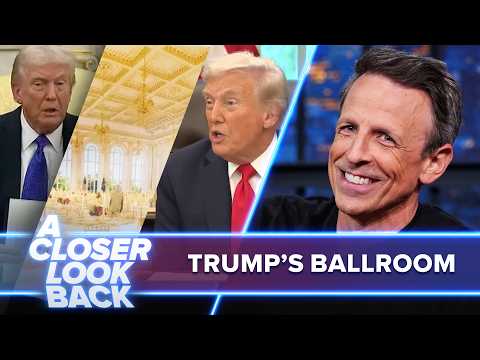
Barack Obama’s joke comparing Donald Trump’s gold-covered White House renovations to Saddam Hussein opening a Cheesecake Factory becomes the centerpiece of Seth Meyers’ latest political takedown. With Election Day approaching, Meyers examines the increasingly hostile rhetoric coming from Republican campaigns, Trump's unusual grievances against foreign countries, and conservative outrage over Obama's humor. The result is an energetic installment of A Closer Look that combines campaign criticism, political absurdity, and sharp observational comedy while maintaining a consistently skeptical view of Republican messaging.
Meyers establishes his central argument by contrasting Obama's optimistic closing message from the 2008 presidential campaign with the inflammatory rhetoric he attributes to current Republican candidates. He highlights examples involving religious prejudice, anti-transgender language, and homophobic jokes, including a remark from JD Vance directed at James Talarico. His response, imagining the vice president's humor appealing to a fifth-grade lunch table, effectively ridicules the childishness of the insult. However, the discussion presents these controversies almost entirely through Meyers' interpretation, offering limited context about the individual campaigns or the broader electoral issues surrounding them.
Trump's complaints about immigration and foreign countries provide some of the segment's strongest comedic material. Meyers revisits Trump's past derogatory description of certain nations before examining his apparent hostility toward Norway over the Nobel Peace Prize. The comedian highlights the distinction between Norway's government and the committee responsible for selecting the prize recipient, exposing the weakness in Trump's stated grievance. His exaggerated Norwegian accent and jokes about Americans paying thousands of dollars for medical appointments add humor, although the healthcare comparison relies on broad national stereotypes rather than a detailed examination of either system.
The discussion of Trump's disappointment over not receiving the Nobel Peace Prize is similarly effective because Meyers allows the former president's own remarks to establish the comedic premise. Trump's reported question about whether two prizes could be awarded provides an opportunity for Meyers to compare political recognition with entertainment awards, particularly his imagined reaction to losing an Emmy to John Oliver. These jokes emphasize the perceived vanity behind Trump's complaints without requiring elaborate explanations. Nevertheless, Meyers treats the remarks primarily as evidence of personal insecurity rather than exploring the diplomatic accomplishments Trump believes deserve recognition.
One of the more substantive political exchanges involves Michigan Republican Mike Rogers repeatedly avoiding questions about whether he identifies with MAGA or supports Trump's agenda. Meyers uses the interview footage to illustrate the difficulties Republican candidates may face when balancing their association with Trump against their individual electoral interests. His elaborate impression of Rogers pretending to lose his connection, complete with a hair dryer and background distractions, turns an evasive interview into an entertaining comedy sequence. Although the interpretation is plausible, the segment does not establish how representative Rogers' behavior is of Republican candidates generally, making the broader conclusions somewhat stronger than the evidence presented.
Obama's criticism of Trump's White House renovations gives Meyers an opportunity to examine the conservative reaction to political satire. The former president's comparison of the administration's decorative choices to an extravagant restaurant becomes particularly amusing when Meyers contrasts conservative complaints about Obama's supposed elitism with previous declarations that comedy should be unrestricted. His mock celebration of offended commentators as supposedly triggered snowflakes exposes the inconsistency he sees in their response. The segment also uses Trump's own remarks about supporters applauding almost anything he says to challenge accusations that Obama looks down on ordinary Americans. This juxtaposition works well comedically, even if the opposing reactions are selected to reinforce a predetermined political argument.
Meyers' delivery remains a major strength throughout, particularly his ability to move between recognizable political footage, exaggerated impressions, and increasingly ridiculous hypothetical situations. His recurring jokes about fifth-grade humor, Trump's strange statements, and the willingness of political audiences to applaud questionable remarks create continuity across several otherwise disconnected controversies. At the same time, some extended impressions and absurdist tangents run longer than necessary, occasionally interrupting the political analysis rather than strengthening it. The closing argument that Republicans have abandoned substantive issues in favor of bigotry and fearmongering delivers a forceful conclusion, but its sweeping characterization leaves little room for nuance or competing interpretations.
Pros
- Effectively contrasts Obama's optimistic 2008 campaign rhetoric with the divisive Republican messaging highlighted in the segment.
- Delivers memorable political comedy through Trump's Nobel Peace Prize complaints, Meyers' exaggerated Norwegian impression, and the Cheesecake Factory comparison.
- Uses revealing interview footage of Mike Rogers to illustrate the challenges of avoiding questions about Trump's political agenda.
- Highlights the apparent contradiction between conservative defenses of unrestricted comedy and outrage over Obama's jokes.
- Features energetic delivery, creative impressions, and recurring comedic references that connect several different political controversies.
- Incorporates politicians' own statements and public appearances, giving many of the jokes recognizable material to build upon.
Cons
- Consistently approaches the political controversies from a strongly partisan perspective, with limited consideration of alternative explanations.
- Broad conclusions about Republican candidates and voters occasionally extend beyond the specific examples presented.
- Several political accusations and campaign controversies receive little contextual examination beyond their comedic usefulness.
- Extended impressions and recurring jokes occasionally disrupt the pacing and reduce the time devoted to substantive analysis.
Seth Meyers delivers a lively and frequently funny examination of Republican campaign rhetoric, Trump's personal grievances, and the political backlash surrounding Obama's White House jokes. The combination of revealing footage, clever comparisons, and confident comedic delivery makes the segment entertaining, although its one-sided framing and occasional overextended routines limit its value as balanced political analysis. It succeeds most convincingly as pointed political satire for viewers who appreciate Meyers' established perspective rather than as a comprehensive examination of the approaching election.