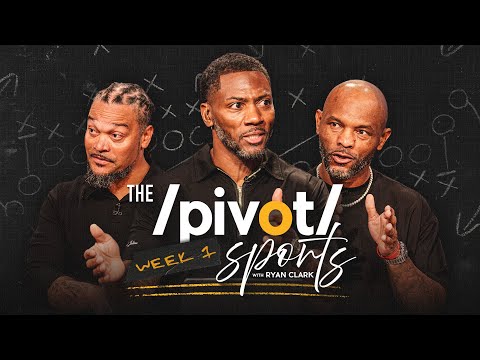
Baltimore’s late-game execution against Dallas gives Ryan Clark and the crew exactly the sort of sequence that makes their football analysis valuable. Rather than simply praising Lamar Jackson for finding Zay Flowers before the winning field goal, Clark breaks down Dallas’ coverage, the middle robber’s positioning and how Flowers found space behind the defense. The accompanying discussion of Baltimore recommitting to Derrick Henry, Jackson and the running game also connects the decisive drive to a broader offensive adjustment after the previous week’s loss.
That film-room approach produces several of the show’s best moments. Nate Wiggins’ coverage of George Pickens is examined through leverage, personnel and Dak Prescott’s responsibility to put the ball safely out of bounds when the matchup was not favorable. Later, Justin Herbert’s interception is contrasted with Josh Allen taking an available underneath option, turning a general argument about quarterback decision-making into something viewers can actually see developing on the field. The disagreement over the late Rams-Broncos pass-interference call is similarly specific, with the hosts explaining why they believe Josh Wallace was entitled to play the football rather than merely complaining about officiating.
The conversational chemistry keeps a very long show energetic. Channing Crowder’s exaggerations, Fred Taylor’s running-back perspective and Clark’s willingness to physically demonstrate coverage concepts create a loose atmosphere without completely sacrificing substance. The Cincinnati-Pittsburgh discussion is especially entertaining, as Darnell Washington’s tackle-breaking becomes both a comedy routine and a legitimate examination of Cincinnati’s poor tackling. That balance does occasionally tip too far toward extended jokes, however, and several bits linger after their football point has already been made.
Breadth is both an asset and the biggest structural problem. Buffalo-Chargers, Raiders-Saints, Bengals-Steelers, Rams-Broncos, Jacksonville, Indianapolis, San Francisco, Minnesota and the upcoming Bears-Eagles matchup all receive attention, while interviews with Parker Washington and Daniel Jones add firsthand player perspectives. Yet the sheer number of segments makes the program feel more like an entire football block than a tightly constructed Week 3 breakdown. Sponsor transitions, recurring comedy and promotional interludes further interrupt the momentum, particularly when a strong tactical segment is followed by material only loosely connected to it.
The interviews provide useful changes of perspective. Washington gives a concrete explanation of expanding his route responsibilities and developing chemistry with Trevor Lawrence, while also discussing Travis Hunter’s mentality as a two-way player. Jones is measured about his return from injury, Indianapolis’ urgency after an 0-2 start and the importance of Jonathan Taylor to the offense. These conversations work because the players are allowed to discuss preparation and responsibilities rather than being pushed solely toward headline-friendly declarations.
Some of the broader conclusions are much less rigorous than the play breakdowns. Joe Burrow’s reported 1-34 record when trailing during the final eight minutes is openly treated with surprise and even qualified with “if” language, yet it immediately becomes the basis for questioning whether he can be considered elite without the statistic being established or contextualized. Similar certainty appears when the panel declares San Francisco the NFC West’s best team and discusses Brock Purdy as leading the MVP conversation after only three games. The JJ McCarthy trade discussion is also largely speculative about what the Giants’ decision signifies for Jackson Dart, Jameis Winston and the organization’s immediate ambitions.
The Bears-Eagles preview brings the show back toward its strongest mode. The panel connects Chicago’s likely approach without Caleb Williams to the running game, then uses specific Jalen Hurts throws, receiver motion and Chicago pressure packages to explain where the matchup could turn. The hosts ultimately agree on Philadelphia, but their reasoning contains enough discussion of Chicago’s rushing opportunity and Philadelphia’s uneven start to avoid presenting the matchup as automatic. Across the full program, that combination of former-player insight, energetic debate and detailed visual explanation is consistently worthwhile; it simply needs tighter editing and more restraint when moving from observable football to sweeping conclusions.
Pros
- Clark’s coverage, leverage and personnel breakdowns make several decisive plays substantially easier to understand.
- The Herbert-Allen comparison uses specific fourth-quarter decisions to illustrate the difference between forcing a throw and accepting an underneath option.
- Parker Washington and Daniel Jones provide useful firsthand perspectives on preparation, player development and offensive responsibilities.
- Crowder, Taylor and Clark have lively chemistry that keeps an unusually long program entertaining.
- The Bears-Eagles preview examines both offensive and defensive concepts rather than relying entirely on predictions and narratives.
Cons
- The enormous number of games, interviews, comedy bits and sponsor transitions makes the show feel overstuffed and frequently disrupts its analytical momentum.
- Several jokes continue well beyond the football point they were originally illustrating.
- The discussion of Joe Burrow’s reported late-game record draws a major conclusion from a statistic the hosts themselves express uncertainty about and do not contextualize.
- Early-season judgments about teams, quarterbacks and award conversations are sometimes stated with more confidence than three weeks of results can support.
- The JJ McCarthy discussion moves quickly from the reported trade to speculation about the Giants’ motives and quarterback plans without evidence establishing those interpretations.
Pivot Sports is at its best when Ryan Clark slows down a decisive snap and the panel combines tactical detail with the perspective of former NFL players. Week 3 supplies plenty of material for that formula, but the sharp analysis is stretched across an excessively crowded production where speculation, extended comedy and constant transitions dilute the strongest football discussion.