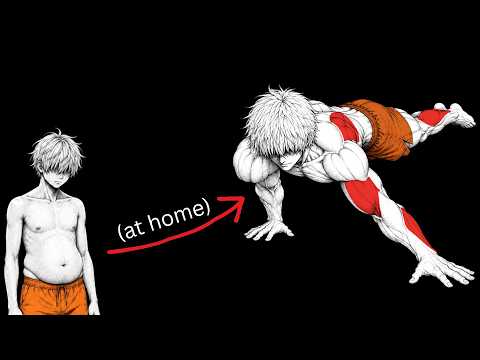
Stronger tendons could make everyday activities such as climbing stairs, carrying groceries, pushing furniture, and walking long distances feel easier. Fit Zip builds its fitness presentation around this idea, arguing that conventional strength training often emphasizes visible muscles while overlooking the connective tissues responsible for transmitting force. Through six exercises targeting different areas of the body, the presentation offers an accessible approach to developing strength, stability, and physical resilience without requiring elaborate equipment.
The introduction uses the remarkable story of Russian strongman Alexander Zass to establish the importance of tendon strength. His reported feats of bending iron bars, carrying a horse, and developing strength through resistance against chains provide an entertaining historical foundation. Importantly, the narrator acknowledges that parts of Zass's imprisonment and escape story may have become exaggerated over time. This qualification adds credibility, although the historical anecdotes remain illustrative rather than scientific evidence supporting the specific training recommendations.
The Spanish squat and Copenhagen plank introduce the practical exercises through an emphasis on knee stability and inner-thigh strength. The Spanish squat demonstration explains how a strap positioned behind the knees allows a supported squat while maintaining relatively vertical shins. The narrator connects this exercise to research reporting substantial improvements in tendon stiffness and force production among older adults undergoing leg training. The Copenhagen plank receives similarly compelling support through a study involving more than 600 soccer players, with the narrator reporting a 41% reduction in groin problems among participating teams. However, the presentation does not establish that these precise improvements would result from the prescribed static holds, particularly since the soccer study used repetitions rather than sustained positions.
Upper-body training receives attention through the isometric push-up hold and the 90-degree biceps curl hold. Both exercises are explained in straightforward terms, with the narrator emphasizing sustained tension rather than rapid repetitions or heavy lifting. The discussion of joint-angle-specific strength adaptations is particularly useful because it acknowledges that isometric training tends to produce its greatest improvements near the position being trained. Connecting these movements to getting off the floor, moving furniture, and carrying household objects makes the recommendations approachable, although the suggestion that conventional push-ups largely neglect tendon development oversimplifies how tendons respond to resistance exercise.
The dead hang and single-leg eccentric calf raise complete the routine by addressing overhead strength, grip endurance, and the Achilles tendon. The dead hang section explains the relationship between grip strength and general physical health, citing a large international study associating weaker grip strength with increased mortality risk. That association is interesting, but it does not demonstrate that improving grip through hanging directly reduces mortality. The Achilles section offers one of the clearest functional explanations, describing how the tendon stores and releases energy during walking. Slow heel lowering is presented as a practical method for loading this tissue, with clear instructions for controlling movement and adjusting the exercise when necessary.
Accessibility is a consistent strength throughout the presentation. Wall sits substitute for Spanish squats, seated pillow squeezes provide an easier inner-thigh exercise, countertop push-up holds reduce upper-body loading, and supported hangs accommodate people unable to suspend their full body weight. Suggested durations, repetitions, and positioning cues make the routine easy to understand and potentially convenient to incorporate into an existing fitness program. The narrator also advises people with previous shoulder injuries, Achilles problems, or sharp heel pain to seek appropriate professional guidance. Nevertheless, several recommendations are delivered with considerable certainty despite the absence of individualized progression plans, clear intensity targets, or detailed distinctions between strengthening healthy tendons and rehabilitating injured ones.
The presentation's greatest weakness is its tendency to turn plausible physiological principles into sweeping promises about everyday performance. Stronger tendons can contribute to efficient movement, but statements implying that particular holds will make heavy objects noticeably lighter, prevent injuries during slips, or restore springiness to walking are more confident than the evidence presented establishes. Tendons, muscles, coordination, and joint function work together, making it difficult to attribute improvements to tendon adaptations alone. Repeated promotions for the Reset Your Body Blueprint and a fitness newsletter also interrupt the educational flow, while broad claims about aging and neglected stabilizer muscles serve the promotional message more effectively than they explain the underlying science.
Pros
- Presents six accessible exercises targeting the knees, inner thighs, upper body, shoulders, grip, and Achilles tendons, creating a practical whole-body training overview.
- Explains tendon functions through understandable examples involving force transmission, joint stability, and energy storage during movement.
- Incorporates relevant research findings, including studies involving older adults, soccer players, isometric strength development, and grip strength.
- Provides specific exercise instructions, suggested hold durations, repetition ranges, and useful modifications for different ability levels.
- Connects strength training to recognizable daily activities, making the recommendations relevant beyond athletic performance or muscle development.
- Includes meaningful safety considerations for previous shoulder injuries, Achilles problems, and painful movements.
- Uses the Alexander Zass story to introduce the subject while acknowledging uncertainty surrounding some historical claims.
Cons
- Sometimes treats findings from broader strength-training research as support for specific exercises without demonstrating that the prescribed routines produce equivalent results.
- Overstates the relationship between tendon training and improvements in injury prevention, walking endurance, lifting ability, and everyday physical resilience.
- The grip-strength mortality study establishes an association rather than proving that dead hangs improve longevity.
- The emphasis on tendon adaptations occasionally overlooks the simultaneous contributions of muscles, coordination, and other structures to physical performance.
- Exercise prescriptions lack detailed guidance on progressive loading, individual intensity, and expected adaptation timelines.
- Repeated promotions for the paid training program interrupt the educational material and introduce broad claims about aging without adequate support.
Fit Zip delivers an informative and approachable introduction to tendon-focused strength training, combining practical exercises with understandable explanations of how connective tissues contribute to movement. Its strongest qualities are the accessible modifications, everyday applications, and generally clear instruction, although the scientific evidence does not always justify the confidence of its promises. The result is a useful starting point for exploring isometric and eccentric exercises, provided viewers recognize that comprehensive strength and injury prevention involve considerably more than tendon training alone.