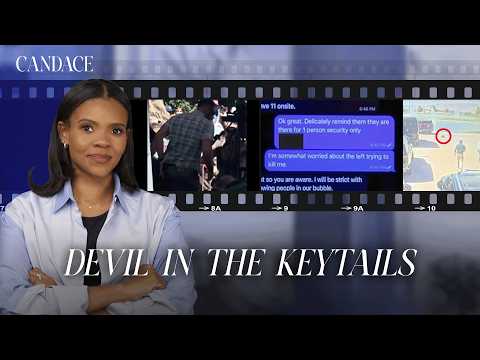
Four months of Vanity Fair access to Erika Kirk gives Candace Owens an unusually substantial piece of outside reporting to dissect, and she wastes little time turning its details into ammunition in her continuing conflict with Turning Point USA. Her strongest material comes directly from the profile: Kirk’s reluctance to articulate political positions, descriptions of her religious focus, details surrounding her rapid elevation to leadership and observations from the reporter about the difficulty of getting clear political answers. Owens is energetic and often genuinely funny while working through these passages, particularly when contrasting the expectations placed on the head of a political organization with Kirk’s repeated emphasis on faith, family and grief.
The central criticism is straightforward and worth examining on its own terms: Owens argues that someone leading Turning Point USA should be capable of discussing major political questions even while navigating extraordinary personal circumstances. Kirk’s quoted comments about not having the “bandwidth” to engage deeply with Israel and Benjamin Netanyahu give Owens something concrete to challenge, while the reporter’s own description of Kirk as reluctant to discuss politics reinforces the issue independently within the material presented. Owens, however, repeatedly pushes beyond that defensible criticism into personal judgments about Kirk’s intelligence, ambition, clothing, grief and motivations. Those conclusions are substantially more speculative than the underlying observations and frequently overwhelm what could have been a focused discussion about leadership and political competence.
That problem becomes particularly pronounced when Owens analyzes Kirk’s behavior following Charlie Kirk’s death. Clothing purchases, office arrangements, a glittering suit and the timing of professional decisions are treated as evidence that something about Kirk’s conduct is abnormal or dishonest. Owens is entitled to find these details strange, and she sometimes identifies apparent inconsistencies worth questioning, but her argument relies heavily on assumptions about how a grieving widow should behave. Her comparison with another woman responding to her husband’s medical emergency does not establish a meaningful standard for grief, and statements that Kirk should have been catatonic or unconcerned with clothing turn subjective expectations into purported evidence.
The episode is considerably stronger when it stays with documented statements and identifiable contradictions. Owens highlights the article’s acknowledgement that Turning Point searched for internal sources leaking information to her, Tucker Carlson’s reported comments about the organization’s focus on Owens, the confirmation that Charlie and Erika Kirk had been working on their will, and the board’s vote shortly after Charlie’s death. These details help explain why Owens regards the Vanity Fair piece as vindication of some earlier claims. Yet confirmation of individual details does not automatically establish the larger theories she attaches to them, including allegations about internal motives, security failures, marital issues or coordinated efforts against her. Owens sometimes says “allegedly” or identifies information as coming from sources, but the broader presentation repeatedly encourages connections that the material shown does not itself prove.
The second half demonstrates that weakness even more clearly. Owens responds to lurid allegations about her sexuality, supposed online profiles, her husband’s study of ancient Hebrew and other purported discoveries with humor and specific counterpoints, including contextualizing an old college journalism project. Challenging questionable allegations by asking for verifiable evidence is one of the episode’s more reasonable instincts. But she then builds her own ominous narrative around archive dates, Netanyahu’s presence in Washington, Charlie Kirk’s activities and Bill Ackman’s social-media behavior. Temporal proximity is presented as increasingly unlikely to be coincidence without evidence establishing that the people or events are actually connected, making the argument substantially less persuasive than her simpler rebuttal that extraordinary accusations require demonstrable proof.
Presentation is simultaneously the show’s greatest asset and one of its largest liabilities. Owens can make an extremely long monologue feel conversational through impressions, pop-culture references, sarcastic reenactments and rapid shifts between quotations and commentary. Her Mean Girls comparisons and delight at some of Vanity Fair’s descriptions keep an otherwise dense media-analysis segment moving. The cost is discipline: lengthy advertisements, audience comments, repeated declarations of vindication, personal insults and extended speculation turn potentially strong points into sprawling arguments. By the closing stretch, phrases about timelines becoming “scary,” government involvement, coordinated attacks and what people supposedly think happened to Charlie are escalating faster than the evidence presented.
Most importantly, the episode needs a much firmer boundary between what is documented, what other people have claimed and what Owens personally infers. The Vanity Fair material provides legitimate subjects for scrutiny, particularly the questions surrounding political leadership and Turning Point’s internal response to Owens. Other assertions—including alleged government coordination, motives behind archived webpages, private marital information and implications surrounding Charlie Kirk’s death—remain claims or interpretations within the program rather than established conclusions. Owens repeatedly encourages viewers to fact-check, which is welcome, but the episode itself would be substantially more credible if it applied that same evidentiary restraint before connecting disparate events.
Pros
- Extensive use of passages from the Vanity Fair profile gives much of the opening discussion a concrete source to analyze.
- Kirk’s reluctance to discuss political questions creates a legitimate leadership issue for Owens to examine given the organization she leads.
- The profile’s descriptions of Turning Point’s internal leak concerns and rapid leadership transition provide substantive material beyond personal commentary.
- Owens is an energetic storyteller whose humor, impressions and cultural references keep a very long discussion lively.
- Her response to sensational allegations against her correctly emphasizes the importance of examining whether supporting evidence is actually available.
Cons
- Personal attacks on Erika Kirk’s intelligence, appearance, ambition and grieving behavior repeatedly substitute speculation for evidence.
- Ordinary or ambiguous details such as clothing choices and office arrangements are frequently assigned sinister or deceptive significance without establishing those conclusions.
- Archive dates, Netanyahu’s movements, Bill Ackman’s posts and events involving Charlie Kirk are connected through timing rather than demonstrated causal evidence.
- Serious allegations involving Turning Point USA, government actors, private marital matters and Charlie Kirk’s death are mixed too freely with documented material and commentary.
- Repetition, lengthy advertisements, audience comments and extended tangents make the episode substantially less focused than its strongest source-based analysis deserves.
A revealing outside profile gives Owens some of her best material for questioning Turning Point’s leadership, but the episode repeatedly weakens those points by escalating uncertainty into suspicion and suspicion into sweeping narratives. The humor and detailed quotation make the media critique entertaining, while the increasingly speculative second half demonstrates why documented contradictions and unproven connections need much clearer separation.