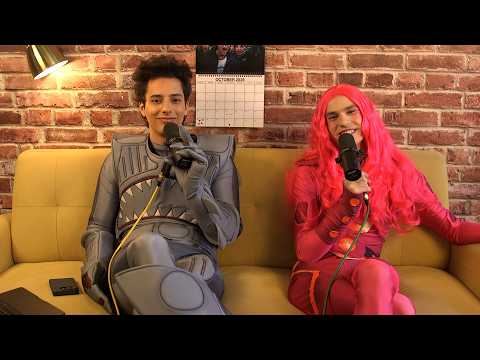
A single-frame censorship mistake involving Captain sets the tone for Tom and Don’s commentary: technically obsessive filmmaking discussed with the same crude humor that defines Space King itself. Their walkthrough of the fifth installment moves freely between tiny animation decisions, abandoned jokes, production headaches and broader storytelling intentions, creating an unusually candid picture of how much deliberate work sits underneath something designed to look gleefully ridiculous.
The most revealing material concerns the episode’s construction. Tom and Don explain that the opening once ran roughly eight minutes before the characters properly reached War World, forcing them to cut exposition from an increasingly dense fictional universe. They also describe the narrative purpose behind Captain refusing to share relics, the decision to interrupt the extended action with a quieter character sequence, and the need to establish Grimbor as a sufficiently dangerous opponent before the squad finally works together. These observations make the commentary more than a collection of trivia because they show how pacing, character development and spectacle were repeatedly adjusted to serve the finished story.
There is equally strong insight into the visual production. The creators discuss a color script used to keep locations visually distinct, explain why the Space Hogs and orange smoke ended up with their particular palette, and repeatedly credit background artists, animatic artists, riggers, effects specialists and other collaborators for details they themselves did not originate. Particularly interesting are examples where seemingly effortless moments required highly specific work: the timing of a visual gag involving the suspended globules, perspective changes during Chestnut’s encounter, the movement of the globules aboard the vehicle, and the elaborate rigging necessary before animators could manipulate characters convincingly. Their enthusiasm can become repetitive, but it convincingly communicates how collaborative the production is.
The War World chase provides the clearest window into the project’s ambition and risk. Tom and Don openly identify Mad Max: Fury Road and Small Soldiers as major inspirations while discussing the challenge of creating enemies, vehicles, weapons and escalating character classes that still belonged to their own universe. They say the installment became substantially denser and more expensive than their previous work and acknowledge that its commercial performance mattered because of how heavily they had invested in it. That combination of artistic ambition and practical production anxiety gives the behind-the-scenes discussion genuine stakes beyond celebrating the finished animation.
Some of the best material comes from unexpectedly mundane solutions to elaborate audiovisual problems. A sound effect for colliding globules partly emerged from someone physically slapping his hands together, while a creature sequence involved a practical costume with the performer’s face positioned in its neck and another person remotely operating the tongue. The commentary also explains how animation reference, compositing, camera movement, smoke effects and sound design contributed to the perceived weight of the action. These details are specific enough to be genuinely informative for viewers interested in animation rather than merely promotional anecdotes.
The discussion becomes more thoughtful when the creators examine the tension between comedy and sincerity. They describe Space King as increasingly built around childlike lessons despite characters who occupy an intentionally strange space between childhood and adulthood, and they explain why Hate Monger’s prayer felt creatively riskier than another joke: earnest material cannot retreat behind comedy if audiences reject it. Their discussion of friendship works similarly, presenting the squad’s cruelty toward one another alongside the underlying affection they want the characters to retain. Not every thematic explanation is equally polished, but hearing the creators articulate what they were attempting gives several chaotic scenes additional narrative context.
The presentation is considerably less disciplined when promotion takes over. Repeated plugs for the board game, Kickstarter and Patreon become running jokes, but repetition does not stop them from interrupting discussions that are otherwise packed with worthwhile production information. The commentary also spends considerable time admiring individual shots, designs and jokes with variations of the same enthusiastic reaction. That excitement feels genuine and suits the informal format, yet tighter editing could have preserved the personality while making the production insights easier to absorb.
A particularly personal section concerns composer Lead Geo, whose medical situation Tom and Don say they received permission to discuss. They recount his brain-tumor diagnosis, surgery and resulting hearing impairment while emphasizing their admiration for his attitude and musical contributions. Because this is a sensitive medical account presented secondhand, it should be understood as the creators’ description rather than independently established medical information. Within the commentary, however, it functions primarily as heartfelt recognition of a collaborator, fitting a broader pattern in which Tom and Don repeatedly redirect credit toward the large team responsible for bringing their ambitious ideas to the screen.
Pros
- Provides unusually specific production insight into scripting, storyboarding, animation rigging, color scripting, effects, sound design, practical creature work and last-minute revisions.
- Explains the storytelling logic behind Captain’s arc, the quieter midpoint, Grimbor’s expanded battle and the squad finally functioning together rather than merely pointing out visual details.
- Openly identifies major influences such as Mad Max: Fury Road and Small Soldiers while discussing the challenge of turning those inspirations into a coherent original setting.
- Consistently credits animators, artists, riggers, musicians, sound designers and production collaborators, revealing how extensively the finished episode depended on contributions beyond its creators.
- The creators’ willingness to discuss discarded ideas, mistakes, budget pressure and creative disagreements makes the commentary feel candid rather than purely celebratory.
Cons
- Repeated board-game, Kickstarter and Patreon promotions substantially interrupt the behind-the-scenes discussion even when some of the repetition is intentionally comedic.
- Extended stretches of enthusiastic self-congratulation and repeated admiration for individual shots could have been condensed without losing meaningful production information.
- The highly conversational structure frequently jumps between lore, jokes, technical explanations and promotion, making the strongest filmmaking insights less organized than they could be.
- The account of Lead Geo’s serious medical experience is inherently sensitive and remains a personal secondhand account rather than something the presentation independently substantiates.
Tom and Don turn an irreverent watch-along into a surprisingly detailed account of the creative compromises, technical labor and collaborative problem-solving behind an unusually ambitious installment. The constant promotional interruptions and loose structure keep it from becoming a truly polished making-of feature, but its specificity, candor and obvious investment in the production make it rewarding for viewers interested in how Space King is actually assembled.