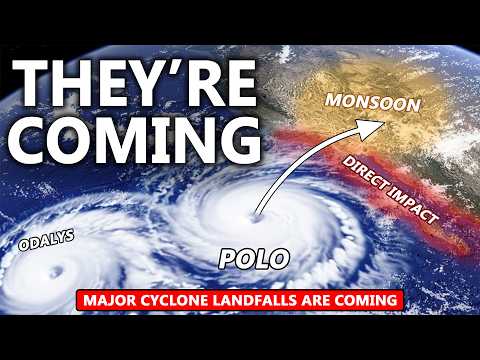
Three powerful Pacific cyclones provide an unusually active backdrop for an ambitious attempt to connect hurricanes, earthquakes, solar wind, atmospheric electricity, and California’s fault systems. The presentation moves quickly through storm tracks, sea-surface temperatures, jet-stream patterns, earthquake locations, and solar observations, giving viewers a broad tour of several dynamic systems at once. That breadth creates genuine interest, particularly when the discussion stays focused on observable storm behavior and the uncertainty surrounding future tracks.
The hurricane coverage is strongest when it explains the immediate situation. Polo’s repeated changes in intensity, Odalis strengthening beyond the forecast described by the presenter, the approaching interaction range between the two systems, and Nolo’s potential effects on Hawaii are all presented with useful geographical context. The explanation of the Fujiwhara effect is especially accessible, showing why two nearby cyclones could influence one another’s movement rather than behaving as completely independent storms. Importantly, the presenter does acknowledge uncertainty when considering whether Polo might shift farther north than forecast.
Much of the episode, however, depends on a much more speculative argument: that solar-wind activity may be helping drive hurricane intensification and significant earthquakes. The presenter repeatedly points to temporal correlations, such as a magnitude 6.6 earthquake occurring after an increase in solar-wind velocity and Odalis strengthening while the high-speed stream was intensifying. Those observations can motivate a hypothesis, but timing alone does not establish that one event caused the other. Statements that these correlations show the analysis is “onto something” therefore carry considerably more confidence than the evidence demonstrated here can support.
That problem becomes more pronounced as additional phenomena are folded into the same framework. The equinox, auroras, the full moon, ionospheric electrical conditions, a solar eruption, thunderstorms, lightning, earthquakes, and cyclone behavior are presented as components of an interconnected energetic state. Some individual physical processes are explained in considerable detail, but the crucial causal steps linking them are not demonstrated with comparable rigor. References to research papers and recurring correlations would be more persuasive if specific studies, methods, effect sizes, competing explanations, and limitations were examined rather than primarily invoking coincident timing.
The California earthquake discussion stretches the argument further. Long-term fault strain, historical ruptures, piezoelectric effects, cyclone electrical charge, traffic-generated seismic noise, coastal erosion, atmospheric mass changes, and storm-related energy are accumulated into a case that the current conditions could increase earthquake risk. Yet the presentation does not establish how large these proposed contributions are relative to the tectonic forces already acting on major faults. The anecdote about a green flash reportedly witnessed after an earthquake is interesting, but personal recollection cannot by itself establish that earthquake-generated electrical activity occurred or support the broader risk argument.
There is also a recurring tension between appropriate caution and dramatic prediction. The presenter says a major California earthquake is not necessarily imminent, assigns only a very small speculative probability to a direct Southern California hurricane impact, and repeatedly admits that the exact outcome is unknown. At other moments, however, phrases such as “locked and loaded,” expectations of surprise events, and suggestions that another large earthquake could arrive soon give uncertain possibilities considerably more weight. The closing community messages and concern for people potentially affected by severe weather add a sincere human element, but the lengthy supporter acknowledgments, prayer, and speculative quantum discussion make an already sprawling presentation less focused.
Pros
- The Pacific cyclone situation is explained with useful geographical, atmospheric, and storm-track context.
- The Fujiwhara effect is presented in an accessible way that helps viewers understand why nearby cyclones may influence one another.
- Maps, solar-wind measurements, earthquake information, and storm-position data give viewers concrete material to follow rather than relying entirely on narration.
- The presenter frequently acknowledges uncertainty about future hurricane tracks and the timing of possible geological events.
Cons
- Temporal correlations between solar activity, cyclone intensification, and earthquakes are repeatedly treated as stronger evidence of causation than the presentation establishes.
- The earthquake-risk argument combines many proposed influences without quantifying whether they are significant relative to ordinary tectonic forces.
- References to scientific research remain too general to substantiate several of the episode’s most consequential claims.
- Dramatic language about California faults and possible upcoming earthquakes can overshadow the presenter’s more cautious qualifications.
- The discussion becomes increasingly diffuse as hurricanes, solar activity, the full moon, atmospheric electricity, traffic, quantum technology, and seismic activity are brought into the same explanatory framework.
Detailed maps and energetic explanations make the unfolding Pacific weather situation engaging, particularly when the focus remains on cyclone behavior and forecast uncertainty. The much broader attempt to connect space weather with hurricane intensification and earthquake risk is considerably less convincing because correlations and possible mechanisms are often presented without enough evidence to establish their real-world significance. The result is compelling as speculative geophysical commentary but substantially weaker as a demonstrated explanation of why these events are occurring.