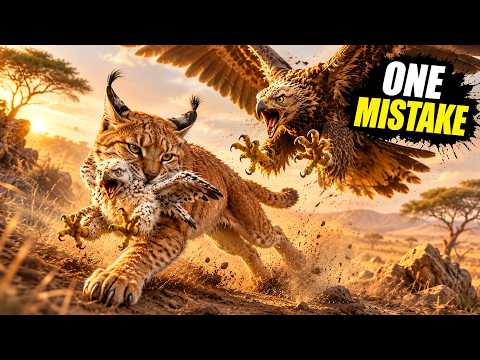
A caracal mother defending both her cub and a fresh kill gives the opening sequence an immediate survival conflict, with the animal forced to divide its attention between protecting food and keeping its youngster out of danger. The arrival of a honey badger escalates that situation into a close struggle before the cub itself becomes vulnerable, leading to a chase toward rocky terrain. The sequence is constructed effectively around changing advantages—strength on the ground, speed in pursuit and finally the cub's ability to use the cliff as an escape route.
Rather than remaining with that encounter, the presentation expands into a succession of interconnected predator-and-prey stories. A particularly elaborate section follows a honey badger family after baboons reach youngsters left near a den while their mother is away feeding. One youngster finds protection in a crevice while another is carried into the trees, forcing the returning mother into a confrontation with the troop. The shifting circumstances—a fall, the appearance of another predator and the mother's eventual recovery of the youngster—give the sequence considerable momentum, although the narration sometimes describes intentions and tactical choices with more certainty than the images alone can necessarily establish.
The account of three cubs losing their mother is considerably darker. Their mother's confrontation with a hunting bird ends with the predator carrying away food for its own family, leaving the inexperienced youngsters to attempt survival without her. Their awkward efforts to hunt and defend a meal make an effective contrast with the earlier depiction of experienced adults, and the presentation is strongest when it allows those practical differences in size, coordination, terrain and experience to drive the drama.
That same structure also produces one of the film's weaknesses: danger arrives with extraordinary regularity. Predators repeatedly appear at precisely the moment another confrontation creates an opening, meals change possession, and one escape leads almost immediately into another threat. These events may make for compelling wildlife storytelling, but the presentation provides no information about when, where or how the footage was recorded, nor does it explain whether the encounters occurred together as depicted. Without that context, viewers have little basis for judging how literally to interpret the continuous narrative.
The final major sequence brings a leopard, monkeys and a honey badger into another chain of competing survival pressures. A failed or disrupted leopard hunt eventually places both mothers around the same potential food source, culminating in a fight that the narration says the honey badger cannot escape. The leopard ultimately returns with food for her cubs while the badger's youngsters remain waiting. It is an effective narrative reversal because an animal presented earlier as an exceptionally persistent aggressor becomes the casualty when it encounters a more powerful opponent.
Presentation is energetic throughout, but the narration frequently pushes beyond straightforward observation into dramatic interpretation. Statements about what animals "need," what they recognize as an opportunity and why particular movements occur are delivered confidently rather than framed as interpretations. The concluding claim that nature neither favors the strong nor protects the weak works as a thematic summary, but it simplifies a collection of complicated animal interactions into a familiar survival maxim. Numerous garbled or awkwardly constructed lines also make portions of the narration surprisingly difficult to follow, occasionally obscuring exactly which animal or action is being described.
Pros
- Builds several tense encounters around concrete survival pressures involving food, offspring, terrain and competing predators.
- Effectively shows how physical advantages can change as animals move between open ground, trees, crevices and rocky slopes.
- The inexperienced cubs provide a meaningful contrast with the more capable adult hunters and defenders.
- Connects successful predation with the survival of another animal's offspring rather than presenting each kill solely as spectacle.
Cons
- Provides little contextual information about the footage, making it difficult to determine how closely the continuous story reflects the circumstances in which the encounters occurred.
- Narration frequently assigns motives, strategies and understanding to animals with more certainty than the presentation substantiates.
- The relentless succession of perfectly timed threats can make the wildlife encounters feel overly shaped into a dramatic narrative.
- Garbled sentences and awkward wording repeatedly interfere with clarity.
The strongest material comes from watching survival advantages shift with terrain, size, experience and circumstance, particularly when mothers are balancing their own safety against the needs of their young. The encounters are often gripping, but stronger contextual grounding and more cautious, polished narration would make the wildlife storytelling considerably more convincing.