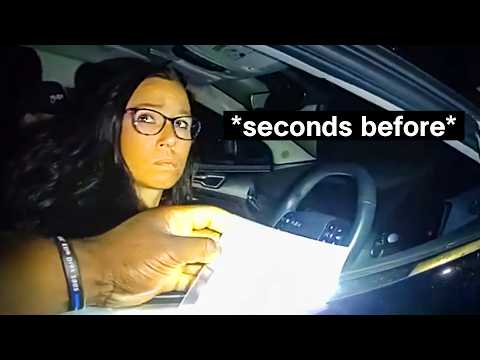
A routine drive home after dropping his children off at school turned into a frightening confrontation for Kevin Finley when a Winter Springs, Florida, police officer approached his garage with a gun drawn. Officer Eric Schwartz accused Finley of fleeing an attempted traffic stop, insisting that he had witnessed reckless driving and pursued the Tesla with his emergency lights and sirens activated. Finley maintained that he had never seen the officer attempting to stop him. Civil rights attorney John Bryan examines how footage recorded by Finley's Tesla challenged the officer's account and became central to a criminal case that took approximately two years to resolve.
The presentation establishes the confrontation through police body camera footage, Finley's firsthand account, and detailed explanations of the events leading up to his arrest-like detention. Finley describes waiting behind another vehicle at an intersection where a newly installed traffic signal was not yet operational. After the vehicle failed to turn despite several apparent opportunities, he drove around it and continued toward his neighborhood. Schwartz interpreted the maneuver as reckless driving and claimed Finley accelerated away from an attempted traffic stop. The competing accounts create a compelling investigative foundation, particularly because the available recordings allow viewers to consider the officer's observations alongside the driver's explanation rather than relying entirely on either person's recollection.
The police interactions provide some of the most revealing material. Body camera recordings capture Schwartz repeatedly insisting that Finley must have seen his emergency lights, while Finley consistently denies knowing that an officer was following him. Other officers explain the confrontation from a law enforcement safety perspective, emphasizing that an officer who believes a driver is fleeing cannot know the driver's intentions. Their explanations introduce a potentially relevant distinction between what Schwartz believed was happening and what Finley actually perceived. However, Schwartz's dismissive language, repeated threats of jail, and discussions about which charges to issue raise legitimate questions about whether the situation was handled proportionately. Bryan makes effective use of these exchanges, although his interpretation increasingly treats disputed motivations as established facts.
Finley's preservation of his Tesla footage becomes the investigation's decisive development. Immediately after being released, he retrieved the recording device to prevent potentially important video from being overwritten. According to the footage and the account presented, Schwartz had to turn his patrol vehicle around after observing Finley's maneuver, leaving considerable distance between the two vehicles. Bryan argues that this undermines the officer's claims about maintaining a visible pursuit and witnessing the Tesla fishtail. The evidence provides a substantial basis for questioning the original allegations, but it is important to distinguish what the cameras establish from conclusions about Schwartz's intentions. A recording that contradicts an officer's recollection does not, by itself, prove that every inaccurate statement was a deliberate lie.
The courtroom developments give the investigation additional weight. Finley explains that prosecutors had access to his recordings before trial, yet continued pursuing the criminal reckless driving charge. He describes rejecting plea agreements, testifying in his own defense, and presenting the footage to the jury before the judge granted a judgment of acquittal. The criminal charge was resolved in his favor, and the failure-to-yield allegation was dismissed, although he still paid a $300 fine for improper passing. Including that remaining violation is important because it prevents the outcome from being misrepresented as a complete dismissal of every traffic allegation. The discussion also raises interesting questions about custodial questioning and Miranda warnings, though it does not provide enough legal detail to independently assess every procedural conclusion.
Bryan's broader examination of police accountability is persuasive when grounded in the documented events. Finley's account of experiencing anxiety around police vehicles afterward gives the confrontation a human dimension beyond the legal proceedings. The discussion of the drawn firearm, the department's response, and Finley's unanswered citizen complaint also highlights the difference between obtaining an acquittal and securing institutional accountability. Bryan appropriately clarifies that Finley had not filed a civil lawsuit despite a police chief referencing pending litigation. Nevertheless, his repeated assertions that Schwartz knowingly lied, prosecutors intentionally pursued an innocent person, and the justice system routinely rewards fabricated accusations go further than the evidence presented conclusively establishes. The suggestion that Finley would likely have become a convicted felon without the recording is similarly speculative, particularly because the felony fleeing allegation was never pursued as the final criminal charge.
The production benefits from extensive firsthand material and a clear investigative progression, moving from the initial confrontation through the preservation of evidence, prosecution, and eventual acquittal. Finley's interview is particularly valuable because his willingness to acknowledge that he may have driven impatiently adds credibility to his more serious objections. However, the lengthy police exchanges occasionally become repetitive, and the Rocket Money sponsorship interrupts the opening momentum at an awkward moment. The concluding commentary also grows increasingly confrontational, replacing some of the careful evidence-based analysis with sweeping distrust of police officers and government institutions. A more measured examination of the department's possible justification for the initial response, together with a clearer distinction between legal findings and Bryan's personal interpretations, would have strengthened the presentation considerably.
Pros
- The opening confrontation immediately establishes the seriousness of the allegations and the potential consequences for Kevin Finley.
- Extensive police body camera recordings allow viewers to examine the officers' statements, actions, and discussions surrounding the decision to issue charges.
- Finley's detailed firsthand account provides valuable context about the intersection, the driving maneuver, and his confusion during the confrontation.
- Tesla camera footage offers unusually direct evidence for evaluating the officer's account of the alleged pursuit and reckless driving.
- The examination of the two-year prosecution, rejected plea agreements, courtroom proceedings, and judgment of acquittal gives the investigation substantial legal and procedural depth.
- Acknowledging the remaining improper-passing fine preserves an important distinction between the criminal acquittal and the separate traffic violations.
- The discussion of Finley's emotional response and unanswered complaint broadens the investigation beyond the immediate courtroom outcome.
- The practical recommendation to preserve dash camera recordings provides viewers with a useful lesson about documenting disputed incidents.
Cons
- Bryan repeatedly characterizes the officer's disputed statements as deliberate lies without conclusively establishing intentional deception.
- Assertions about prosecutors' motivations and institutional retaliation rely heavily on interpretation rather than direct evidence of intent.
- The suggestion that Finley would probably have become a convicted felon without the Tesla footage overstates what can be established about a hypothetical outcome.
- Broad generalizations about police officers and government institutions undermine the otherwise detailed, case-specific investigation.
- The legal discussion could more carefully distinguish potentially unreasonable police conduct from conduct conclusively established as unlawful.
- Several extended body camera conversations repeat similar arguments, slowing the narrative without consistently adding new information.
- The early sponsorship interrupts a tense opening, while the increasingly combative closing commentary weakens the presentation's analytical balance.
John Bryan delivers a detailed and often troubling examination of how disputed police observations developed into a prolonged criminal prosecution, with Kevin Finley's camera recordings providing the investigation's strongest evidence. The firsthand testimony, body camera exchanges, and courtroom outcome make this a compelling example of the importance of independently recorded evidence. Although the presentation sometimes stretches beyond its documented findings through accusations of deliberate misconduct and sweeping institutional criticism, its central investigation remains informative, engaging, and worthwhile.