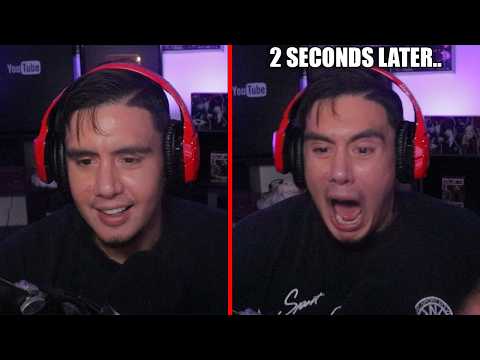
The actual social-deduction game is almost secondary to the challenge of keeping this group focused long enough to play it. One Night Ultimate Werewolf provides the structure—hidden roles, nighttime card manipulation, accusations and a final vote—but nearly every attempt at deduction becomes an opportunity for an impression, movie reference, musical joke or increasingly absurd tangent. That makes the episode considerably less useful as a showcase for clever Werewolf strategy than it is as a vehicle for the Chosen personas, and the cast largely understands that distinction.
The first round establishes the balance particularly well. The rules are explained clearly enough to follow the Seer, Robber, Troublemaker, Insomniac, villagers, werewolves and Tanner without spending too much time on instruction, while the possibility of both werewolves being among the center cards gives the discussion some genuine uncertainty. Spencer's refusal to claim a role ultimately works because everyone else becomes preoccupied with constructing a logical chain around him. His later explanation—that seeing the Tanner in the center gave him another identity he could potentially exploit—provides one of the episode's better pieces of actual strategy and makes the reveal feel earned rather than arbitrary.
Later rounds become funnier but substantially messier. Card swaps create situations where players have to distinguish between the role they started with and the role they now possess, and the group does not always communicate that distinction cleanly. The second game in particular devolves into confusion over who was switched, who should have known what and whether a particular player ever had a viable route to victory. The post-game reconstruction eventually makes the mistake understandable, but it also demonstrates how easily the comedy overwhelms the game's underlying logic.
That looseness is also responsible for much of the video's appeal. The Chosen characterization gives everyone permission to speak in an exaggerated mixture of solemn declarations, faux wisdom and niche pop-culture knowledge. References ricochet through Hunter S. Thompson, X-Men, Starship Troopers, Avatar, Star Trek, Stephen Sondheim, Blade, Demolition Man, Van Helsing and The League of Extraordinary Gentlemen, often with barely any connection to the game. Some of the funniest moments come from the group's commitment to treating these diversions as though they are essential pieces of werewolf analysis.
There is, however, a point at which improvisational freedom becomes self-indulgence. Entire stretches barely advance the game at all, and discussions about movies, musicals, fictional anatomy and increasingly crude jokes sometimes continue well after their initial punch line has landed. Even the players openly acknowledge how far they have wandered from Werewolf. Viewers invested in the group's chemistry may see that as the feature rather than the flaw, but anyone hoping for a tightly edited deduction game will find substantial portions unnecessarily long.
The strongest later rounds regain some momentum by allowing the role interactions themselves to generate comedy. Angela's Insomniac information, Troublemaker swaps and competing claims produce deductions that are genuinely connected to what happened during the night phase. Shane's predicament after his card is switched into a werewolf is especially effective because his eventual realization arrives through information he cannot fully control. The final round similarly creates a promising chain involving the Seer, Robber, Troublemaker and Insomniac before Shane's Tanner claim collapses under the information already circulating around the table. These sequences show that the format works best when the cast's improvisation grows out of the game rather than replacing it.
By the end, the episode has become less a contest with a clean competitive arc than an extended ensemble comedy built around a tabletop game. The repeated callbacks, Chosen mannerisms and willingness to derail one another give it a distinctive personality, while the visible mistakes prevent the competition from feeling artificially polished. That same spontaneity produces uneven pacing and occasionally makes the state of play harder to follow than it needs to be, but the cast generates enough memorable interactions that the disorder usually feels entertaining rather than merely careless.
Pros
- The Chosen personas turn ordinary accusations and role claims into consistently committed character comedy.
- Spencer's first-round werewolf strategy gives the opening game a satisfying piece of genuine deception beneath the jokes.
- Role swaps involving the Troublemaker, Robber and Insomniac create several legitimately entertaining deduction problems.
- The cast is willing to expose and dissect its own mistakes rather than pretending every round was played perfectly.
- Recurring callbacks and absurdly specific pop-culture references give the ensemble interaction a distinctive comedic identity.
Cons
- Long tangents about films, musicals and unrelated subjects repeatedly overwhelm the Werewolf gameplay.
- Several rounds become difficult to follow because role changes and player assumptions are communicated amid constant interruptions.
- Some jokes continue well beyond their strongest moment, contributing to an unnecessarily loose pace.
- Viewers primarily interested in social-deduction strategy may find relatively little sustained strategic discussion between the comedic diversions.
The episode succeeds because Werewolf gives a naturally chaotic ensemble just enough structure to turn its interruptions, false claims and character bits into a game. It is much stronger as an extended Chosen comedy session than as a disciplined showcase of social deduction, but the best rounds demonstrate that it can be both when the improvisation and game mechanics reinforce each other. Tighter editing around the longest tangents would preserve the chemistry while giving the betrayals and deductions more room to matter.