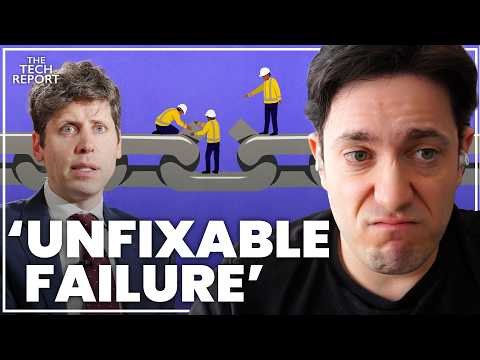
Ed Zitron’s central argument rests on a straightforward question that often disappears beneath enormous growth forecasts: where does the money ultimately come from? He challenges projections that would put OpenAI at roughly $284 billion in annual revenue by 2030 while competitors and infrastructure suppliers simultaneously expand to extraordinary sizes. His point is not merely that such growth sounds ambitious, but that customers would have to generate enough economic value from AI to support dramatically higher enterprise and consumer spending. That framing gives the discussion a useful economic foundation instead of treating revenue projections as numbers that can rise independently of the customers expected to pay them.
The most informative section examines the distinction between recurring revenue and an annualized run rate. Zitron argues that extrapolating a short period of subscriptions or usage-based API spending can create an impressive headline number without demonstrating that the same spending will persist for a full year. His explanation is clear and accessible, particularly when he notes that token consumption is not necessarily recurring in the same way as a contracted subscription. The criticism would be stronger with the underlying calculations and source documents presented directly, however, because several figures and descriptions are attributed to reports without enough detail here for viewers to independently judge how accurately those publications or companies characterized the metrics.
OpenAI’s enormous reported commitments form the backbone of the collapse thesis. Zitron cites obligations involving Oracle and other infrastructure providers, alongside operating expenses, data centers, hardware projects, and the continuing cost of running a large organization. He argues that slowing revenue growth becomes especially dangerous when expenditure commitments assume continued acceleration. That is a meaningful tension to highlight, but the discussion frequently moves from financial pressure to certainty about eventual failure without establishing every intermediate step. Claims that particular data centers will never be built, that OpenAI will be dead before certain projects are completed, or that specific funding sources are effectively exhausted are Zitron’s predictions rather than demonstrated outcomes.
The examination of potential financing is nevertheless one of the more substantive parts of the conversation. Amazon, Nvidia, SoftBank, venture capital, private equity, and a possible public offering are considered as potential sources of additional money, with Zitron explaining why he believes each has practical limitations. His description of SoftBank relying on borrowing and collateral, for example, is used to illustrate the broader problem of repeatedly funding companies that may require tens of billions of dollars more each year. Yet the presentation rarely subjects his assumptions to serious resistance. The interviewer asks useful follow-ups, but largely allows the argument to progress on Zitron’s terms rather than testing alternative financing structures, spending reductions, improving inference economics, or revenue scenarios that might complicate the collapse narrative.
That imbalance becomes more noticeable when the discussion turns to Anthropic, executives leaving OpenAI, paused training, and the motivations of journalists. Zitron frequently interprets ambiguous developments as supporting evidence: an executive departure becomes evidence of unrealistic expectations, training pauses attributed to safety are characterized as likely compute constraints, and favorable reporting is portrayed as the product of credulous or compromised journalism. Some of these interpretations may be plausible, but the evidence presented here does not establish them. His willingness to distinguish what he knows from what he suspects varies considerably, and statements about internal screaming, executive motives, regulatory questions, and future corporate behavior sometimes move well beyond the information demonstrated during the interview.
The rhetorical style makes the conversation lively but also reduces its analytical precision. Zitron is unusually direct, funny in places, and effective at puncturing the psychological power of gigantic projections by comparing them with the revenues of companies such as Microsoft and Meta. At the same time, insults aimed at executives, analysts, journalists, investors, and enthusiastic users repeatedly substitute contempt for argument. Phrases dismissing entire groups as stupid, captured, or dishonest may entertain viewers who already share his skepticism, but they make it harder to separate the strongest financial criticism from personal hostility. The result is a provocative and worthwhile bearish case that raises important questions about AI economics, but it functions better as an aggressive stress test of the prevailing optimism than as a settled demonstration that OpenAI's collapse is inevitable.
Pros
- The discussion repeatedly asks how extraordinary AI revenue projections can ultimately be supported by real enterprise and consumer spending rather than treating growth forecasts as self-validating.
- The explanation of annualized run rates versus genuinely recurring revenue provides useful context for interpreting impressive-looking financial headlines.
- Comparisons with the scale of major technology companies make the magnitude of the projected 2030 revenue figures easier to understand.
- The examination of infrastructure commitments, financing sources, IPO constraints, and possible corporate outcomes gives the collapse argument more substance than a simple claim that AI is overvalued.
- Zitron’s energetic delivery keeps a highly financial discussion accessible and gives the interview a clear point of view.
Cons
- Numerous predictions about OpenAI's death, unfinished data centers, exhausted financing options, training pauses, and executive motivations are stated with greater certainty than the evidence presented supports.
- The interviewer provides limited adversarial testing of Zitron’s assumptions, leaving important counterarguments about future efficiency improvements, spending reductions, financing alternatives, and possible sources of demand largely unexplored.
- Personal attacks on executives, journalists, analysts, investors, and users frequently distract from otherwise substantive economic criticism.
- Several important financial figures are referenced from outside reporting without enough methodological detail to independently evaluate their accuracy or interpretation.
- Speculation about internal company behavior and individual motives sometimes becomes difficult to distinguish from documented financial evidence.
Zitron offers a forceful and often illuminating challenge to the assumption that enormous AI spending commitments can be justified simply by projecting equally enormous future revenues. The financial questions deserve serious attention, but the certainty of his collapse scenario exceeds what the evidence presented here can establish, and the interview would benefit considerably from stronger counterarguments and less personal derision. As a skeptical examination of AI economics it is valuable; as proof of OpenAI's inevitable failure, it is considerably less convincing.