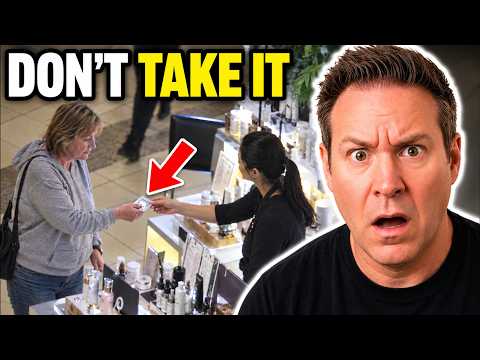
A $42,000 skincare bill for an elderly mall shopper is the disturbing starting point for an NPR investigation into an industry accused of exploiting customers through aggressive sales tactics, misleading prices, and questionable credit card charges. What initially appears to be an isolated incident in Ann Arbor, Michigan, develops into a nationwide pattern of complaints involving independently operated beauty stores connected through a common distribution network. The reporting effectively establishes the human consequences of these transactions while pursuing a larger question: how can so many businesses allegedly employ remarkably similar practices without facing broader accountability?
The experiences of Mary Ellen Eckert and her son Mark provide some of the investigation's strongest evidence of consumer vulnerability. Mary Ellen describes being approached by a friendly salesperson before accumulating substantial charges, while Mark recounts discovering what he alleges were unauthorized transactions involving copied credit cards. Their account illustrates how personal attention, confusing payment arrangements, and reassurances about declined transactions can undermine a customer's financial judgment. Mary Ellen's acknowledgment that older shoppers may be particularly susceptible to promises of maintaining a youthful appearance adds an important psychological dimension. However, the investigation primarily presents the customers' accounts rather than independently establishing every disputed transaction.
The reporting becomes more substantial when it connects numerous skincare brands and retail locations to Mazal Group, a family-associated distribution business based near Los Angeles. Rather than treating the complaints as unrelated examples of misconduct, the journalists examine the corporate relationships linking the products, their distribution, and the independent retailers selling them. The investigation identifies family members associated with the business, traces the development of its beauty brands, and examines a Hawaii class action involving 110 consumers. The reported $650,000 settlement is significant, although the company and individual defendants admitted no liability. Importantly, the reporting distinguishes the distributors' business connections from direct ownership of individual stores, leaving corporate responsibility as a central unresolved issue rather than a legally established conclusion.
Another investigative thread examines immigration violations historically associated with certain mall skincare operations. Drawing on State Department communications, a federal investigation, and an interview with a former Labor Department special agent, the journalists describe an earlier case involving workers employed on tourist visas, off-the-books payments, and a store owner who pleaded guilty to visa fraud conspiracy and money laundering. A contemporary recruitment inquiry, in which a prospective worker discloses having a tourist visa and receives an apparently welcoming response, raises legitimate questions about whether similar practices continue. Nevertheless, that exchange does not independently establish an ongoing immigration violation. The historical case provides valuable context, but the connection between past criminal activity and the present distribution network requires careful interpretation, especially because the stores operate independently.
The chemical testing of an expensive anti-aging product offers one of the investigation's most revealing moments. Laboratory analysis reportedly finds no detectable vitamin E, only trace amounts of vitamin A, and the presence of hexapeptide-8, an ingredient described as potentially beneficial for reducing wrinkles. The journalists appropriately acknowledge the limited sample size, preventing the findings from supporting sweeping conclusions about every product sold through the network. More striking is the pricing information: a product reportedly purchased by stores for approximately $20 carries a suggested retail price of $1,300, while internal order forms reveal similarly substantial markups on other items. Combined with the absence of visible price tags and commission-based compensation, these figures provide a plausible financial explanation for the aggressive selling described by customers. Still, ingredient costs and wholesale-to-retail comparisons cannot independently establish a product's effectiveness or whether every individual price constitutes deception.
The journalists' attempts to obtain answers directly from Mazal Group provide an engaging but somewhat inconclusive final phase. Their visit to the company's offices produces a brief confrontation over recording and a referral to its legal department, while an attempt to approach a family member at her residence yields no substantive interview. These encounters demonstrate the difficulty of securing accountability from businesses facing serious allegations, although the lack of an on-camera response should not itself be interpreted as proof of wrongdoing. The subsequent statement from company lawyers provides an important counterposition, emphasizing that Mazal Group neither owns retail locations nor directly manufactures the products. The discovery of a terminated California business license and a different company name on the office building adds intrigue, but the precise significance of these developments remains unverified. The investigation's suggestion of a possible pattern of corporate restructuring is therefore stronger as a question for further reporting than as a definitive conclusion.
As a piece of investigative journalism, the presentation succeeds through its combination of personal testimony, historical records, legal proceedings, undercover recruitment inquiries, laboratory testing, and internal pricing documents. The progression from individual financial harm to corporate structure and sales incentives gives the story considerable depth without losing sight of its consumer-protection implications. At times, however, the movement between alleged credit card misconduct, immigration fraud, product quality, and corporate restructuring risks suggesting a more unified operation than the presented evidence conclusively establishes. The investigation would also benefit from more detailed scrutiny of transaction records, clearer discussion of the current prevalence of the alleged practices, and additional independent responses from individual retailers. Even with those limitations, it offers a persuasive examination of how opaque pricing and high-pressure retail environments can expose consumers to substantial financial risks.
Pros
- The opening $42,000 skincare case establishes immediate stakes and gives the investigation a compelling consumer-protection focus.
- Mary Ellen Eckert and her son's accounts illustrate the potential financial and psychological consequences of aggressive skincare sales, particularly for older customers.
- The examination of Mazal Group's distribution network provides valuable context for understanding similarities among independently operated retailers.
- Federal investigative records, historical criminal proceedings, and the contemporary recruitment inquiry add depth to the examination of employment practices.
- Laboratory testing and internal wholesale pricing documents introduce concrete evidence that strengthens the investigation beyond customer complaints alone.
- The discussion of the Hawaii lawsuit appropriately acknowledges that the $650,000 settlement involved no admission of liability.
- The journalists pursue direct responses from the company and include its lawyers' position rather than relying exclusively on allegations from customers and former workers.
Cons
- The investigation does not independently resolve every allegation involving copied credit cards, unauthorized charges, or disputed customer purchases.
- Historical immigration violations and a contemporary recruitment exchange raise concerns but do not conclusively establish how widespread illegal employment practices may currently be.
- Testing a single skincare product provides limited grounds for evaluating the effectiveness or ingredient quality of the broader product portfolio.
- The relationship between independent retailers' alleged misconduct and Mazal Group's legal responsibility remains unresolved despite the documented business connections.
- The significance of the terminated business license and altered corporate signage is left uncertain, making the concluding revelations less definitive than their presentation suggests.
- The wide range of investigative threads occasionally reduces the attention given to the specific mechanisms and documentation behind individual consumer complaints.
A detailed and frequently troubling investigation that combines human stories, financial evidence, corporate research, and firsthand reporting to expose serious concerns about high-pressure skincare retailing. Its strongest findings involve opaque pricing, extraordinary suggested markups, and recurring consumer allegations, while broader questions about corporate accountability and ongoing misconduct remain less conclusively answered. Despite those evidentiary limitations, the reporting delivers a valuable warning about consumer vulnerability and the financial risks hidden behind seemingly harmless retail promotions.