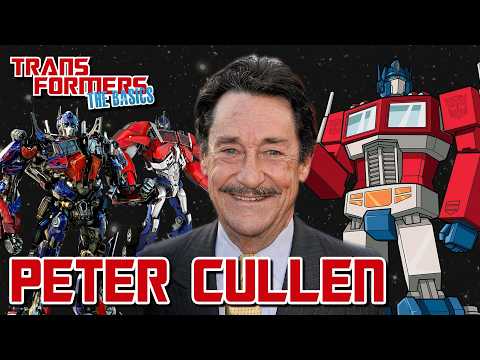
Peter Cullen’s interpretation of Optimus Prime is presented not merely as a memorable voice performance, but as the result of a specific philosophy about heroism. The centerpiece is Cullen’s account of seeking advice from his brother Larry before the 1984 audition and being told that a genuine hero should be “strong enough to be gentle.” That story gives the tribute a meaningful foundation: rather than simply cataloging famous roles, it connects Cullen’s performance choices to the qualities that made Optimus Prime so important to generations of fans.
The career overview provides considerable scope without losing sight of that central role. Cullen’s early work in Montreal, his audition for both Optimus Prime and Ironhide, the backlash surrounding Optimus Prime’s 1986 death, and his later return to the character establish a long professional arc. Other work—including Voltron, G.I. Joe, Knight Rider, Predator, and Winnie the Pooh—is used effectively to demonstrate how widely audiences may have encountered his voice without realizing it. These biographical and production-history details are presented as factual history, however, without sources or much qualification, so the piece functions better as an affectionate retrospective than as rigorously documented biography.
The discussion becomes particularly interesting when it describes the relationship between an actor and a character whose cultural importance apparently exceeded what the production itself initially understood. The account of fan protests after Optimus Prime’s death reinforces the argument that Cullen had created something audiences regarded as more than another cartoon performance. Later references to Transformers Prime, Rescue Bots, Bumblebee, Rise of the Beasts, video games, conventions and his friendship with Megatron voice actor Frank Welker broaden that legacy considerably. The NASA-related material is another worthwhile addition because it portrays Cullen’s association with Optimus as something that extended into encouraging young people rather than remaining confined to entertainment.
What distinguishes the tribute, though, is the creator’s lengthy personal account of discovering Transformers through an older brother and seeing the 2007 film at age seven. Her memories of gradually becoming captivated once the Transformers themselves appear lead naturally into why Optimus became such an enduring influence. She does not pretend that the Michael Bay films are universally admired, even acknowledging the criticism that their version of Prime departs dramatically from earlier portrayals. That concession strengthens the personal argument: regardless of debates over the movies themselves, Cullen’s performance gave one viewer a lasting model of leadership, sacrifice and principled strength.
That autobiographical section is emotionally sincere but also considerably more expansive than the career material surrounding it. Stories about childhood toys, other movies, a missed convention appearance, cosplay and fandom friendships make the grief feel genuine, yet some could have been tightened without diminishing the emotional effect. The best personal details are those directly illustrating Cullen’s influence, particularly the decision to build an Optimus Prime cosplay and the disappointment of missing an opportunity to meet him. Those moments translate admiration into something concrete rather than simply asserting that Cullen mattered.
The closing contributions from the creator’s best friend and social-media followers appropriately widen the perspective beyond one fan. The friend’s description of carrying the “strong enough to be gentle” principle into his own life directly supports the tribute’s central argument that Cullen’s legacy rests partly in values audiences associated with his performance. At its best, the presentation recognizes an important distinction: Cullen voiced a fictional hero, but the significance viewers attached to that hero became real in their own lives. The emotion occasionally pushes the language toward reverence rather than critical biography, but for a memorial piece that emphasis feels purposeful rather than manipulative.
Pros
- Builds the tribute around Cullen’s memorable philosophy of portraying heroism through strength tempered by gentleness.
- Connects Optimus Prime’s enduring popularity to specific moments in Cullen’s career rather than relying entirely on general praise.
- Covers a broad range of voice work beyond Transformers, illustrating how extensive Cullen’s career was presented to be.
- The creator’s personal history with Optimus gives the memorial genuine emotional stakes and explains why Cullen’s work mattered to her.
- Acknowledging criticism of the Michael Bay interpretation prevents the fandom discussion from becoming completely uncritical.
- The best friend’s account effectively demonstrates how Cullen’s portrayal could influence viewers beyond simple entertainment.
Cons
- Numerous biographical, production-history and career claims are presented without sourcing or qualification.
- The lengthy childhood and fandom recollections sometimes overwhelm the more informative career retrospective.
- The consistently reverential tone leaves little room for a more rounded examination of Cullen’s professional development or performances beyond Optimus Prime.
- Some secondary anecdotes contribute less to the central tribute and could have been condensed for a tighter presentation.
Personal grief and pop-culture history work unusually well together here because the tribute explains not only what Peter Cullen performed, but why one performance became a moral ideal for many fans. A tighter structure and stronger support for its biographical claims would improve it as a retrospective, yet its sincerity and clear understanding of Cullen’s appeal make it an affecting celebration of his legacy.