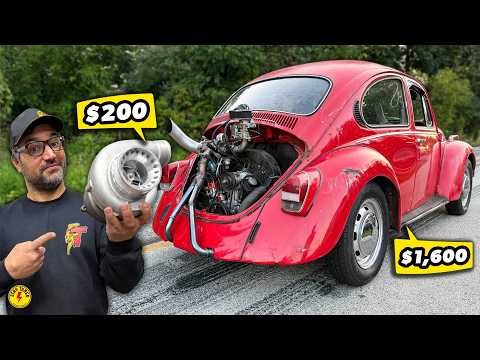
A rusty, oil-filled turbo and a wastegate welded shut turn what could have been a simple cosmetic refresh into a much more substantial mechanical project. Mighty Car Mods approaches the Daihatsu with the same philosophy that defined its early builds—take an inexpensive, ordinary car and make it entertaining—but now with the tools, workshop space, and technical knowledge accumulated since those driveway days. That contrast between old-school enthusiasm and modern capability gives the project more purpose than merely recreating an earlier car.
The mechanical work is satisfyingly varied. Coilovers replace the untouched factory suspension, worn brake pads make way for new components, the calipers receive the familiar bright-red treatment, braided brake lines are fitted, and secondhand gold wheels are prepared to transform the car's stance. These modifications are presented as attainable upgrades rather than exotic fabrication exercises, and practical details such as cleaning the calipers thoroughly, using a white base coat beneath the red paint, and dealing with the unusual wheel fitment give the build useful texture.
Marty's turbo work provides the more technically interesting half of the episode. The questionable existing unit is replaced with a $299 TD04-style turbo, while the external wastegate arrangement is converted to an internal setup and the temporary oil return through the dipstick opening is replaced by a welded sump fitting. A larger front-mounted intercooler, intake piping, coolant plumbing, temperature sensing, and an adjustable actuator gradually turn the improvised setup into something intended for actual road use. Importantly, the presenters do not claim that the inexpensive replacement turbo is inherently superior; they acknowledge that a stock Subaru unit would probably be the safer conventional choice and essentially treat the cheap part as an experiment.
The standalone ECU installation adds another worthwhile layer. A spare L700 loom is repinned for a Haltech Elite 550, with support for injector changes, boost control, wideband monitoring, and a digital CAN-connected gauge. The explanation makes the wiring seem approachable by emphasizing the comparatively small number of essential circuits and the value of a multimeter, wiring diagram, workshop manual, and patience. Even so, viewers hoping for a genuinely instructional ECU-wiring guide will find the treatment abbreviated, because much of the detailed pin identification and configuration happens outside the presentation.
There is also a coherent mechanical objective behind all the modifications. Rather than chasing maximum boost, the builders discuss keeping wastegate pressure around 6–8 psi on the factory engine and ultimately envision roughly 7–10 psi, while upgrading the brakes and focusing on drivability. The claimed combination of approximately 750 kilograms and increased power sounds promising, but performance remains prospective here: the car is neither started on the new setup nor tuned, driven, or tested before the episode ends. That makes the turbo's low price an effective hook without actually answering the most important questions about its durability or performance.
The project's personality is equally important to the presentation. The hosts' affection for cheap Japanese cars, jokes about red calipers adding power, deliberately crude fabrication references, and use of their original 2008 camera create a convincing retrospective atmosphere. Their argument that modifying affordable cars can be more personally meaningful than simply purchasing an expensive supercar fits the build naturally, although the broader dismissal of supercar culture and claims about manufacturers taking legal action against modifiers are presented rhetorically rather than explored or substantiated. Repeated promotion of the limited-edition poster also interrupts the mechanical flow more than once.
Most importantly, there is tangible progress by the end: suspension, brakes, turbo, intercooler, intake, wastegate hardware, and much of the ECU preparation have all moved forward. Yet the episode deliberately stops just before the payoff, with wiring, fluids, ECU configuration, startup, tuning, exterior restoration, and road testing still outstanding. As one installment in a continuing build, that works well and creates anticipation, but as an evaluation of an ultra-cheap turbo specifically, it remains incomplete because the component has yet to prove itself under boost.
Pros
- The project combines suspension, braking, turbo, intercooler, fabrication, and ECU work into a varied but coherent effort to make the Daihatsu genuinely usable.
- Practical details such as the proper turbo oil return, adjustable wastegate actuator, intake-temperature sensor, brake preparation, and standalone ECU wiring give the build meaningful technical substance.
- The presenters acknowledge the uncertainty surrounding the inexpensive replacement turbo rather than pretending its low price guarantees quality.
- The retrospective 2008-camera footage and obvious enthusiasm for affordable modified cars give the episode a distinctive personality that fits the project.
Cons
- The replacement turbo is never started, tuned, driven, or tested, so its performance and reliability remain completely unresolved by the end.
- ECU wiring and several fabrication steps are explained clearly at a conceptual level but move too quickly to function as detailed instructional material.
- Broad criticism of supercar culture and manufacturer behavior is asserted more confidently than the episode's evidence supports.
- Repeated poster promotion and extended comedic tangents occasionally interrupt an otherwise engaging mechanical build.
A tiny Daihatsu undergoing sensible supporting upgrades makes for an entertaining celebration of inexpensive car modification, and the blend of fabrication, electronics, and humor keeps the build engaging. The cheap turbo remains an intriguing experiment rather than a demonstrated bargain, however, because the crucial startup, tuning, and driving results are deferred to the next installment.