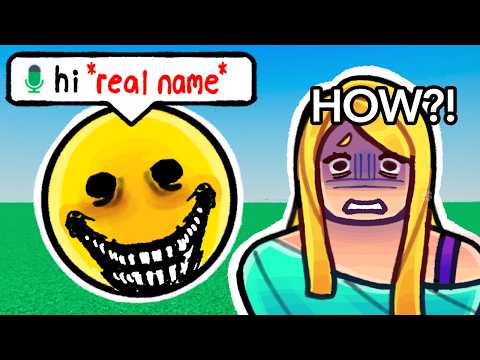
The prank begins with a useful setup: Verity is presented as an all-knowing yellow character that initially seems helpful but becomes increasingly possessive and disturbing. That premise gives the video a clear escalation path before Slurpy even encounters the character. Rather than immediately using the frightening version, the creator joins Brookhaven as the harmless-looking Verity, answers questions, and gradually introduces increasingly obsessive behavior. The contrast between the cheerful avatar and what Verity supposedly becomes is simple, but it gives the prank enough structure to feel like more than a collection of random scares.
The early Roblox interaction is strongest when it focuses on building Slurpy's confidence in Verity. Basic questions about the American flag and Roblox YouTubers establish the character's supposed knowledge, while the goth-girl question turns the exchange into comedy before the tone changes. The major credibility boost comes when Slurpy asks Verity for Robux and receives 30,000 after the creator purchases them through an account he says was already signed in on his phone. That moment gives Slurpy an apparent reason to take Verity's claims seriously, although the prank depends heavily on access and manipulation occurring outside the game rather than anything Verity itself is actually capable of doing.
Stefan's arrival provides the video's clearest transition from strange to threatening. Once Verity starts objecting to Slurpy having another friend, the earlier comments about being "best friends" gain a purpose, and transforming into the frightening avatar before apparently eating Stefan pays off the introductory explanation of the character. Stefan immediately leaving both the game and call makes the disappearance more convincing. The follow-up FaceTime sequence pushes the trick further by showing his gaming room empty, extending an in-game gag into a staged suggestion that something may have happened to him in real life.
That escalation also creates the video's biggest tonal problem. Slurpy is encouraged to believe, at least within the prank's premise, that Stefan may actually have disappeared or been harmed, while Verity repeatedly insists that he no longer needs other friends. The resulting fear gives the middle section considerably more impact than a conventional Roblox troll, but the joke relies on deliberately sustaining concern about a friend's safety. The creator ultimately reveals Stefan unharmed, yet the prank spends a substantial amount of time exploiting that uncertainty before providing the payoff.
The production is unusually elaborate for the basic concept. The creator describes using access to Slurpy's computer to play Verity's voice and prevent him from leaving Brookhaven, coordinates Stefan's disappearance, stages the FaceTime check, and finally travels to Slurpy's house. These layers keep introducing new ways for the same central illusion to continue instead of relying entirely on avatar changes and scripted dialogue. At the same time, viewers only have the video's presentation for claims about the computer access and control involved; the entertainment value comes from how those elements support the prank rather than independently demonstrating the technical mechanisms behind them.
The final trip to Slurpy's house gives the video an appropriately larger payoff after the digital tricks. Stefan joins the creator but stays hidden while the creator enters the house and knocks near Slurpy's gaming room, making Verity's promise to get "really close" appear to cross into the real world. Slurpy quickly realizes who is outside, so the climactic scare does not last especially long, but revealing that the creator was Verity and then bringing Stefan back resolves both major deceptions together. The casual joking during the drive and house entry is energetic, though it stretches the buildup after the prank has already reached its most effective psychological beat with Stefan's disappearance.
As a presentation, the video maintains momentum through constant reactions, avatar changes, calls, physical movement, and escalating tricks. The creator repeatedly explains what he is about to do, however, which can make the structure feel over-signposted; viewers often know the next beat before Slurpy experiences it. Some tangents and repeated commentary similarly add runtime without strengthening the prank. Still, the core progression is coherent: establish Verity as useful, make the impossible seem plausible, introduce possessiveness, remove a friend, suggest the threat extends beyond Roblox, and finish with an in-person reveal.
Pros
- Verity's progression from helpful yellow avatar to possessive threat gives the prank a clear escalating structure.
- The Robux purchase, Stefan's staged disappearance, empty-room FaceTime check, and house visit create multiple layers to the deception rather than relying on a single Roblox gimmick.
- Stefan's cooperation provides one of the strongest sequences, allowing the apparent in-game attack to have consequences outside the game.
- The final in-person reveal resolves both Verity's identity and Stefan's disappearance instead of leaving the prank without a payoff.
Cons
- The prank deliberately encourages Slurpy to fear that something serious may have happened to Stefan, pushing the joke into harsher territory than the playful opening suggests.
- Frequent explanations of upcoming prank steps reduce surprise for the audience even when Slurpy remains unaware of what is happening.
- Repeated reactions, side jokes, and the extended trip to Slurpy's house occasionally slow an otherwise straightforward escalation.
- Several important elements depend on claimed computer and account access that the video uses as prank mechanics without meaningfully explaining how they work.
The Verity prank succeeds primarily because it keeps expanding its original Roblox premise. What starts as a strange yellow avatar answering questions eventually involves real Robux, an accomplice disappearing on cue, a staged search through an empty room, apparent control over Slurpy's game, and finally someone arriving at his house. That progression makes the video considerably more involved than a basic character troll, and Stefan's disappearance provides an effective bridge between the virtual and real-world portions. The prank sometimes overexplains its own setup, and making Slurpy worry that his friend may have been harmed gives the middle section an uncomfortable edge. Even so, the coordination and escalating presentation deliver a strong payoff, with the final reveal neatly exposing every major part of the trick.