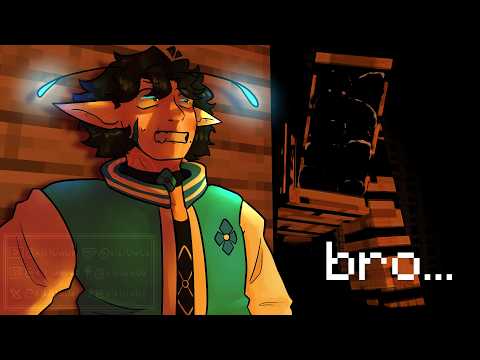
The most effective idea here arrives before the horror does: Verity is not simply another Minecraft creature waiting in the darkness, but a talking companion whose behavior can apparently change according to how the player treats it. Ryan begins with no real knowledge of what the mod will do, which gives the early experimentation an appealing spontaneity. Asking Verity math questions, requesting sounds, testing its Minecraft knowledge, and discovering its karma meter gradually establishes the creature as an interactive personality rather than an ordinary scripted enemy. That makes the eventual promise of a transformation more intriguing because the video has spent time building a strange relationship with it first.
Much of the entertainment comes from Ryan deliberately testing that relationship. Verity can follow him, comment on light levels, report its health, react to insults, refuse certain requests, and sometimes acknowledge events happening around it. The funniest moments exploit the gap between its confident helper persona and its actual usefulness: it cannot locate cobblestone, misunderstands jokes, gives questionable reassurance about danger, and begins producing increasingly garbled responses. Ryan is quick at turning those failures into comedy, especially as his initial curiosity gives way to irritation at Verity's repetitive noises and contradictory advice.
There is also a genuinely unsettling quality to the creature when its behavior stops feeling predictable. Its slurred or overlapping speech, strange expressions, persistent following, repeated declarations that it is alone, and changing attitude create unease without requiring a conventional monster attack. The unusually dark Minecraft nights help considerably, as ordinary skeletons, creepers, caves, and survival problems become more stressful while Verity rambles nearby. Ryan's paranoia that he will eventually turn around and find something other than the smiling ball is more effective than most of what the mod actually delivers during the session.
Unfortunately, technical problems steadily become the dominant story. The interaction system begins returning repeated API and rate-limit errors, preventing Ryan from reliably talking to Verity and apparently removing the main mechanism for affecting its mood. That damages more than a novelty feature because conversation is central to the mod's premise. Once Ryan cannot consistently provoke, question, or direct the creature, long stretches become ordinary Minecraft survival accompanied by Verity repeating itself. The video openly acknowledges this deterioration rather than pretending the intended experience is still unfolding, but honesty cannot replace the missing functionality.
The middle portion consequently becomes much looser than the opening. Ryan dies, becomes trapped underground, searches for resources, rebuilds basic equipment, establishes another shelter, and repeatedly tries to reconnect with Verity while waiting for something significant to happen. His commentary keeps individual moments lively, and the running frustration with the creature produces some good improvised jokes, but there is limited progression. Even Ryan recognizes that he has spent a substantial amount of time moving around without reaching the promised payoff. The repetition communicates how thoroughly the mod has stalled, though it also makes the video feel longer and less focused than the concept warrants.
The strongest late development is Verity's threat that it will transform the following day. Ryan prepares for the encounter, attempts to provoke it, and is eventually given coordinates and threats suggesting something hostile should be approaching. Nothing meaningful materializes. Looking at another depiction of Verity near the end suggests the intended experience may involve far more disturbing imagery and behavior, but the video appropriately treats that as what apparently should have happened rather than claiming Ryan experienced it himself. The glimpse makes the unrealized potential clearer while simultaneously emphasizing how little of the horror premise actually functioned during his playthrough.
That leaves the video in an unusual position: the failed experiment is more compelling than the successful horror experience, because there largely is no successful horror experience. Ryan's willingness to preserve an imperfect first encounter makes sense for a mod whose appeal depends heavily on surprise, and the opening demonstrates why Verity could be fascinating when its conversational systems cooperate. Yet more than two hours of attempted play ultimately produce an entertaining personality test, some accidental comedy, mounting technical frustration, and a transformation that never arrives. Ryan carries the video through those limitations, but the mod itself prevents the premise from reaching the unsettling payoff it repeatedly promises.
Pros
- Verity's conversational behavior, karma system, expressions, following, and environmental responses create an unusually interactive horror premise.
- Ryan's unfamiliarity with the mod produces spontaneous reactions and playful experimentation with the creature.
- The combination of dark Minecraft environments, unpredictable speech, and changing behavior generates genuine tension before the technical problems take over.
- Ryan turns Verity's misunderstandings, contradictions, strange noises, and repeated complaints into effective improvised comedy.
- The video is transparent about the malfunctioning interaction system and the absence of the expected transformation rather than presenting an incomplete experience as successful.
Cons
- API and rate-limit failures disable the conversation system that appears central to influencing Verity and progressing the experience.
- The promised transformation never meaningfully occurs, leaving the main horror buildup without a payoff.
- Large portions of the session become repetitive Minecraft survival and resource gathering once interaction with Verity breaks.
- Repeated errors, complaints, threats, and attempts to trigger progression make the middle and later sections feel increasingly unfocused.
- The brief look at what Verity apparently can become highlights the mod's potential but also makes the failed horror experience more disappointing.
Ryan's reactions, improvisation, and growing frustration make this failed encounter surprisingly watchable, while Verity's conversational design shows real potential for a distinctive kind of Minecraft horror. The early interaction and creeping unpredictability are memorable, but broken communication, repetitive survival stretches, and an absent transformation prevent that potential from becoming a satisfying horror experience. What remains is an entertaining first encounter with a compelling concept that never gets the chance to fully reveal itself.