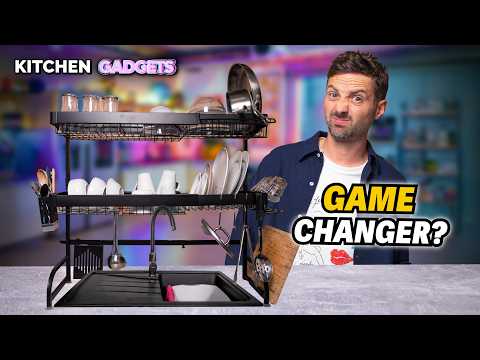
A mortar-shaped bottle opener sets the tone by working far more aggressively than expected, first launching a bottle cap and then apparently breaking the neck of another glass bottle. It is an entertaining demonstration because the product genuinely surprises the presenter, but it also exposes one of the recurring tensions in the format: proving that a gadget functions does not necessarily mean it is sensible or safe to use. Calling this one successful while acknowledging that it may work “too well” is a fitting opening to a collection dominated by strange compromises.
Many of the better segments go beyond a simple yes-or-no verdict. The sauce-lifting tool is tried with ketchup, honey and olive oil, revealing that thicker substances are easier to collect than free-flowing oil. The expensive inflatable ironing machine is tested on a visibly wrinkled shirt and produces a convincing improvement in only a few minutes, while the spill-resistant shirt handles water, Coca-Cola and Gatorade before finally struggling with honey. Similarly, the stain treatment performs impressively on strawberry but less decisively on Gatorade and Coca-Cola. These escalating tests make the successes more informative because viewers get some sense of where each product's usefulness ends.
Other gadgets succeed in smaller, sometimes amusing ways. The sunflower-seed frog actually cracks a shell, the phone magnifier enlarges an image while introducing visible distortion, the 3D pen produces a rough construction despite the presenter's lack of experience, and the drawing robot accurately creates a butterfly that can then be colored in. The faucet attachment also provides the promised range of movement, although having to duct-tape it to an incompatible sink weakens the demonstration of how practical installation would be. The compact grocery bag is another useful example of a product technically fulfilling its purpose while proving much less impressive in scale than its promotional clip suggests.
The outright failures provide some of the funniest material, but the testing is not always rigorous enough to support broad conclusions. Chrome paint appears reflective while wet before drying to a comparatively ordinary silver finish, the posture device repeatedly reports positions that do not match what the presenter believes he is doing, and the heavy-duty scissors fail to cut the chosen dog bone. The improvised bottle-based water shoes sink rather than supporting him, but that experiment does not actually test the advertised shoes, which never arrived. In that case, the failed delivery is evidence of a problematic purchase experience, while the homemade substitute is really a separate experiment.
Scientific and health-related claims are handled much less carefully. The anti-gravity fountain creates the appearance of upward-moving droplets, but describing the result as genuinely “anti-gravity” is not established by the demonstration. The foot board's printed claims connecting specific areas of the feet to distant parts of the body are tested through personal sensation rather than evidence, while the vibrating head device feels pleasant but is then described as something that might solve a migraine. The brief “not medical advice” qualification does not substitute for evidence that the device treats migraine, and subjective relief during a demonstration cannot establish such a medical effect.
The money segment has a similar problem with explanation even though the underlying novelty is compelling. Receiving an uncut sheet of currency is visually interesting, but the alcohol-and-water flame trick is presented as confirming that the bills are genuine without establishing that it is a reliable authentication method. Elsewhere, the money-filled soap delivers on its basic promise while producing only a $1 bill after a roughly $16 purchase, nicely illustrating the distinction between a product containing what was advertised and it actually representing good value.
Presentation is energetic and consistently easy to follow, with each promotional clip establishing a clear claim before the purchased item is shown and tested. That repetition gives a very long collection a dependable rhythm, and the presenter's willingness to revise his initial skepticism creates several satisfying reversals. The major interruption is the extended sponsored Halloween shopping section, which temporarily abandons the product-testing premise for a lengthy assortment of candy, decorations, clothing and other promotional items. Combined with frequent exaggerated reactions and occasionally overconfident conclusions, it makes the finale feel more like fast entertainment than careful consumer testing, even though many individual demonstrations remain genuinely useful.
Pros
- Testing products with multiple materials or increasingly difficult conditions often reveals limitations that the original promotional clips do not show.
- Successful demonstrations such as the inflatable iron, spill-resistant shirt, sauce tool, drawing robot and 3D pen provide clear visual evidence of what the gadgets can actually do.
- The presenter regularly acknowledges compromises involving price, capacity, distortion, compatibility and practicality rather than treating every functioning gadget as worthwhile.
- Failed and unexpectedly successful products create enough variety to sustain the lengthy compilation.
- The consistent claim-purchase-test-verdict structure keeps a large number of unrelated products easy to follow.
Cons
- Health-related segments make conclusions about migraine relief and body-pressure-point effects without evidence capable of establishing those claims.
- The “anti-gravity” fountain and currency flame test receive explanations or conclusions that go beyond what the demonstrations actually prove.
- Homemade bottle shoes cannot meaningfully verify the performance of the advertised water shoes that never arrived.
- Some verdicts label products clickbait based on expectations about performance or size even when the underlying function substantially works.
- The lengthy sponsored Halloween segment significantly interrupts the testing format and adds little to the central evaluation.
- Several tests rely heavily on immediate impressions rather than repeat trials, controlled comparisons or longer-term use.
The strongest demonstrations turn exaggerated social-media advertising into entertaining practical tests, especially when a product works but reveals limitations its promotional clip concealed. The loose methodology and overconfident treatment of a few scientific and health claims prevent the collection from functioning as rigorous consumer guidance, but its breadth, clear demonstrations and frequent surprises make it an engaging finale.