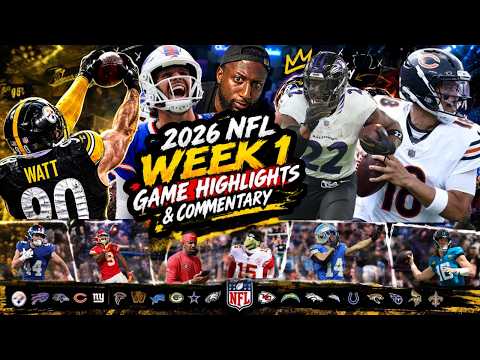
Turnovers arrive almost immediately, and the commentary treats them as an invitation to establish the frantic tone that carries through the entire Week 2 roundup. Cooper Rush’s early problems, Josh Allen’s fumble, Seattle’s quick strike to Jaxon Smith-Njigba and a succession of interceptions give the host plenty of material for the exaggerated nicknames, recurring jokes and shouted reactions that define the format. Rather than simply narrating highlights, he tries to turn virtually every play into a punchline, creating an unmistakable personality but also making an already packed slate feel even more relentless.
The coverage is impressively broad. Games around the league receive attention, with enough sequencing to communicate momentum swings rather than merely presenting disconnected scoring plays. Buffalo’s strong performance, Carolina’s domination of Atlanta, Seattle’s offensive success, Dallas pulling away from Washington and San Francisco controlling Miami all develop into recognizable game stories. The commentary is particularly effective when a running gag grows naturally from what is happening on the field, such as Atlanta’s repeated turnovers or the Chargers repeatedly failing to capitalize on opportunities.
There are also moments when the football itself takes precedence over the comedy. Jaxon Smith-Njigba’s touchdown catch is praised for its execution, Ja’Marr Chase’s difficult reception receives specific attention for body control and awareness, and the late Indianapolis-Kansas City sequence gets substantially more play-by-play analysis than many earlier highlights. The host questions Indianapolis’ conservative overtime play-calling after an explosive completion and carefully describes the down-by-contact ruling that prevented an apparent Kansas City fumble recovery from immediately ending the game. Those stretches show that the presentation can deliver energetic football analysis without abandoning its comedic identity.
Injuries are handled with noticeably more restraint. Jackson Dart’s knee injury, Jayden Daniels’ apparent arm injury and Caleb Williams leaving on a cart prompt concern and wishes for successful recoveries rather than becoming opportunities for extended jokes. Importantly, the descriptions generally stay observational—such as saying Daniels appeared to have suffered a dislocated elbow—rather than presenting an unconfirmed diagnosis as certain. That change in tone gives serious moments appropriate separation from the surrounding irreverence.
The comedy itself is much more uneven. Wordplay involving player names, pop-culture references, recurring sound effects and absurd characterizations can be inventive, but the volume is enormous, and many jokes are repeated well beyond their initial payoff. More significantly, some humor relies on racial and sexual stereotypes, rape references, disability-related insults and suicide language. Those moments do not merely make the presentation provocative; they frequently distract from stronger football jokes and analysis that already provide enough personality without requiring the additional shock value.
Pacing suffers from the same excess. DraftKings advertising, Patreon promotion, Cameo promotion, social-media appeals and a lengthy request for Sports Streamer of the Year nominations repeatedly interrupt an already long highlight package. The promotional segments are clearly separated from the football, but their cumulative effect is substantial. By the time the final overtime games arrive, the strongest material is competing not only with the sheer number of highlights but with several interruptions that make the production feel more sprawling than necessary.
Still, the closing stretch demonstrates why the format can work. Several close games are allowed to develop toward meaningful finishes, including New Orleans’ late touchdown against Baltimore, Philadelphia’s response against Tennessee, Minnesota’s walk-off sack and the two overtime contests. The Indianapolis-Kansas City finish is especially well served by slowing down enough to explain possession, contact, play-calling decisions and the eventual winning field goal. More selective editing and greater confidence in those genuinely dramatic football moments would make the entire package considerably stronger.
Pros
- Covers a large Week 2 slate while preserving the basic momentum and turning points of individual games.
- Recurring jokes and player nicknames give the commentary a distinctive, energetic personality.
- Several major plays receive useful football-specific observations rather than simple play-by-play repetition.
- Serious injuries are generally treated with appropriate concern and uncertainty.
- The extended Indianapolis-Kansas City overtime sequence provides one of the clearest examples of commentary, humor and game analysis working together.
Cons
- Constant punchlines and repeated running jokes can overwhelm the actual football.
- Racial and sexual stereotypes, rape references, disability-related insults and suicide language frequently substitute shock value for stronger comedy.
- Multiple sponsorships, self-promotional segments and calls to action substantially interrupt the flow.
- Some jokes and reactions are stretched far beyond their initial payoff.
- The enormous number of games and references makes portions of the presentation exhausting rather than consistently engaging.
The combination of league-wide coverage, genuine enthusiasm and an enormous vocabulary of running jokes gives the Week 2 roundup a personality far removed from a conventional highlight reel. Its best stretches prove that sharp football observations and comedy can coexist, but excessive repetition, disruptive promotion and unnecessarily abrasive humor prevent the stronger game commentary from consistently controlling the show.