Texas leaving Knoxville with a 20-17 win becomes less a celebration of offensive firepower than an argument for accepting what the team actually is right now. Josh Pate emphasizes the defense’s 10 sacks, Tennessee’s 221 yards and the Longhorns’ ability to survive despite an inconsistent Arch Manning, limited rushing production, a special-teams score allowed and a lost turnover battle. His assessment is appropriately qualified: Texas proved it can win an ugly road game, but an offense lacking rhythm could become a serious limitation when future opponents force the Longhorns to trade points rather than dominate defensively.
That willingness to separate a good result from a flawless performance carries into several of the strongest reactions. Oregon’s 41-27 win at USC earns particular praise because Dante Moore’s frightening injury could have destabilized the entire team, yet Oregon maintained its composure and continued producing long scoring drives. Pate gives Dan Lanning substantial credit for keeping the sideline under control after the hit and its aftermath, while his verdict on USC and Lincoln Riley is far harsher. After years of defending Riley, he treats another double-digit loss to Oregon as the point where patience is no longer justified, though the extended Titanic, Cheers and fan-club metaphors stretch that conclusion well beyond what is necessary.
Florida and Alabama provide the show’s clearest examples of early-season perceptions being revised upward. Florida’s 52-28 demolition of Ole Miss is framed around practical offensive evidence: 302 rushing yards, seven conversions on 11 third downs, no sacks allowed and heavy usage of Jaden Ball. Pate goes considerably further by arguing that Florida’s ceiling reaches the national championship, but he presents that as an assessment rather than an established outcome and acknowledges defensive questions. Alabama receives similarly enthusiastic treatment behind Keelon Russell, whose production and composure lead Pate to upgrade the Crimson Tide from a “conditional contender” to a contender while still noting that the difficult portion of the schedule remains ahead.
The breadth of the reaction show is both an asset and a liability. Iowa’s improbable win over Michigan, Georgia’s rout of Oklahoma, Mississippi State’s victory over Missouri, LSU’s comfortable result against Texas A&M, Wake Forest upsetting Louisville, Wisconsin beating Penn State and several other games receive enough statistical or situational detail to make the rapid tour useful. The best segments resist reducing everything to the final score: Michigan’s 153-58 rushing advantage and productive passing numbers are contrasted with red-zone failures and poor late defense, while Georgia’s dominance is tied heavily to Oklahoma turnovers and advantageous field position rather than exaggerated into proof that every part of the Bulldogs’ offense was exceptional.
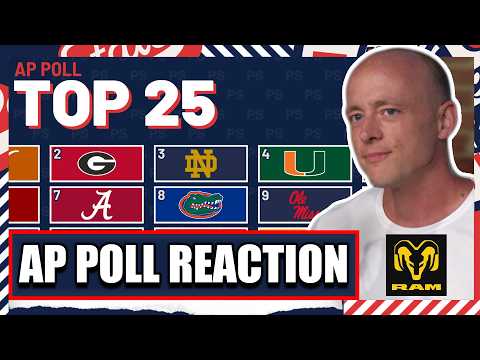
The AP Poll discussion gives the show a coherent argument beyond game recaps. Pate objects to Missouri remaining ranked, USC falling only to No. 18, Indiana sitting at No. 6 and Mississippi State remaining No. 16 despite what he views as a stronger current résumé. His central principle—that early rankings should change dramatically as actual results replace preseason projections—is clearly stated and applied to Duke, Wake Forest, UCLA and especially Florida. The repeated “drugs” joke about voters is deliberately theatrical, however, and eventually substitutes mockery for deeper examination of why reasonable voters might weigh résumé, team quality and prior expectations differently.
Personality is inseparable from the presentation. The invented “chalice” ratings, paper-popper statistics, pro-wrestling comparisons, Titanic references and the Sarah McLachlan treatment for Maryland give a very long college-football discussion a recognizable comic rhythm. The story about unexpectedly meeting Glenn Jacobs after repeatedly comparing Wisconsin’s season to Kane’s 1997 wrestling reinvention is genuinely amusing because Wisconsin then completed the upset of Penn State that Pate had connected to the analogy. At the same time, lengthy stories about Knoxville, merchandise, live-show attendees, promotional partners and multiple calls to like and subscribe repeatedly pull attention away from the Week 4 analysis.
Pros
- Texas-Tennessee analysis distinguishes an important road victory from the unresolved offensive problems that could matter against stronger quarterbacks.
- Oregon’s response to Dante Moore’s injury is evaluated in terms of both football performance and the team’s composure during an emotionally charged situation.
- Florida and Alabama assessments use specific production, personnel and scheduling context rather than relying only on rankings or final scores.
- Iowa-Michigan and Georgia-Oklahoma demonstrate a useful willingness to examine how games were won rather than simply rewarding the winner.
- The AP Poll segment advances a consistent argument for valuing current-season résumés more heavily as evidence accumulates.
- Humor, recurring show devices and personal stories give a sprawling national recap a distinctive identity.
Cons
- Numerous sponsor reads, merchandise plugs, subscription reminders and live-show stories make an already lengthy reaction show substantially less focused.
- Some conclusions, particularly the complete abandonment of Lincoln Riley and Florida’s championship ceiling, are delivered with greater certainty than four weeks of results can firmly establish.
- The repeated attacks on AP voters become more performative than analytical and leave little room for alternative ranking philosophies.
- Several metaphors and comedic digressions continue long after their underlying football point has been established.
- The rapid treatment of the later slate creates an uneven structure in which some significant games receive only brief summaries after extremely long opening segments.
Week 4 gives Pate plenty of material to challenge preseason assumptions, and the show is at its best when statistics and game context force those reassessments rather than rankings or reputation. Its enormous scope and unmistakable personality make it entertaining, but repeated promotions, tangents and overstated rhetoric keep a strong national recap from being as sharp as its best individual analyses.