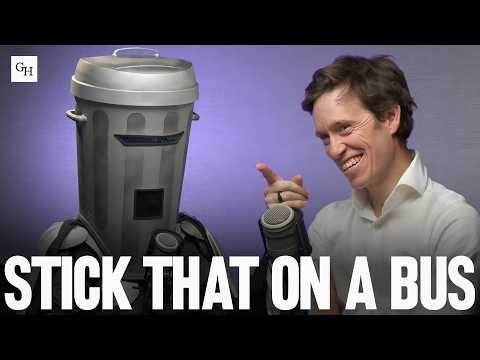
Pete Davidson and Tony Hinchcliffe making Charlie Kirk jokes at the same Netflix roast gives the argument an immediate point of contrast: the narrator highlights Fox News condemning Davidson while largely overlooking Hinchcliffe, despite Hinchcliffe’s established relationship with Donald Trump’s political world. From there, the discussion expands into a much larger argument about selective outrage, institutional power, and a comedy culture that presents itself as persecuted even after gaining enormous control over its own venues and distribution. It is an ambitious framing because the subject is ultimately less about whether offensive jokes should be permitted than about who receives protection, who faces consequences, and who gets to define censorship.
The strongest section gives genuine weight to the opposing case rather than pretending concerns about punitive reactions to comedy were invented. Gilbert Gottfried losing his Aflac role after jokes about the Japanese earthquake and tsunami, Kevin Hart stepping away from the Oscars after old homophobic material resurfaced, and Tony Hinchcliffe losing representation after his anti-Asian slur are presented as examples of professional consequences that helped create the modern backlash against “woke” comedy. That acknowledgment makes the criticism more persuasive: the narrator is not arguing that comedians imagined every threat, but that a legitimate concern about cultural punishment eventually hardened into an ideological identity that can persist even after circumstances change.
Joe Rogan becomes the center of the broader structural argument, and the detailed reconstruction of his Austin ecosystem is one of the most interesting parts. His enormous podcast audience, the relocation of comedians to Texas, ownership of the Comedy Mothership, relationships with performers, and influence over a scene capable of creating careers are assembled into a picture of unusual independence from traditional entertainment institutions. The repeated clips of Rogan encouraging people to move to Austin are especially effective because they make the formation of that community feel tangible rather than abstract. Still, describing it as the most complete “immunity structure” in American entertainment is the narrator's interpretation, not something established merely by documenting Rogan's influence.
Kill Tony provides a useful second layer because it shows how that ecosystem can create opportunity as well as conformity. The random bucket format gives unknown comics access to enormous audiences without following the traditional agency-and-booking ladder, and the narrator fairly acknowledges the show's ability to launch careers. At the same time, brutal interviews, racial material, shock humor, and criticism from comedians who believe performers are imitating what they think Austin expects support the argument that eliminating one form of gatekeeping does not eliminate incentives to conform. The video is at its best here because it recognizes that a system can simultaneously democratize access and develop its own hierarchy.
The political section is more contentious but also central to the thesis. Hinchcliffe's appearance at Donald Trump's Madison Square Garden rally is connected to campaign appearances on podcasts hosted by Theo Von, Andrew Schulz, and Rogan, with the narrator arguing that this comedy-and-podcast network had become politically valuable because of the trust it had accumulated with younger audiences. The distinction between documenting those appearances and proving their electoral impact is handled reasonably well: the narrator explicitly avoids claiming how many votes the podcasts actually moved and instead points to campaign figures and hosts taking credit themselves. The broader conclusion that Trump knowingly exploited the group's audience and “incompetence,” however, moves beyond the evidence presented and into a more speculative characterization of motive.
The discussion becomes more nuanced again when it follows Rogan and others criticizing the administration they had previously supported. Rogan's stated concerns about immigration enforcement and the Epstein files, Schulz's criticism of Trump, and Theo Von objecting after his likeness appeared in a deportation-related promotional video complicate any attempt to describe these figures simply as partisan operatives. Including that dissent is important because it prevents the argument from collapsing into guilt by association. The narrator's real accusation is instead one of inconsistency: a community built around opposition to censorship appeared comparatively quiet when ordinary workers and Jimmy Kimmel faced the kinds of political and professional pressure that its members had spent years warning about.
Presentation is energetic, heavily illustrated with clips, and frequently funny, but the narrator is correct to concede near the end that the piece has turned into something of a rant. The central thread remains visible, yet detours into Kevin Hart's gambling promotion, Rogan's biography, individual comedy routines, and extended compilations sometimes delay the argument rather than sharpen it. Several historical and political claims are delivered confidently without enough sourcing or qualification within the presentation to independently establish them, particularly descriptions of government involvement in firings, FCC pressure, the scale of political influence attributed to podcasts, and some details surrounding the Austin scene. What remains compelling is the underlying contradiction the video identifies: once supposedly embattled outsiders possess their own platforms, venues, audiences, talent pipelines, and political access, continuing to describe every criticism as censorship becomes much harder to defend without examining who actually holds power.
Pros
- The argument acknowledges real examples of professional punishment for offensive comedy instead of dismissing every complaint about censorship as imaginary.
- Rogan's Austin network, the Comedy Mothership, and Kill Tony are connected into a coherent examination of how alternative institutions can develop their own power structures.
- The treatment of Rogan, Schulz, and Theo Von includes their later disagreements with the Trump administration, adding useful complexity rather than reducing them to a single political identity.
- Extensive clips give the analysis concrete material to examine and frequently expose contradictions more effectively than commentary alone.
Cons
- Some political and historical assertions are presented with greater certainty than the evidence shown can independently support.
- The claim that the Austin ecosystem constitutes an unprecedented entertainment “immunity structure” is rhetorically strong but insufficiently demonstrated as a comparative historical conclusion.
- Long digressions and repeated clips make the argument feel increasingly rant-like and occasionally obscure its strongest points.
- Speculation about political motives and the intentions of individual figures sometimes extends beyond what their quoted statements actually establish.
A legitimate debate over creative freedom becomes a more interesting investigation of what happens when outsiders acquire institutions and influence of their own. The analysis is strongest when exposing tensions between anti-censorship rhetoric and selective reactions to political pressure, but its sweeping conclusions occasionally outrun the evidence and its sprawling presentation could use substantially tighter discipline.