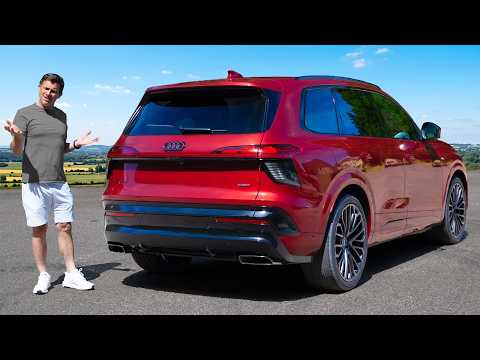
The strongest argument for the Marc Philipp Gemballa Marsien GT is made through its details rather than its headline performance figures. Instead of presenting the car as merely a lowered version of the off-road Marsien, the video carefully walks through the substantial body changes, from the squared-off front intakes and wheel-arch extraction vents to the roof scoop, enormous 959-inspired rear wing, active aerodynamic elements, and aggressive diffuser. That attention gives viewers a convincing sense that this is a thoroughly reworked 911 rather than a conventional Turbo S wearing an extravagant body kit.
The connection to Porsche history is particularly effective because the 959 influence extends beyond superficial nostalgia. The presenter briefly explains why the original 959 was so technologically remarkable for its era, citing its sophisticated all-wheel-drive system, sequential turbocharging, adaptive suspension, composite construction, magnesium wheels, tire-pressure monitoring, and near-200-mph performance. Those historical points provide useful context for why the Marsien GT's shape matters, although the rapid presentation leaves little room to examine those claims or the engineering lineage in greater depth.
Performance is predictably extreme. The car uses a RUF-tuned twin-turbo flat-six with 830 horsepower as standard, while a 900-horsepower version is offered as an upgrade. The stated 0-to-62-mph time of 2.4 seconds and 205-mph top speed place the Marsien GT firmly in supercar territory on paper, but these remain quoted specifications rather than demonstrated results here. The engine is started, yet the absence of an actual road drive means viewers never discover how the wider chassis, aerodynamic changes, suspension setup, or additional power affect the experience behind the wheel.
The cabin provides one of the more interesting surprises. Rather than simply rebadging a standard 911 interior, the Marsien GT receives a redesigned bridge-style center console intended to evoke Porsche supercars such as the Carrera GT and 918, along with a Carrera GT-inspired gear selector and GT3 RS paddles. The presenter also makes a persuasive enthusiast's case for retaining the earlier 992 Turbo S donor's physical tachometer and twist-style starter. Some of the commentary is openly subjective, particularly the criticism of newer Porsche controls, but those opinions give the interior discussion personality while making clear what the presenter values in a special car.
There is also welcome context around Marc Philipp Gemballa and the company's origins. The explanation of the connection to Uwe Gemballa, the reason for the newer company's name, and the earlier Marsien project prevents the GT from appearing without background. The limited production plan is similarly meaningful: 30 GTs will complement 40 Marsiens for a total of 70 cars, described as a tribute to Uwe Gemballa's 70th birthday. A short conversation with Marc Philipp Gemballa also establishes that the company intends to pursue additional road-focused projects rather than treating this as a one-off exercise.
The weakest part of the evaluation is the value discussion. A starting figure of €770,000 before tax, options, and the donor car makes the Marsien GT extraordinarily expensive, and the presenter estimates that a finished example could effectively reach around a million in the relevant currency once everything is included. Calling it a possible bargain within the rarefied world of hypercars and Porsche restomods is an entertaining observation, but the video does not provide enough direct comparison with rivals to establish that case. Several competing Porsche-based supercars are named, yet none receives the detailed specification, craftsmanship, performance, or pricing comparison necessary to determine where the Marsien GT genuinely stands.
Pros
- Gives a detailed exterior tour that clearly identifies how extensively the Marsien GT differs from the off-road Marsien.
- Connects the design to the Porsche 959 through useful historical and technological context rather than styling alone.
- Clearly explains the 830-horsepower standard configuration, optional 900-horsepower tune, and claimed performance figures.
- Highlights meaningful cabin changes instead of treating the interior as an afterthought.
- Provides useful background on Marc Philipp Gemballa, the original Marsien, limited production, and plans for future road cars.
- Energetic commentary makes a highly technical walkaround accessible without losing enthusiasm for the engineering details.
Cons
- There is no driving segment, leaving the car's handling, ride, braking, performance, and overall character unevaluated.
- The claimed acceleration and top-speed figures are presented without independent demonstration.
- The suggestion that the car could represent relative value is not supported by a detailed comparison with the Porsche-based alternatives mentioned.
- Some historical and technical material moves quickly enough that significant engineering concepts receive only brief explanations.
The Marsien GT receives an engaging and unusually detailed introduction that succeeds at explaining why this is more ambitious than an expensive modified 911. Its combination of 959-inspired design, extensive bespoke bodywork, serious power, and thoughtful interior changes makes a compelling case for the concept, but without driving the car or seriously comparing it with its costly rivals, this remains an excellent first look rather than a complete assessment.