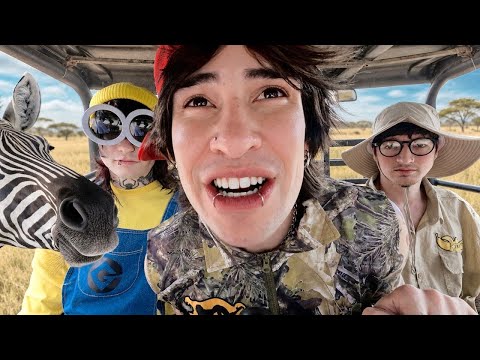
A katana slicing cleanly through a human body is exactly the kind of exaggerated fictional image that gives Hank Green and Erika Ishii a productive place to start. Green works through sharpness, force, blade durability and historical sword-testing practices before explaining why the familiar image of a bisected person remaining upright cannot work as depicted: severing the spinal cord would immediately eliminate the brain’s control of the legs. It establishes the episode’s basic formula well, taking a playful question seriously enough to investigate it without pretending that fantasy conventions must obey reality.
Ishii proves particularly well suited to that format because the questions reveal genuine curiosity rather than simply setting Green up to deliver prepared facts. Their discussion of the Voynich manuscript expands into the mysteries of extinct human relatives, lost cultures and what interactions among different human species might have looked like. Some of this section necessarily becomes speculative, and Green generally signals that uncertainty with language about possibilities rather than presenting imagined Neanderthal cultures or interspecies relationships as established history. The willingness to follow interesting tangents makes the conversation lively, although it also means individual subjects are rarely explored comprehensively.
The pet-fox discussion is one of the clearest examples of the show balancing an appealing premise with an inconvenient scientific answer. Green describes reported physical differences between urban and rural foxes and connects them to traits associated with domestication, including the results of selective-breeding experiments in which foxes chosen for friendliness also developed other changes. Crucially, he does not turn early signs of adaptation around humans into a claim that foxes are inevitably becoming pets. His distinction between animals adapting to urban environments and a genuinely domesticated population is useful, as is the blunt reminder that wanting a fox partly because it seems wild conflicts with what domestication would actually remove.
The placebo discussion is fascinating but less disciplined. Green distinguishes the reported increase in placebo responses in some research from open-label placebos, where people know they are receiving an inactive treatment, and offers possible explanations involving greater interaction with healthcare providers and expectations formed by previous experience with medicine. He and Ishii also repeatedly emphasize that placebo responses do not mean belief can treat everything, explicitly rejecting ideas such as crystals reducing viral load or treating cancer. Even so, the conversation moves rapidly from clinical research to personal anecdotes about sleep, THC, CBD, pain and crystals, leaving several claims with less qualification and evidentiary detail than a medical subject ideally deserves.
A question about developing empathy later in life produces the episode’s most serious and sprawling exchange. Rather than claiming there is a simple technique for making people care, the discussion centers on trust, fear, social groups, media incentives and the difficulty of listening across political divisions. Green argues that fear can make it easier to exclude people from one’s moral concern and describes attention-driven media systems as reinforcing distrust and polarization. These are presented largely as interpretations of complicated social dynamics rather than settled conclusions, but the section ranges across algorithms, cable news, gerrymandering, political communication and specific public figures without enough supporting research to turn the conversation into a rigorous explanation of empathy itself.
The closing ferrofluid question returns the show to imaginative science and demonstrates why the pairing works. Green separates Ishii’s distant dream of becoming a T-1000-like shape-shifting substance from technologies that actually exist, then improvises a much more limited concept involving ferrofluid and electromagnetism. He openly labels the more ambitious possibilities as extremely distant rather than dressing speculation up as technological forecasting. More broadly, Ishii’s enthusiasm continually gives Green new directions to explore, while their closing discussion about asking people what they enjoy rather than merely what they do neatly reinforces the episode’s larger interest in curiosity as a way of understanding someone. The sponsor break and repeated podcast or project mentions interrupt the flow somewhat, but they do not overwhelm an unusually energetic conversation.
Pros
- Uses imaginative questions about katanas, foxes, placebos and ferrofluids to make scientific concepts approachable.
- Clearly explains why urban fox adaptation does not automatically mean pet foxes are imminent.
- Frequently distinguishes established mechanisms, plausible hypotheses and outright speculation.
- Ishii’s enthusiasm and follow-up questions create genuine conversational chemistry rather than a rigid interview.
- The katana discussion effectively connects physics, anatomy, history and fictional conventions.
- Serious subjects such as empathy and polarization are approached with appropriate acknowledgment of their complexity.
Cons
- Several discussions wander far beyond the original question and leave potentially interesting subjects only partially examined.
- The placebo section mixes research claims with anecdotes and playful examples in ways that sometimes blur the strength of the underlying evidence.
- The empathy discussion makes broad claims about media, algorithms, fear and political behavior without providing enough research detail to support a firm explanatory model.
- Promotional interruptions and references to outside projects occasionally disrupt the otherwise natural conversational rhythm.
Curiosity rather than any single scientific subject holds this conversation together, and Ishii’s unusual questions give Green plenty of opportunities to explain, speculate and occasionally admit where knowledge runs out. Its looseness sometimes sacrifices depth and evidentiary precision, particularly on placebo effects and empathy, but the combination of intellectual playfulness, clear caveats and strong chemistry makes the wide-ranging discussion consistently engaging.