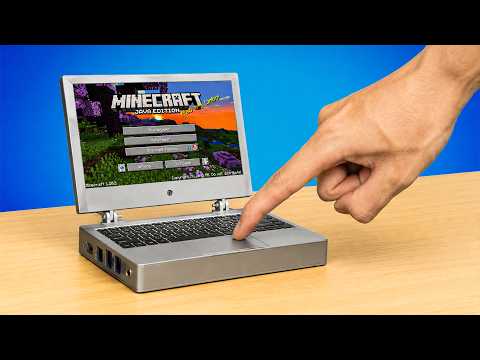
A discarded Dell Latitude 3490 with a dual-core Core i3-6006U, 4GB of single-channel RAM and integrated graphics is about as unpromising a gaming platform as possible. The opening Minecraft test establishes that limitation effectively: roughly 30 FPS quickly deteriorates during movement, memory is completely occupied, and the machine even hits zero FPS. Starting with such an obviously constrained system gives the eventual transformation a meaningful baseline rather than relying on vague before-and-after impressions.
The central modification is both clever and well explained. Because the laptop lacks a conventional PCIe expansion slot, its M.2 connection is repurposed through an M.2-to-PCIe adapter for a desktop graphics card. That forces storage elsewhere, initially through USB-C and later through a storage extension cable, while a separate 400W Flex ATX power supply handles the GPU. A GTX 1050 Ti proves the concept before the final build receives a GTX 1650 4GB, and another 4GB of RAM brings the system to 8GB while enabling dual-channel operation. The presentation does a good job of showing how each limitation creates the next engineering decision.
Turning those exposed components into an actual computer rather than leaving them scattered across a desk makes the project considerably more interesting. Measurements feed into a custom 3D-printed enclosure with dedicated I/O access, ventilation, threaded inserts and mounting points for the motherboard, GPU and power supply. Mistakes are left in rather than concealed: one printed part has to be redone, missing standoffs require improvised mounting points, and a forgotten opening for the laptop's power connector gets drilled afterward. Those imperfections make the fabrication process feel practical and credible while demonstrating useful techniques for securing components inside a custom chassis.
There is also thoughtful attention to details that could easily have been ignored in a novelty build. The dirty laptop fan gets cleaned, the graphics card receives additional physical support, the unnecessarily long PSU wiring is reduced, and the power supply gets its own external switch. Clear acrylic on top preserves visibility of the internals while ventilation slots provide additional airflow. The finished machine may resemble a radio more than a conventional gaming PC, as the creator jokes, but it looks like a deliberately constructed system rather than a temporary demonstration.
Performance testing provides the project's payoff while also exposing its limits. Minecraft jumps from barely playable behavior to around 200 FPS or more under the demonstrated conditions, although frame-rate drops remain and GPU utilization shows that the GTX 1650 is being badly restricted by the old processor. Adding a relatively simple shader pack at reduced settings produces a more balanced workload and a reported 60–70 FPS. These tests convincingly demonstrate that the dedicated GPU and memory upgrade have dramatically expanded what the old hardware can do, even though they do not amount to a comprehensive benchmark suite.
Cyberpunk 2077 supplies an entertaining finale but also prevents the transformation from being oversold as a genuinely capable modern gaming PC. At 720p, the game manages only about 13 FPS while the CPU remains fully utilized and approaches 100 degrees Celsius. Being able to launch such a demanding game is amusing proof of how far the system has come, but it is not playable performance, and the temperature is a clear warning that the original laptop cooling system remains a serious constraint. More extensive temperature measurements, longer gaming tests and benchmarks across several games would have made the practical limits of the finished machine much clearer.
Pros
- Establishes a clear before-and-after comparison with the original laptop's extremely poor Minecraft performance.
- Repurposing the M.2 connection for a desktop GPU is explained clearly and gives the project a strong technical foundation.
- The custom 3D-printed enclosure turns an improvised hardware experiment into a cohesive finished build.
- Design mistakes and improvised fixes are shown openly, making the fabrication process more useful and believable.
- The RAM upgrade, GPU selection, dedicated power supply and mounting decisions reflect the limitations of the original hardware rather than simply chasing maximum specifications.
- Final testing demonstrates a dramatic improvement while openly showing the severe CPU bottleneck.
Cons
- Gaming testing is too limited to establish how useful the finished system would be across a broader range of titles.
- Cyberpunk 2077 running at roughly 13 FPS is more of a successful launch demonstration than evidence of practical gaming capability.
- The CPU approaching 100 degrees Celsius raises an important thermal concern that is identified but not investigated or addressed.
- There is no complete project cost breakdown to show whether the conversion makes economic sense compared with buying different used hardware.
- Longer stability, power and temperature testing would have better established whether the custom machine is suitable for sustained use.
The project succeeds most convincingly as a creative hardware rescue rather than as a route to a powerful budget gaming computer. Smart use of the M.2 interface, thoughtful enclosure work and dramatic Minecraft gains make the transformation satisfying, while the weak CPU, extreme temperature and limited benchmarks keep its practical capabilities firmly in perspective.