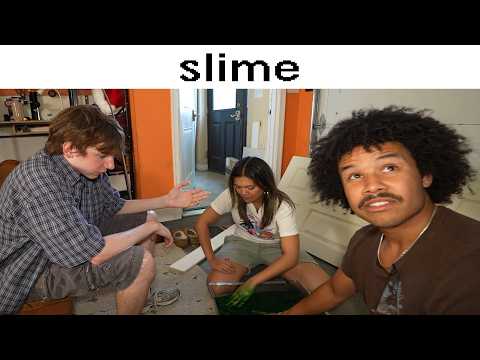
The most interesting idea here is not simply replacing an aging bathroom treatment, but recognizing that DIY skills have to evolve when projects move beyond decorative experimentation. The creator looks back at two earlier renovations with enough distance to identify what no longer works: peel-and-stick subway tile that is lifting and yellowing, and a faux-stone wall whose flat, digitally printed appearance no longer satisfies her. With a Victorian-themed coffee shop looming in the future, these household redos become practice for working with more durable materials and methods. That gives the episode a stronger purpose than cosmetic dissatisfaction alone, even though only one of the two planned transformations actually reaches completion.
The bathroom provides the clearest test of that progression because the replacement involves real ceramic subway tile rather than another temporary surface treatment. The process is refreshingly imperfect. A level establishes the starting line, a small test section provides some confidence before committing to the wall, and edge pieces are scored and cut as the installation progresses. More importantly, mistakes remain visible. The tile calculator badly underestimates the amount required, leaving the first box sufficient for only about half the wall, while narrow cuts create additional waste. Grouting proves messier and more exhausting than expected, and waiting too long before cleaning excess grout leaves residue beginning to harden on the tile. Those problems make the project more useful as a DIY account because the finished wall is not presented as the product of effortless competence.
There are practical lessons embedded in those setbacks, although the video remains more project diary than comprehensive tutorial. The creator warns about sharp ceramic edges, demonstrates scoring tile, recognizes that grout cleanup would have been easier in smaller sections, and finds that a proper grouting sponge improves the process. At the end, she also acknowledges unfinished details: fixtures still need to be secured properly, grout sealer needs to be applied, and paint requires touching up. That honesty is valuable, but it also complicates the claim that the new surface is unquestionably going to last forever. Real tile is clearly being treated as the more permanent solution here, yet the video does not establish lifetime durability, particularly while sealing and fixture installation remain incomplete.
The second project is visually more ambitious but narratively less satisfying because it stops midway. After removing the old plastic stone covering, the creator begins rebuilding the wall with insulation-foam scraps, EVA foam and joint compound, aiming for stones with greater depth and eventually a large artificial tree emerging from the wall and ceiling. Reusing scraps fits naturally with her established trash-based crafting approach, while varying the underlying thickness is a sensible artistic strategy for avoiding the flatness she disliked in the original wall. The comparison between premixed joint compound and powder mixed with water is also useful within the context of this particular build: she finds the premix too runny for the effect she wants and ultimately prefers the material she mixes herself.
Humidity then becomes the episode's most consequential obstacle. The joint compound remains wet or gummy after sitting overnight, especially in areas made with the premixed product, preventing the planned layering, smoothing, sanding and painting. Rather than force the wall through those stages to meet the video's schedule, the creator decides to continue it in a second installment. That is a sensible decision and one of the episode's better moments of self-assessment. She explicitly recognizes the alternative—trying to dry everything, finish the build, paint it, clean up and then rush through editing late into the night—and chooses not to manufacture a finished reveal at the expense of the process. The result is healthier pacing for the project, even if it leaves this particular episode structurally incomplete.
Presentation is driven heavily by personality, with exaggerated reactions, childhood scar stories, jokes about the mess and frequent commentary about the creator's own working habits. That keeps long stretches of tiling, cutting and joint-compound work from becoming monotonous, and the willingness to show miscalculations and fatigue gives the renovation an appealingly unpolished character. At the same time, digressions sometimes pull attention away from the actual construction. The lengthy sponsored grocery segment arrives before the main work has gathered much momentum, while stories and comedic asides occasionally interrupt moments where more precise explanation of materials, measurements or installation choices would have made the episode stronger as DIY instruction.
Ultimately, the bathroom redo succeeds more as a demonstration of growth than as a dramatic makeover. Visually, the final room is intentionally very similar to the earlier design, so the payoff comes from replacing a deteriorating imitation surface with actual tile rather than reinventing the aesthetic. That makes the reveal understated but thematically appropriate: improvement here means learning to execute an existing idea more convincingly, not constantly inventing something new. The unfinished rock wall prevents the episode from delivering the broader transformation promised at the outset, but its failure to cooperate also reinforces the video's central point. Becoming better at DIY includes recognizing bad estimates, unsuitable material consistency, drying problems and unrealistic schedules instead of disguising them behind a polished reveal.
Pros
- The bathroom project shows meaningful progression from a deteriorating peel-and-stick treatment to working with real ceramic tile.
- Miscalculations, difficult cuts, grout cleanup problems and fatigue are retained rather than edited into an unrealistically smooth renovation.
- Practical observations about scoring tile, cleaning grout sooner and using a grouting sponge emerge naturally from the work.
- The redesigned stone wall has a clear goal of adding dimensionality, with scrap foam used to vary depth while reducing the amount of joint compound needed.
- Choosing to postpone the second project rather than rush wet materials into a forced reveal demonstrates sensible project management.
Cons
- The episode promises two redos but completes only the bathroom, leaving the more ambitious stone wall and tree without a payoff.
- Important installation details remain unfinished in the bathroom, including securing fixtures, sealing the grout and touching up paint.
- The tile quantity calculation proves substantially inaccurate, creating an avoidable interruption and highlighting limited advance planning.
- The long sponsorship and frequent comedic digressions reduce the amount of focused DIY instruction.
- Claims about the new bathroom surface lasting forever go beyond what the project itself can demonstrate.
The strongest part of this renovation is the willingness to redefine improvement as better execution rather than a more spectacular design. The bathroom ends up looking broadly like it did before, but the creator addresses the specific flaws that had bothered her for years and gains experience with a more involved installation in the process. Just as importantly, the video leaves in the wrong material estimate, messy grouting, slow cutting and unfinished details that make real DIY projects considerably less tidy than their final photographs suggest. The rock wall is more frustrating because its transformation is only beginning when the episode ends, but postponing it is preferable to pretending damp joint compound can be rushed into a finished build. As a complete makeover video, the missing second reveal limits the payoff. As a candid account of recognizing old mistakes, attempting more durable techniques and learning when a project needs more time, it works considerably better.