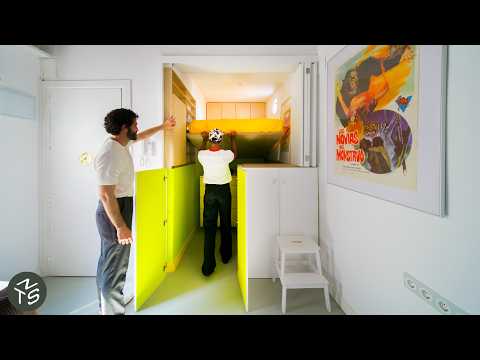
Sam’s clothes rack was doing a job his tiny closet couldn’t handle, but he was tired of seeing his wardrobe out in the open. Alexandra’s opening conversation gives the makeover a practical brief. Sam wants closed storage, softer lighting, and a coffee table. He already likes watching TV in the studio and works from the kitchen, so there’s little reason to carve out space for a desk. Those details give the eventual reveal something more concrete to deliver than a change of color.
The bed nook shows how much the team can do by keeping a layout that already works. The queen mattress fits so tightly between the walls that Alexandra and her team abandon the search for a new frame. Turning the bed would also cost Sam his nightstand and make the window harder to reach. A separate headboard, underbed storage, and a rolling side table improve the setup within those limits. The olive walls and striped Roman shade give the nook a finished look without asking it to accommodate more furniture.
Floating the leather sofa across from the TV is the bigger spatial change. Its position gives the seating area a boundary, while two slatted dividers help define where the kitchen ends and the living area begins. Graham’s adjustable divider also gives Alexandra a way to soften the abrupt edge of the dark paint. The build segment earns its time by showing how leftover material becomes a working feature, right down to the linked slats that turn together and let Sam control how much light passes through.
The $150 Marketplace armoire is the most satisfying purchase because it answers Sam’s first complaint directly. It has hanging space and two drawers, with more closed storage available in the sideboard beneath the TV. The lift-top coffee table does similar work in the living area, giving Sam a place to eat or use a laptop as well as another spot to put things away. Naming the armoire’s price makes that solution easy to assess, though the episode gives too little cost information to judge how much of the finished room a viewer could recreate on a similar budget.
Alexandra also takes Sam’s complaint about the overhead spotlights seriously. Table lamps and a paper lantern give him several ways to light the room in the evening, and the new ceiling fixture sits high enough to suit the low ceiling. The navy accents pick up a color Sam likes, while a piece from his vintage fish art collection gives the room a detail that was already his. The styling feels more personal when Alexandra works with those preferences than when the finishing sequence settles into a succession of retailer names and accessories.
The episode has an easygoing rhythm when the team is solving problems together, though a fishing tangent and a pitch for virtual consultations interrupt that momentum. The sponsored rug has a clear reason for being there, since washability matters in a small apartment with a dog, but the extended sales copy and repeated offer take up time the makeover has already earned on its own. Sam’s reveal brings the focus back to the room. His surprise is fun to watch, and his comments about the drawer space, mirror, and improved flow give the reaction substance, even if the episode ends before he’s had time to live with the layout.
Pros
- The opening consultation establishes which parts of the studio need attention and which already suit Sam’s routine.
- The bed nook demonstrates how to improve a tight layout while retaining the existing bed setup.
- The floating sofa and slatted dividers define separate areas while allowing light to travel through the studio.
- Graham’s build segment shows how the adjustable divider works and what went into making it from scrap material.
- The secondhand armoire solves Sam’s main storage problem at a clearly stated price.
- The layered lighting and use of Sam’s fish art make the room feel suited to the person who lives there.
Cons
- The episode gives too little cost information to assess the makeover as a whole.
- The extended rug promotion and consultation pitch interrupt the pace of the installation.
- The fishing tangent takes attention away from an otherwise focused divider build.
- The immediate reveal leaves the everyday performance of the layout and storage untested.
Alexandra makes a small studio feel tailored to the way Sam already lives, which gives the transformation more staying power as a design idea than a dramatic reveal alone. The episode is most useful when it shows the reasoning behind each choice, and a fuller accounting of costs would make those ideas easier to apply.