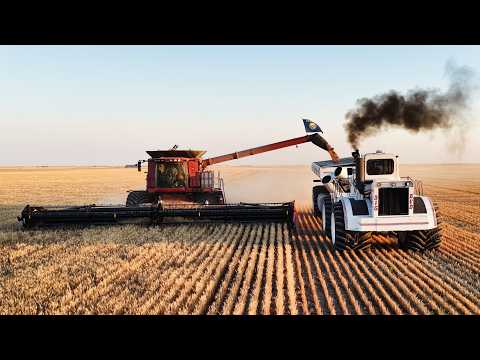
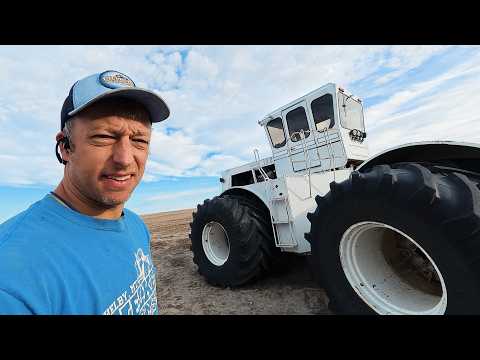
A forecast for two warm, dry days is enough to park the Big Bud and get the combines moving again. The crew wants to finish harvest before cooler, more humid weather comes in, while the operator’s father keeps seeding winter wheat with another drill. When the Big Bud goes back to seeding, the operator has a different reason to hurry. He says the moisture near the surface is receding, and waiting could mean planting deeper to reach it. The two jobs give the farm vlog a clear sense of why plans keep changing.
The harvest updates are especially good when the crew puts numbers to what they’re seeing. One field is running about 15 to 20 bushels an acre, and the operator attributes some of the damage to spring winds that moved topsoil and destroyed seedlings. A reading of eight bushels an acre elsewhere prompts a different explanation about how that ground responds to drought. The figures give the harvest some texture, while a quieter detour to a repaired reservoir lets the operator’s father share what he’s noticed about water levels and passing ducks over the years.
The family comes through in small moments. A child rides up on a balance bike for a turn in the tractor, and a conversation about what he can see from the cab follows a candid acknowledgment of how much the family depends on the women at home. That warmth fits the day-in-the-life format. The opening access-point repair and several later equipment updates are more uneven, especially when the conversation circles back to the temporary cable or assumes viewers already know the machinery.
A sunset recollection about harvesting before GPS gives the discussion of guidance a personal touch. The operator remembers circling fields behind a slower combine and eating its chaff, then explains how GPS lets each combine stay in its own lane. That memory makes it easier to appreciate what he’s trying to accomplish with automated turns, even if the talk about settings and rejoining a guidance line gets dense for anyone who has never run a drill.
The ditch incident works because the operator owns the mistake as it happens. He says the automated turn started late after he changed a setting, and by the time he took over, the front tires had slipped into the wet ditch. His decision to stop spinning the wheels gives the recovery a clear sequence, and Leg Arms bringing a 600 Big Bud to pull out the 700 makes for a dryly funny payoff. The late turn gets explained several times, though the pull itself is refreshingly quick.
The final calibration check resolves a problem introduced before harvest took over. Having forgotten to reset the acre counter on the first attempt, the operator records the hopper weights and checks product use against the field acreage on the next run. His seed calculation comes to about 163 acres on a 168-acre field, with overlap offered as an explanation for the difference. The fertilizer check is harder to follow because he draws from a second hopper near the end and gives a quicker account of how that affects the total.
Pros
- The switch between combining and seeding shows how the same stretch of dry weather creates two different deadlines.
- The bushels-per-acre readings make the variation between fields tangible.
- The child’s tractor ride and the recollection of harvesting before GPS give the work a personal history.
- The operator explains his own role in the ditch incident, and the second Big Bud provides an understated payoff.
- The hopper-weight check shows why the operator verifies the drill’s application rate after seeding.
Cons
- The access-point repair and repeated cable updates slow the episode’s early momentum.
- The discussion of automated-turn settings assumes familiarity with how a drill follows a guidance line.
- The explanation of the late turn repeats while the recovery is already underway.
- The closing fertilizer calculation is harder to verify because the contribution from the second hopper is left approximate.
The quick tow earns its place in a farm vlog that gives equal weight to getting unstuck and finding out whether the drill put down the right amount of seed. The pace wanders through some of the equipment talk, but the crew’s candor and the pressure of getting two jobs done in the same weather window hold the day together.