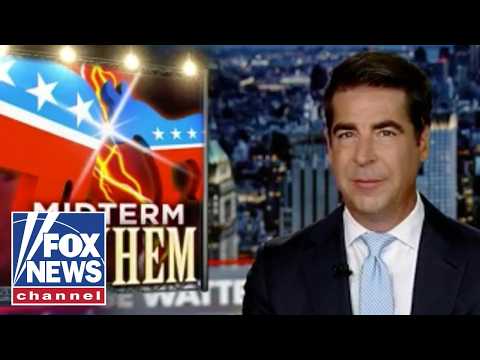
Chuck Schumer’s effort to describe Democrats as a “big tent” becomes the organizing target for a broader argument about whether the party can accommodate establishment figures, democratic socialists and insurgent Senate candidates without losing ideological coherence. The panel identifies a genuine political tension: Schumer is publicly supporting candidates who may be considerably less supportive of his leadership than traditional Democratic recruits. That contradiction gives the discussion a substantive starting point, even as several panelists rapidly move from analyzing it to predicting Schumer’s motives and political demise.
Paul Morro makes the most direct version of that argument, portraying Schumer as an establishment politician frightened by the possibility that Alexandria Ocasio-Cortez could eventually challenge him. His metaphors about an unhappy wedding and an aging man unsuccessfully pursuing younger women make the segment lively, but they also substitute ridicule for evidence. Assertions about Schumer’s finances, career history and personal fear of unemployment are presented confidently without supporting documentation, while the claim that his support for newer Democrats is driven primarily by self-preservation remains interpretation rather than demonstrated fact.
Jessica Tarlov provides the principal counterweight by pointing to Senate candidates Schumer successfully recruited and arguing that voters may care more about material issues than ideological labels. She also redirects attention toward healthcare, housing costs and public dissatisfaction with the Trump administration. That broadens the discussion beyond internal Democratic warfare, but her own factual claims—including polling percentages, economic conditions, deaths attributed to lack of healthcare and Trump’s alleged earnings—arrive just as rapidly and with little context. The resulting exchange becomes less an examination of Michigan or Florida than a competition between large political claims.
Jesse Watters returns the conversation to candidate liabilities, emphasizing controversial statements and positions attributed to Abdul El-Sayed and Angie Nixon. Some of these could be significant if accurately represented, particularly in a Senate campaign, but the segment does not provide enough surrounding context for viewers to evaluate what either candidate actually said or meant. An allegation involving El-Sayed’s mother-in-law is introduced with an “allegedly” qualifier but still becomes part of a wider insinuation about whether he belongs in the country or Senate. Similar shorthand reduces Nixon to a string of provocative characterizations rather than examining her platform in depth.
Greg Gutfeld offers the segment’s most developed thesis: expanding an organization to include ideological outliers can eventually drive away a larger number of moderates. That is a coherent argument and provides more analytical substance than the personal mockery elsewhere. Yet the supporting comparisons—to women’s sports, Protestant churches and the Daughters of the American Revolution—are asserted rather than demonstrated, and they move the discussion far from the Senate races that initiated it. His “normies versus radicals” framework also assumes the very categorization it is supposed to prove, leaving little room for voters whose positions do not fit either camp.
The panel’s chemistry keeps the pace energetic, particularly when opposing viewpoints collide over healthcare, DOGE, immigration and Trump. At the same time, interruptions and rapid topic changes prevent several potentially worthwhile disagreements from developing. The exchange illustrates genuine ideological divisions over what constitutes moderation, populism and acceptable political coalition-building, but it rarely establishes enough evidence to determine whose characterization is most accurate. By the closing minutes, “big tent” has become less a specific question about Democratic Senate strategy than a springboard for familiar disputes about the broader left.
As political commentary, the segment succeeds at exposing competing interpretations of Democratic coalition politics and giving viewers a clear sense of how conservative critics perceive the party’s ideological tensions. As analysis, it is much less disciplined: motives are inferred, candidates are reduced to inflammatory excerpts or labels, and factual claims from both sides frequently pass without sourcing or meaningful examination. The entertainment value is considerable, but anyone trying to understand the actual Senate candidates, their records or the electoral arithmetic would need substantially more context.
Pros
- Identifies a real strategic tension between Democratic establishment leadership and insurgent candidates who may not support that leadership.
- Jessica Tarlov provides meaningful ideological pushback and prevents the discussion from becoming entirely one-sided.
- Greg Gutfeld develops a recognizable argument about the electoral risks of coalition expansion rather than relying exclusively on candidate personalities.
- Fast pacing and strong panel chemistry make a dense political discussion energetic and accessible.
Cons
- Frequently assigns motives to Schumer and other politicians without providing evidence that those motives are established facts.
- Serious claims about candidates, finances, polling, healthcare and alleged associations are delivered with little sourcing or surrounding context.
- Personal ridicule and inflammatory labels often displace substantive examination of policy positions or electoral strategy.
- Rapid interruptions and detours into DOGE, immigration, transgender issues and religion dilute the original discussion about Democratic Senate politics.
- Controversial quotations and allegations involving El-Sayed and Nixon receive too little context for viewers to independently judge their significance.
A legitimate question about whether Democrats can reconcile establishment leadership with an increasingly diverse ideological coalition produces an energetic but loosely evidenced panel debate. The strongest moments expose genuine strategic disagreements, while the weakest rely on mockery, speculation and unexplored allegations. It works better as partisan television commentary than as a careful assessment of the candidates or the Democratic Party’s electoral prospects.