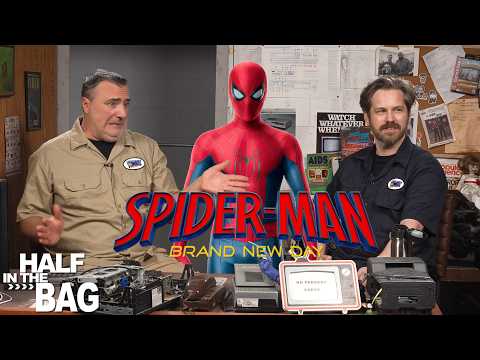
The strongest material comes from treating Tom Holland’s decade as Spider-Man as a personal and creative evolution rather than merely a promotional timeline. He reflects thoughtfully on entering the role as a teenager, gradually gaining confidence within the filmmaking process, and now feeling greater pressure because the latest installment carries more of his own input. That perspective gives the conversation an unusually reflective quality, especially when he contrasts the relative innocence of making Homecoming with the responsibility he feels after three solo films and several larger Marvel appearances.
Holland is particularly engaging when discussing how he physically developed his version of Spider-Man. His explanation of using dance experience, loose arm movements, masked body language, and small recurring gestures offers concrete insight into a performance that can easily be reduced to effects and stunt work. The discussion of costume changes is similarly effective, moving from practical concerns about removing the mask to the influence of earlier Spider-Man suits on the new design. These details reveal both craft and continuity without relying entirely on secretive plot information.
The retrospective sections also benefit from Holland’s willingness to clarify familiar stories. He describes the emotional technique behind Peter Parker’s death in Infinity War, acknowledges that his reputation for revealing spoilers has some basis, and explains that Marvel has occasionally leaned into the joke for publicity. His account of the temporary breakdown between Sony and Marvel is measured rather than sensational, emphasizing confusion and continued confidence in the filmmakers instead of presenting himself as the decisive force behind the studios’ reconciliation.
Discussion of No Way Home is warm and credible because Holland focuses less on its spectacle than on sharing the role with Tobey Maguire and Andrew Garfield. He communicates how unusual that experience was for the performers, while also praising director Jon Watts for making the reunion emotionally coherent rather than treating it as empty novelty. His enthusiasm for other versions of Spider-Man, particularly the animated films, further supports his claim that he still approaches the franchise as a fan, although the host’s repeated attempts to turn that enthusiasm into future casting or crossover revelations produce few substantial answers.
The most revealing material about Brand New Day concerns Holland’s expanded creative involvement. His description of pitching a “Spider puberty” concept—complete with stronger senses, new abilities, and abandoned horror imagery—offers a useful glimpse into how ideas evolve through collaboration. He is careful to identify which concepts were rejected and avoids presenting early brainstorming as finished material. His comments about a longer-term plan involving Miles Morales are intriguing, but deliberately vague, making this more of a statement of intent than meaningful information about a confirmed story.
The shorter conversation with Kevin Feige and Amy Pascal adds valuable institutional context, especially regarding the decision to place Spider-Man in the MCU, recast the character soon after Andrew Garfield’s films, and follow No Way Home with a more concentrated Peter Parker story. Feige’s acknowledgement that the stalled Blade project represents a personal failure is unusually direct, while his answers about Ghost Rider, Storm, Adam Driver, the X-Men, and future crossovers remain predictably guarded. Because the interview was recorded before several developments referenced by the host, some supposedly newsworthy exchanges already feel overtaken by events despite the opening explanation.
Presentation is lively and frequently funny, with Holland’s easy rapport with the host making the long conversation feel informal without becoming careless. However, the episode is interrupted by several extended advertising segments, repeated subscription appeals, and a closing rapid-fire section that varies sharply in usefulness. The playful questions humanize Holland, but they also consume time that could have supported deeper discussion of directing changes, character development, or the practical differences between the new film and earlier installments.
Pros
- Offers thoughtful reflection on how Holland’s relationship with Spider-Man has changed over a decade.
- Provides specific insight into physical performance, costume design, improvisation, and creative collaboration.
- Clearly separates rejected development ideas from material that actually appears in the new film.
- Includes useful perspective from Kevin Feige and Amy Pascal on the franchise’s major creative risks.
- Maintains an energetic, comfortable rapport that encourages candid answers.
Cons
- Reveals relatively little concrete information about Brand New Day despite framing it as a major focus.
- Several future-facing questions receive guarded or noncommittal responses.
- Extended advertisements and promotional reminders repeatedly interrupt the conversation.
- The final rapid-fire material is entertaining but less substantial than the retrospective discussion.
- Some news-oriented exchanges were already outdated by the time of release.
This is most rewarding as a reflective account of Holland’s growth within the Spider-Man franchise rather than as a source of major revelations about its future. Its detailed discussion of performance and collaboration outweighs the vague promotional teases, though tighter editing would have made the episode more focused and consistently informative.