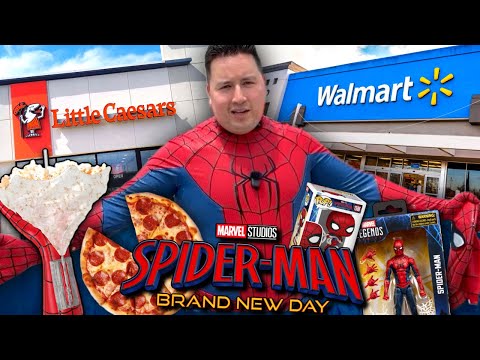
The strongest praise here comes from an unexpected place: the hosts believe a heavily managed studio production has nevertheless emerged as a coherent, emotionally engaging movie. Their opening jokes about executives, algorithms, lawyers, and previsualization teams establish the familiar skepticism, but the discussion gradually becomes an enthusiastic argument that this installment succeeds where many recent superhero films have felt synthetic. That tension between corporate construction and genuine feeling gives the review a useful central question rather than reducing it to a list of references and action scenes.
Much of the conversation focuses on the film’s visual improvement over the previous Tom Holland entries. The hosts repeatedly contrast flat green-screen environments and digitally manufactured costumes with visible shadows, physical locations, a fabric suit, and action that appears to have weight. Their comparisons are subjective and sometimes exaggerated for comedy, yet they clearly explain why the direction feels more cinematic to them. The recurring connection to Sam Raimi’s Spider-Man films is especially effective because it refers not only to poses or surface style, but also to street-level interactions, comic-book framing, and a stronger sense of Peter Parker as a person.
The discussion is equally persuasive when addressing the character reset. Peter begins isolated after everyone has forgotten him, and the hosts appreciate that the movie does not immediately reverse that consequence or restore his relationships through an easy contrivance. They describe his longing for MJ, his concern about revealing his identity, and his conflict between human vulnerability and increasingly dominant spider abilities as the emotional foundation beneath the spectacle. Their interpretation of the biological transformation as a metaphor for maturity, anxiety, and emotional repression may be broader than anything the film explicitly states, but it is grounded in the plot details they describe.
The crowded supporting cast could easily have become evidence of another overstuffed crossover, yet the review argues that most of the additions serve the story. The Hulk, Punisher, Jean Grey, the Hand, and the government research operation are presented as pieces of Peter’s immediate conflict rather than advertisements for unrelated projects. The hosts are particularly interested in the body-hopping mystery and the way Jean Grey’s loneliness reflects Peter’s own isolation. Florence Pugh’s appearance is identified as the clearest exception, functioning mainly as exposition and suggesting that even this comparatively disciplined production cannot entirely resist franchise obligations.
Their enthusiasm for the action is specific rather than automatic. The opening montage of Spider-Man performing everyday heroics, the fight with the Hand, and the confrontation involving the Hulk are praised for choreography, physicality, urgency, and comic-book imagery. Just as important, the hosts value smaller gestures—brief exchanges with civilians, casual encouragement directed at guards, and the image of a neighborhood hero moving through an inhabited city. These observations make a stronger case for the film than their broader declarations that it is the best Spider-Man entry in years.
The episode becomes less focused whenever it drifts into extended discussion of older X-Men films, controversial filmmakers, future casting rumors, Marvel’s release history, and speculative plans for a franchise reset. Some of this context supports the argument that audiences respond better to individual characters than to brand loyalty, but much of it relies on uncertain recollection, unverified financial generalizations, or guesses about future studio strategy. The repeated admissions that the hosts do not remember particular films, shows, characters, or production details preserve honesty, though they also weaken the authority of several industry-wide conclusions.
Comedy remains central to the presentation, with digressions about product placement, organic web shooters, fictional beverages, superhero withdrawal, and the hosts’ fragmented knowledge of continuity. The banter is often funny because it grows naturally from their genuine surprise at enjoying the movie, and their willingness to acknowledge gaps in their knowledge prevents the conversation from becoming falsely definitive. However, several jokes continue long after their point is clear, particularly the closing addiction metaphor for Marvel’s attempt to replace established heroes. The result is an entertaining and unusually positive discussion that could have reached its strongest conclusions with substantially tighter editing.
Pros
- Clearly explains why the film’s lighting, physical environments, costume design, and action feel more cinematic than previous entries.
- Connects Peter Parker’s isolation and changing powers to a meaningful internal conflict rather than treating the movie as pure spectacle.
- Identifies how most crossover characters contribute to the central story instead of merely promoting future installments.
- Gives specific attention to neighborhood-level interactions that restore Spider-Man’s humanity and personality.
- Maintains honest distinctions between direct observations, personal interpretations, uncertain memories, and franchise speculation.
Cons
- Extended X-Men and Marvel continuity digressions repeatedly pull attention away from the film being reviewed.
- Several claims about box-office performance, studio motives, and future franchise plans are speculative or loosely remembered.
- Florence Pugh’s apparently minor role is criticized without much examination beyond its expository function.
- Some comedy riffs, especially the prolonged withdrawal metaphor, outlast their strongest material.
This is an engaging defense of a superhero film that the hosts expected to dismiss but found visually confident, emotionally grounded, and recognizably human. Their strongest insights concern Peter Parker’s loneliness and the restoration of Spider-Man as a neighborhood hero, although loose franchise speculation and overextended jokes prevent the discussion from matching the discipline they admire in the movie.