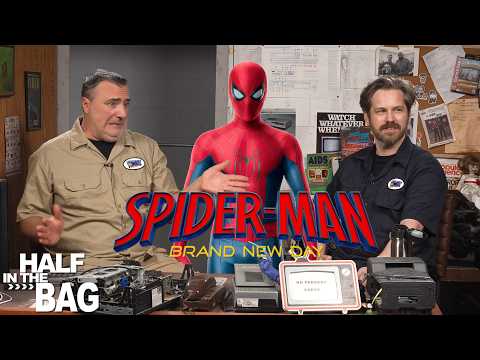
The most persuasive part of this review is its focus on stillness rather than spectacle. Instead of making swinging, fights or superhero cameos the primary argument for the film’s quality, the presenter repeatedly returns to moments when Peter is allowed to absorb grief, rejection and loneliness without an immediate joke or action beat. His discussion of the quiet exchange with MJ at Frank Castle’s hideout is particularly effective because he explains how minimal music, prolonged silence and Peter’s lack of an instant response make the scene meaningful. That attention to pacing gives the review more substance than its extremely enthusiastic opening initially suggests.
Peter’s characterization provides the strongest through line. The presenter makes a convincing case that MJ’s rejection matters not simply because Peter is heartbroken, but because his response demonstrates the qualities the film wants to preserve beneath the mask. He accepts her decision, still takes her home and does not punish her emotionally for failing to reciprocate feelings she cannot remember. The discussion of Peter admitting what happened while MJ was under Jean Grey’s control adds another useful dimension, emphasizing his concern for her agency, while the observation that he misses building Lego with Ned broadens his loss beyond romance. These examples support the argument that the film treats Peter’s isolation as the consequence of losing an entire personal life rather than merely a girlfriend.
The emphasis on Spider-Man actually traversing New York is another well-observed point because it connects visual presentation with character and setting. The presenter argues that repeatedly showing Peter swing between locations makes the city feel continuous rather than like a collection of disconnected sets, and his comparison of Spider-Man landing outside Damage Control and casually entering the building to a seamless videogame transition communicates what he finds immersive about the staging. His claim that the earlier MCU films lacked meaningful swinging sequences is expressed too absolutely, but the larger point is clear: here, movement through New York is being treated as part of the storytelling rather than only as connective spectacle.
The Frank Castle sequence is arguably the review’s best example of analyzing how tone serves theme. A joke about Peter awkwardly drinking coffee through his raised mask leads into Frank challenging Peter’s insistence that the two men are alike. The presenter clearly identifies the crucial distinction: Peter is isolating himself from people who are still alive, while Frank’s isolation follows losses he cannot reverse. That turns what begins as comic character interaction into an argument about Peter’s fear of reconnecting with others, and it supports the broader claim that humor can contribute to dramatic development instead of interrupting it.
Jean Grey receives the most ambitious defense, although this section also exposes the limits of the analysis. The presenter acknowledges the objection to making an X-Men character the primary antagonist of a Spider-Man film and argues that a telepathic character is particularly suited to a story about Peter’s deteriorating psychological state. More compelling is his interpretation of Peter and Jean as parallel figures whose grief and destructive choices bring them into conflict without making either a conventional monster. The Aunt May memory and the revelation concerning “V-Max” are presented as emotional payoffs to that structure. However, the explanation of why Jean was selected is explicitly the presenter’s speculation about the filmmakers’ reasoning, and claims about the director personally originating the idea or the larger franchise’s future direction are asserted without supporting evidence within the review.
The enthusiasm becomes less disciplined near the end. Sweeping declarations that every actor, including every background performer, is excellent are too broad to provide meaningful criticism, while statements about the action being filmed almost entirely practically are presented as fact without substantiation here. The video also spends little time on the flaws implied by its own admission that the film is not flawless. That omission matters because the stated purpose is not merely to celebrate the movie but to establish it above Spider-Man 2. The five-part structure supplies plenty of reasons for admiration, yet there is no comparable examination of weaknesses, making the ranking feel more like a strongly felt personal verdict than a demonstrated comparative case.
Even so, the presenter’s repeated viewings and close attention to individual scenes produce specific observations rather than empty hype. He is strongest when explaining why a silence lasts, why an apparently minor character decision matters, or how a joke changes the direction of a conversation. The weakest moments come when enthusiasm turns subjective reactions into sweeping judgments or when behind-the-scenes and franchise claims are introduced without enough support. As an impassioned reading of Peter Parker’s grief, isolation and gradual willingness to reconnect, however, the video has a coherent argument and follows it consistently.
Pros
- Uses specific scenes and character choices to support its interpretation of Peter’s grief, loneliness and moral character.
- Particularly strong analysis of silence, restrained scoring and slower transitions as tools for allowing emotional moments to register.
- The Frank Castle discussion effectively explains how comedy can transition naturally into meaningful character conflict.
- Makes a thoughtful thematic case for Jean Grey by connecting her isolation and destructive choices with Peter’s own emotional trajectory.
- Connects Spider-Man’s traversal of New York to immersion and storytelling rather than treating swinging purely as spectacle.
Cons
- The claim that this surpasses Spider-Man 2 is not supported by a substantial direct comparison between the films.
- Despite acknowledging that the movie is not flawless, the review provides almost no meaningful criticism of its weaknesses.
- Several judgments become excessively absolute, particularly the blanket praise of the entire cast and dismissal of meaningful swinging in the earlier MCU films.
- Behind-the-scenes claims about creative decisions and practical action filmmaking are presented without supporting evidence.
- Speculation about why Jean Grey was chosen is interesting but cannot establish the filmmakers’ actual reasoning.
The video works best as a passionate close reading of a Spider-Man story centered on loss, isolation and the difficult choice to reconnect with other people. Its detailed scene analysis gives the enthusiasm genuine substance, but the lack of serious criticism and direct comparison prevents the “greatest” verdict from being fully earned as an argument. As an explanation of why the film resonated so strongly with its presenter, it is focused, specific and frequently insightful.