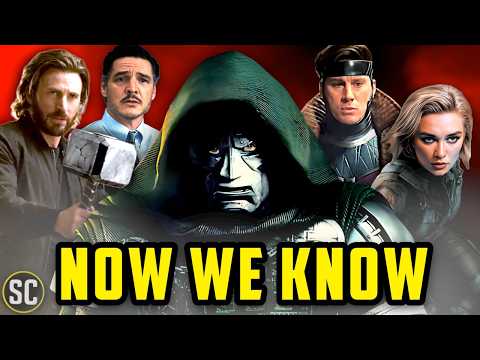
The most persuasive part of Eric Voss's theory is not the proposed mechanics of Doctor Doom's plan, but the attempt to find a single idea connecting several otherwise disconnected trailer details. A countdown gives the heroes less than a day to confront an incursion involving three worlds, Doom appears to withstand Thor's attack rather than openly pursuing him, and a display attributed to Reed Richards shows three color-coded Earths alongside three moving shapes. Voss interprets those shapes as magnets and uses that observation as the foundation for a larger theory: Doom has deliberately manipulated the electromagnetic properties of three Earths, causing them to attract one another so he can combine their worlds and exploit powerful reality-altering characters. It is an inventive framework, and the video makes clear that this is speculative trailer analysis rather than established plot information.
The trailer material provides some useful anchors. Doom's restrained line delivery is contrasted with the overtly villainous introductions of previous Avengers antagonists, leading Voss to suggest that Victor may initially present himself as an ally rather than announce himself as the threat. From there, Franklin Richards, Loki, Wolverine, and Wanda Maximoff become possible targets whose abilities Doom might need. The basic suspicion that a simultaneous three-world incursion could have been deliberately engineered gives the theory narrative logic, but the specific list of characters quickly becomes conjectural. The video frequently moves from a plausible question—who caused the crisis?—to increasingly specific answers about Doom's strategy without equivalent evidence for each additional step.
The official tapestry receives the most detailed interpretation. Voss examines a mother and child, angelic figures, a cracked globe, surrounding orbs, a castle, and figures beneath the world, then considers whether the central pair represents Victor and his mother Cynthia, Victor's lost family, or Susan Storm and Franklin Richards. The comics material involving Cynthia, Mephisto, Franklin, Doctor Strange, and Doom's efforts to rescue his mother's soul gives this imagery a meaningful thematic context rather than treating every shape as a hidden plot code. The strongest parallel is Franklin's established role in a Doom story involving Cynthia, because it provides an actual comics precedent for connecting those characters. Even so, multiple interpretations remain possible, and the video is at its best when it acknowledges that uncertainty.
Other readings of the tapestry stretch much further. The crack in the globe becomes a possible canyon, continental border, Great Wall, border wall, or reference to Ben Grimm's role as a literal wall on Battleworld. The surrounding orbs inspire speculation about multiple moons, tidal control, and even Moon Knight. These connections are imaginative, but their abundance weakens the argument because almost any unusual visual feature can be mapped onto some element of Marvel history. The tapestry may indeed foreshadow Doom's worldview or ambitions, but the video does not establish which symbols are intentional clues and which are simply features of the artwork. A tighter distinction between thematic parallels and predictive evidence would make the analysis more convincing.
The magnetic interpretation of Reed's display is the video's most interesting visual observation. Voss notices that the shapes inside three circles appear to move and concludes that they represent magnets demonstrating attraction among the three Earths. That reading also gives him a way to connect reported comments about Magneto destroying New Jersey with the larger incursion plot. He proposes that Magneto could invert Earth's electromagnetic poles to repel one universe from the others, while potentially generating an EMP against Sentinels. As a piece of superhero plotting, the concept neatly gives Magneto's powers a planet-scale function directly relevant to the multiversal crisis.
The problem is that the theory then treats comic-book magnetism as though it supplies a complete physical mechanism for incursions. Changing Earth's magnetic field is not shown here to be equivalent to making separate universes physically attract one another, and the trailer imagery alone cannot establish that Doom has altered planetary cores. The proposed tidal consequences, Sentinel strategy, Wanda connection, and targeting of Westview pile additional hypotheses onto the initial magnet observation. Voss also invokes possibly leaked VFX material concerning Doom and Sentinels, which is inherently less secure than the official footage and poster serving as the video's main evidence. By the end, the magnetic theory has become an explanation for Doom's plan, Magneto's actions, New Jersey's destruction, Wanda's relevance, the Sentinels, and Battleworld despite beginning with a few ambiguous shapes on a display.
As entertainment, however, the episode benefits from Voss's enthusiasm and ability to move between trailer frames, poster imagery, comics history, cast comments, and possible story mechanics without losing the central thread. The closing magnet joke appropriately acknowledges the playful nature of the exercise. The merchandise promotion near the beginning interrupts the analysis before the argument has properly started, and several speculative branches could be trimmed without sacrificing the core theory. Still, the video succeeds at what detailed trailer speculation often does best: finding a small visual clue, testing how many known pieces it could connect, and producing a prediction specific enough for the eventual movie to confirm or dismantle.
Pros
- The three-Earth display provides a specific visual clue around which the larger incursion theory can be organized.
- Connecting the tapestry's mother-and-child imagery with Cynthia von Doom and Franklin Richards draws on relevant comics material rather than relying entirely on visual resemblance.
- The theory gives Magneto a plausible story function within an incursion crisis instead of treating his destructive role as an isolated action sequence.
- Voss considers multiple interpretations of several symbols rather than pretending every visual detail has one obvious meaning.
- Trailer footage, poster imagery, comics parallels, and reported comments are combined into a coherent theory with clear predictions about Doom's possible plan.
Cons
- The theory accumulates speculative assumptions rapidly, moving from magnet-like imagery to manipulated planetary cores, engineered incursions, reality warpers, tidal destruction, Sentinels, Wanda, and Battleworld.
- Several tapestry interpretations, particularly the border-wall, multiple-moon, tidal-control, and Moon Knight connections, are too loosely supported to contribute much predictive value.
- The proposed electromagnetic mechanism does not explain how changing a planet's magnetic properties would cause separate universes to collide, beyond the visual metaphor suggested by Reed's display.
- Possibly leaked VFX material is incorporated alongside official promotional evidence despite carrying greater uncertainty.
- The early merchandise segment interrupts momentum before the central visual discovery and theory have been established.
The magnetic clue is clever because it potentially gives one simple visual idea relevance to Doom, the three-way incursion, Reed Richards, and Magneto at the same time. Voss also finds worthwhile thematic material in the tapestry, especially where Victor's family history and Franklin Richards intersect with comics precedent. The analysis becomes less convincing when every additional symbol is expected to fit the same prediction and one ambiguous display grows into a detailed explanation of Doom's entire strategy. Magnetism may prove important to the heroes' response, Doom may be engineering the crisis, and the tapestry may foreshadow Battleworld or Victor's family motivations, but the material presented cannot yet establish that these possibilities belong to one mechanism. As trailer theorizing, the episode is energetic, observant, and unusually specific; as a prediction of the movie's actual plot, it remains an elaborate hypothesis built around a genuinely intriguing but still ambiguous detail. :::