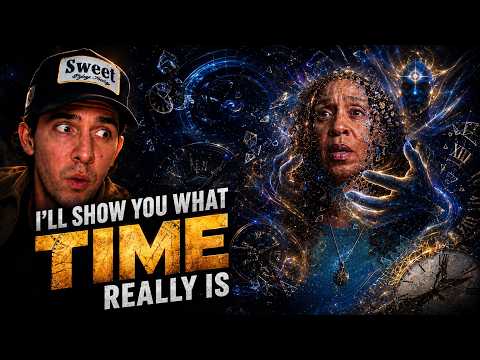
Some interviews challenge your opinions. Others challenge your entire worldview.
This fascinating conversation explores some of the biggest questions humanity has ever asked: What happens after death? Is consciousness separate from the body? Can out-of-body experiences reveal objective reality? And is love the fundamental force behind existence? Whether viewers find the claims convincing or highly speculative, the discussion is undeniably thought-provoking and difficult to ignore.
The interview centers around a guest who describes a profound near-death and out-of-body experience at age sixteen that he believes permanently altered his understanding of reality. According to his account, he encountered a spiritual being who showed him visions of future events, explained the nature of time, and revealed what he believes is humanity's true spiritual identity. He claims many of those visions have unfolded throughout his life, forming the foundation for everything he teaches today.
Rather than presenting these experiences as isolated mystical events, the guest argues they can be intentionally reproduced through deep meditation and controlled sleep paralysis. He describes techniques for consciously entering altered states of awareness and claims that anyone willing to practice can eventually experience leaving their physical body. The discussion includes numerous personal anecdotes about verifying information during these experiences, viewing locations remotely, and witnessing future events before they occurred. These extraordinary claims are presented confidently, though they remain outside mainstream scientific consensus.
One of the interview's strongest aspects is its exploration of fear versus love. Rather than focusing on supernatural phenomena simply for entertainment, the conversation continually returns to the psychological and spiritual implications of fear. The guest argues that fear creates limitations while unconditional love represents the highest state of consciousness and the true nature of existence. Regardless of one's beliefs about out-of-body experiences, this philosophical discussion forms the emotional core of the interview.
The host does an excellent job balancing curiosity with thoughtful follow-up questions. Instead of simply accepting extraordinary claims at face value, he continually asks for clarification, comparisons with psychedelic experiences, and practical explanations. Their chemistry creates an atmosphere that feels more like two explorers exchanging ideas than a debate between skeptic and believer. This conversational style keeps even the most unconventional topics engaging.
The discussion expands far beyond near-death experiences into subjects including consciousness, free will, religious traditions, ancient civilizations, collective thought, sleep paralysis, meditation, life after death, reincarnation, and the concept of humanity's forgotten spiritual origins. References to texts such as the Book of Enoch, Atlantis, multidimensional realities, prophetic visions, and spiritual entities make this feel less like a traditional interview and more like an expansive philosophical exploration.
Perhaps the interview's most compelling message is surprisingly simple: regardless of metaphysical beliefs, choosing love over fear transforms how people experience life. The guest repeatedly emphasizes forgiveness, compassion, and self-awareness over judgment or dogma. Even viewers who reject many of the paranormal claims may still find value in this underlying philosophy.
That said, this interview will almost certainly divide audiences.
Many of the central claims—including remote viewing, prophetic visions, multidimensional travel, spiritual beings, ancient galactic civilizations, and conscious out-of-body exploration—are presented largely through personal testimony rather than independently verifiable evidence. Viewers looking for rigorous scientific validation may find the conversation frustrating, while those interested in consciousness research or spirituality will likely find it captivating. The interview asks viewers to remain open-minded, but it also asks them to accept a number of extraordinary assertions that extend well beyond established scientific understanding.
The conversation is also extremely dense. Topics often branch into multiple philosophical directions before returning to the original question, requiring sustained attention from the audience. Those expecting concise answers may occasionally feel overwhelmed by the sheer volume of ideas presented.
Pros
- Fascinating discussion on consciousness, near-death experiences, and spirituality.
- Thought-provoking exploration of fear, love, and human potential.
- Excellent chemistry between host and guest.
- Covers a wide range of philosophical and metaphysical topics without feeling repetitive.
- Encourages viewers to think critically about their own beliefs rather than simply accepting dogma.
- Raises genuinely interesting questions about consciousness, regardless of where viewers land on the claims.
Cons
- Extraordinary claims rely primarily on personal experience rather than empirical evidence.
- Some discussions become highly speculative.
- Runtime is lengthy and intellectually demanding.
- Viewers seeking scientific rigor may remain unconvinced by many of the conclusions.
This is less an interview and more a philosophical journey into the deepest questions surrounding consciousness and human existence. Whether discussing near-death experiences, sleep paralysis, meditation, ancient civilizations, or the possibility of life beyond physical death, the conversation consistently encourages viewers to question assumptions they may have held their entire lives. You don't have to accept every claim presented to appreciate the interview. In many ways, its greatest strength isn't proving anything—it's inspiring curiosity. It invites viewers to explore difficult questions with an open mind while continually returning to a simple, universal principle: that love, compassion, and self-awareness may ultimately matter more than any paranormal experience. Believers will likely find the interview deeply affirming. Skeptics may challenge many of its conclusions while still appreciating its thoughtful discussion of consciousness and human psychology. Either way, it's an engaging conversation that lingers long after it ends.