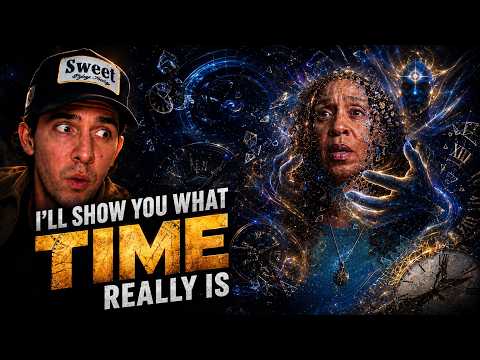
Few subjects generate as much fascination and controversy as astral projection. For decades, books by pioneers like Robert Monroe have inspired countless people to explore out-of-body experiences, spirit guides, reincarnation, and expanded states of consciousness. This interview turns that familiar narrative completely upside down. Rather than celebrating astral travel, the guest—who claims to have experienced dozens of out-of-body experiences himself—argues that the entire phenomenon is an elaborate deception orchestrated by spiritual entities. It is one of the most provocative and polarizing discussions on consciousness you'll likely encounter.
The conversation centers around a man who describes himself as a former New Age seeker turned committed Christian after years of studying astral projection, channeling, reincarnation research, remote viewing, and paranormal literature. Rather than dismissing these subjects from ignorance, he repeatedly emphasizes that he immersed himself in them before ultimately concluding that nearly every supernatural experience outside of Christianity is part of a coordinated spiritual deception.
His central thesis is both simple and radical: astral realms are not objective spiritual dimensions freely explored by consciousness, but carefully controlled simulations created by deceptive entities. According to his interpretation, spirit guides, ascended masters, and higher selves are all manifestations of the same underlying intelligence whose purpose is to reinforce false spiritual beliefs while leading people away from biblical Christianity.
Much of the discussion revolves around his extensive analysis of the writings of Robert Monroe and other well-known figures within the out-of-body experience community. The guest argues that certain passages describing simulations, altered perceptions, and manipulated environments unintentionally reveal the artificial nature of astral experiences. He presents these excerpts as evidence that experienced explorers themselves documented situations where their perceived realities could be completely manufactured without their awareness.
Where the interview becomes especially compelling is not necessarily in proving the theory, but in demonstrating how deeply the guest has thought through his position. Whether discussing reincarnation accounts, channeling literature, near-death experiences, or alleged alien encounters, he consistently attempts to fit every phenomenon into one overarching framework. Even listeners who disagree with his conclusions may appreciate the effort to create a unified explanation rather than treating each paranormal topic separately.
The host deserves considerable credit for maintaining an open but skeptical approach throughout the discussion. Rather than becoming confrontational, he repeatedly asks thoughtful questions that many viewers are likely asking themselves. He challenges the guest on topics such as faith, eternal punishment, religious exclusivity, morality, personal experience, and the diversity of spiritual beliefs without turning the interview into an argument. This balance allows the conversation to remain engaging despite covering highly divisive material.
One of the strongest sections explores how personal experience shapes belief. The guest explains that what ultimately convinced him was not blind faith but his own experiences, combined with years of comparative research. Meanwhile, the host counters by emphasizing honest inquiry, intellectual humility, and the difficulty of treating subjective experiences as objective proof. This philosophical exchange becomes one of the interview's most interesting moments because it highlights two fundamentally different ways of approaching truth.
As the interview progresses, however, the discussion becomes increasingly theological. Topics such as salvation, hell, homosexuality, biblical interpretation, demons, and spiritual warfare occupy a significant portion of the latter half. Viewers primarily interested in consciousness research or astral projection may find this shift less engaging, while Christian audiences may appreciate the deeper exploration of biblical doctrine.
The biggest weakness of the interview is that many of its extraordinary claims rely heavily on interpretation rather than independently verifiable evidence. The guest frequently references material contained in his book and suggests that far more supporting evidence exists than can be covered during the conversation. As a result, listeners are often asked to accept broad conclusions without seeing the complete chain of reasoning behind them. Skeptical viewers will likely remain unconvinced, while those already sympathetic to his worldview may find the arguments persuasive.
The guest's communication style may also divide audiences. His passion is unmistakable, and his conviction is sincere, but his confidence occasionally borders on certainty in areas where many would argue the evidence remains open to interpretation. To the host's credit, he gently points this out, encouraging a more measured tone without dismissing the substance of the discussion.
Pros
- Thought-provoking examination of astral projection from an uncommon perspective.
- Host asks balanced, intelligent questions rather than simply agreeing or arguing.
- Presents a highly developed and internally consistent worldview.
- Explores fascinating intersections between psychology, spirituality, religion, and paranormal research.
- Encourages viewers to critically evaluate extraordinary experiences rather than accepting them uncritically.
Cons
- Many conclusions depend heavily on theological assumptions and personal interpretation.
- Extraordinary claims are often referenced rather than fully demonstrated.
- Discussion gradually shifts from paranormal investigation into extended Christian apologetics.
- Some controversial opinions may alienate portions of the audience.
Whether you ultimately agree or strongly disagree with its conclusions, this interview succeeds at provoking serious thought. Rather than offering simple answers, it challenges many of the assumptions held within both New Age spirituality and mainstream paranormal research. The host provides an effective counterbalance by asking difficult questions while allowing the guest ample opportunity to explain his perspective. This is less a documentary presenting settled facts than a philosophical and theological debate built around one man's interpretation of years spent exploring consciousness and spiritual phenomena. For viewers interested in astral projection, near-death experiences, comparative religion, or the psychology of belief, it offers plenty to consider—even if many of its claims remain highly controversial.