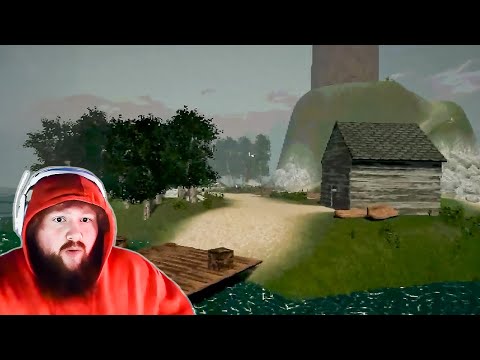
A dying village and an empty well provide an unusually effective reason to descend into danger. What initially looks like a straightforward mission to restore the community’s water supply quickly becomes something much stranger when the protagonist falls into a sprawling underground facility filled with bodies, locked rooms, abandoned work areas, and hostile creatures. The reaction stays closely connected to that escalating mystery, with genuine uncertainty about what happened underground and whether finding the water is even still relevant.
Much of the horror works because the game makes navigation itself stressful. Limited stamina discourages careless sprinting, enemies can wander through important areas, and progression frequently requires returning through previously explored corridors. The streamer’s attempts to judge enemy routes, conserve stamina, use safe pockets, and remember locations give the exploration a satisfying survival-horror rhythm. The creatures’ vulnerability to light also creates a useful mechanic rather than making encounters entirely dependent on running away.
The facility gradually becomes more interesting as scattered notes and environmental details reveal a workplace that collapsed into catastrophe. References to excavation, missing workers, the foreman, the unexpected discovery of water, and people being attacked build a fragmented history without immediately explaining everything. Smaller character moments, including the painter regretting his wasted life and encouraging a younger worker not to follow the same path, give the doomed inhabitants more personality than anonymous horror-game corpses usually receive.
Progression can become excessively elaborate, however. Finding paintings to obtain a combination, retrieving a scalpel to extract a swallowed key, using that key to reach a screwdriver, removing a battery, traveling to maintenance, solving a power-reset puzzle, and finally charging the battery creates an almost comical chain of dependencies. The streamer repeatedly jokes about how many errands stand between him and escape, and the frustration is understandable. Several objectives also depend heavily on remembering rooms and instructions across a large environment, occasionally leaving the playthrough confused about where to return next.
The power section partly redeems that complexity with one of the more satisfying puzzles. Once the relationship between the generated signals and the lights becomes clear, the solution produces a genuine moment of discovery rather than feeling like random trial and error. Enemy patrols also receive specific praise for being difficult to predict, which helps repeated trips through familiar areas retain some tension. By contrast, the long vent sequences and repeated backtracking stretch the middle portion beyond what its scares consistently support.
Escaping the industrial complex only opens the door to a much stranger final act, and that shift is the game’s biggest surprise. The underground child, the mysterious figure promising passage home, the ritual involving hands and candles, Merkett’s transformation, and the eventual revelation of a supernatural force turn the original water crisis into something far larger. The ending pays that escalation off cruelly: the supposed village hero returns as a host for the entities below and is compelled to slaughter the very people he entered the well to save. The streamer’s transition from confusion to enthusiastic disbelief sells the reveal particularly well, culminating in a highly positive assessment that feels earned by how thoroughly the game keeps reinventing its threat.
Pros
- The empty-well premise gives the protagonist a clear motivation and provides an effective gateway into the underground horror.
- Limited stamina, light-sensitive enemies, patrol routes, and safe areas create sustained tension during exploration.
- Notes and environmental storytelling gradually build a compelling history around the excavation and its doomed workers.
- Several minor characters receive memorable moments that add humanity to the facility’s backstory.
- The power-reset puzzle rewards observation and produces a satisfying breakthrough once its logic becomes clear.
- The surreal final act dramatically expands the mystery and delivers a grim payoff to the protagonist’s original rescue mission.
- Genuine fear, confusion, relief, and excitement make the reaction energetic without disguising moments of frustration.
Cons
- The extended chain of keys, paintings, tools, batteries, and maintenance objectives makes the middle section feel unnecessarily convoluted.
- Heavy backtracking through previously explored areas occasionally turns tension into repetition.
- Objectives and locations are sometimes forgotten, producing stretches of uncertain navigation.
- Repeated chase mechanics become less frightening as their patterns grow familiar.
- The late supernatural revelations arrive rapidly enough that some of the mythology remains difficult to fully parse.
What begins as a desperate trip for water develops into an impressively unpredictable horror journey, with strong enemy design, environmental storytelling, and a finale that radically recontextualizes the protagonist’s mission. Some overextended fetch quests and backtracking slow the middle, but the sustained fear and increasingly bizarre discoveries make the descent memorable. The disastrous return to the village provides exactly the kind of dark payoff the escalating mystery needs.