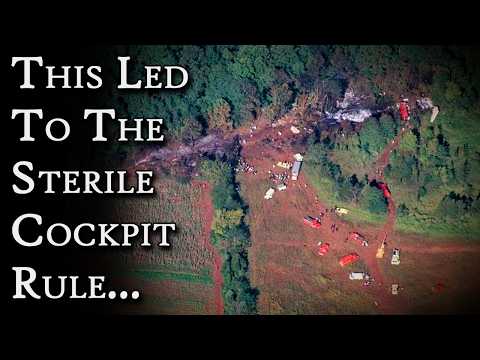
On August 2, 1985, a routine commercial approach into Dallas-Fort Worth became a defining moment in aviation safety history when a powerful but poorly understood weather phenomenon overwhelmed a highly experienced flight crew. The review of the accident presented here focuses not on mechanical failure or pilot negligence, but on the difficult combination of rapidly changing conditions, limited technology, and procedures that had not yet caught up with scientific understanding.
The presentation does a strong job of establishing the professionalism of the crew before examining the events that unfolded. By highlighting their experience, cautious decisions earlier in the flight, and willingness to avoid a larger storm cell, the story avoids the common mistake of reducing a complex accident to a simple human error narrative. This creates a more balanced look at how skilled professionals can still face situations where available information is incomplete.
One of the strongest parts of the coverage is its explanation of microbursts and why they are so dangerous during takeoff and landing. The breakdown of how an aircraft can first encounter increasing headwinds, then sudden downdrafts and damaging tailwinds, provides useful context for understanding why traditional reactions were not enough in this situation. The explanation connects atmospheric science with cockpit decision-making in a way that makes a complicated aviation concept accessible.
The discussion of 1985-era limitations also adds significant value. The account explains that pilots, controllers, and weather systems lacked the tools needed to identify and predict a rapidly developing microburst with enough warning. Rather than suggesting that one person or one decision caused the disaster, the presentation shows how gaps in technology, training, and operational procedures combined to create a dangerous environment.
The reconstruction of the final approach is detailed and tense, effectively showing how quickly the situation deteriorated once the aircraft entered the storm. The focus on changing airspeed, altitude loss, engine power, and the crew’s attempts to recover creates a clear picture of the challenges faced in those final moments. However, the extensive technical detail may feel overwhelming for viewers who are unfamiliar with aviation terminology or aircraft operations.
The broader discussion of what changed afterward gives the story a meaningful conclusion beyond the tragedy itself. The improvements in weather detection, cockpit warning systems, and pilot training are presented as lessons learned from a devastating event. This emphasis on progress helps transform the accident from a historical account into an examination of how aviation safety evolves through difficult experiences.
While the presentation is generally careful and informative, some sections could benefit from a more streamlined approach. The long technical explanations and repeated descriptions of wind shear effects occasionally slow the pacing, especially for viewers who already understand the basic concept. A slightly tighter balance between technical accuracy and narrative momentum would make the story more accessible without sacrificing its educational value.
Pros
- Provides a thorough and balanced explanation of the accident without relying on simplistic blame.
- Clearly explains the dangers of microbursts and why they were difficult to detect at the time.
- Connects the tragedy to important improvements in aviation technology and training.
- Uses detailed reconstruction to create a strong sense of the challenges faced by the crew.
Cons
- The extensive technical discussion may be difficult for viewers unfamiliar with aviation concepts.
- Some sections could be shortened to maintain a stronger narrative pace.
- The presentation occasionally prioritizes detailed mechanics over emotional and human elements of the tragedy.
This is a thoughtful examination of a major aviation disaster and the lessons that emerged from it. Its greatest strength is showing how safety improvements often come from understanding failures rather than assigning simple blame. While the technical depth may limit its accessibility for some viewers, it remains a valuable and carefully presented account of an event that changed aviation forever.