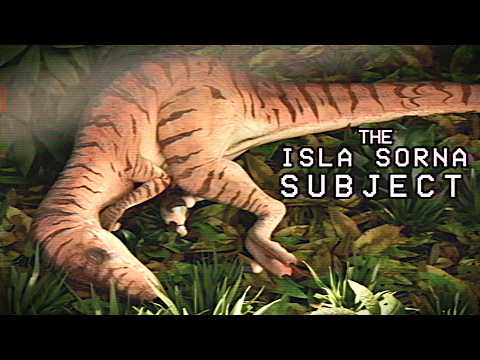
A clutch of unexplained eggs and a visibly distressed Styracosaurus give this found-footage entry two mysteries to develop at once. Muldoon’s cautious response to the eggs is especially effective because the tension comes from an ordinary animal-management decision: handling them could reveal whether they are viable, but disturbing the nest might provoke an unpredictable response from Eve. The uncertainty fits the Jurassic Park setting well, where supposedly controlled animals continually expose gaps in what their handlers actually understand.
The discussion of Eve also gives the fictional wildlife management a convincing procedural quality. Nest temperature, humidity, shell condition and the possibility of candling are considered rather than immediately turning the discovery into a dramatic spectacle. The comparison with modern birds is explicitly treated as an inference rather than proof of how a recreated raptor would behave, which makes the dialogue sound appropriately cautious within the story’s premise.
A darker ethical thread emerges through Jerry’s account of euthanizing an animal suffering from severe abnormalities. Muldoon supports the decision as an act intended to end the animal’s suffering, while their conversation portrays InGen as primarily concerned with preventing the public from seeing mutations. References to lawsuits and increasing questions from a victim’s wife broaden the sense that the park’s problems extend beyond escaped dinosaurs or malfunctioning equipment. These details are brief, but they make institutional secrecy part of the horror rather than relying entirely on creatures.
The Styracosaurus material initially feels almost like a game warden’s field report. Muldoon describes an otherwise healthy animal hiding from something she apparently hears, then considers whether the low-frequency hum of a nearby geothermal plant could explain her agitation. Comparisons with nervous rhinoceroses help communicate the central contradiction effectively: a huge, heavily armored herbivore can still become profoundly frightened by a stimulus it cannot identify.
That methodical setup pays off during the overnight recording. The animal stands virtually motionless for hours, refuses to lie down and repeatedly listens toward something the equipment initially fails to capture. It is a restrained approach to analog horror, allowing abnormal behavior to establish the danger before revealing any obvious source. The repeated emphasis on standing and listening runs slightly long, but that repetition also reinforces how persistent the animal’s fear has become.
The strongest turn comes when Muldoon finally recognizes the faint sound as his missing fence diagnostic unit, supposedly lost near the raptor enclosure. That discovery connects the animal’s unexplained fear to an earlier event without immediately explaining how the device reached the barn, and the abrupt final disturbance preserves the uncertainty. Some dialogue and terminology are difficult to parse, and the rapid movement between eggs, corporate wrongdoing and the Styracosaurus investigation can make the narrative feel fragmented, but the entry succeeds at making routine observation gradually feel unsafe.
Pros
- The unexplained eggs create tension through a believable conflict between gathering information and avoiding disturbance.
- Animal observation and procedural details give the found-footage format a convincing in-universe purpose.
- The frightened Styracosaurus provides an effective example of suspense built from behavior rather than immediate creature attacks.
- InGen’s treatment of mutations and legal problems adds an unsettling institutional dimension to the story.
- The missing diagnostic unit provides a strong late connection between seemingly routine monitoring and a potentially larger threat.
- The unresolved final disturbance ends the entry on an appropriately ominous note.
Cons
- Movement between the egg storyline, euthanasia discussion and Styracosaurus investigation can feel somewhat disjointed.
- Several lines and technical or species references are difficult to understand clearly.
- The extended description of the Styracosaurus standing and listening becomes mildly repetitive before the payoff arrives.
- The ending deliberately withholds explanation, which preserves the horror but leaves much of the immediate mystery unresolved.
Patient animal observation proves surprisingly effective as a foundation for Jurassic Park analog horror, especially once a frightened herbivore begins detecting something its human handlers cannot. The fragmented storytelling occasionally works against the tension, but the procedural tone, corporate unease and ominous diagnostic-unit reveal create a convincing sense that another containment problem is developing just out of sight.